
Can a single missing signature or an overlooked translation actually jeopardize months of high-stakes litigation strategy? For many legal professionals, the answer is a resounding yes when dealing with the rigid requirements of international service. Navigating the inter-american service convention process is often viewed as a daunting procedural ritual where the margin for error is razor-thin. You likely recognize that the specific demands of Central Authorities across Latin American jurisdictions create a significant risk of procedural dismissal if even the smallest detail is missed.
This guide provides an authoritative roadmap to help you master these complexities, ensuring your service is executed with precision and recognized by foreign courts. We’ll examine the mandatory triplicate rule, the technical requirements for the Mandatory Form, and the nuances of serving process in active signatory nations such as Brazil, Mexico, and Argentina. By the end of this article, you’ll have a clear understanding of how to navigate this six to twelve month process with the confidence of a seasoned global facilitator.
Key Takeaways
- Mastering the triplicate rule is essential for ensuring that every document set is identical and meets the strict standards of foreign Central Authorities.
- Precision in completing the Mandatory Form prevents the high rate of rejection associated with clerical errors in the inter-american service convention process.
- Strategic selection between this treaty and the Hague Convention depends on specific jurisdictional requirements and the status of the destination country.
- Utilizing integrated skip tracing and translation services provides a turnkey solution that mitigates the risk of serving an incorrect or outdated address.
- Adherence to formal treaty channels is the only reliable method to ensure that a resulting judgment remains enforceable in international courts.
Understanding the Inter-American Service Convention Process
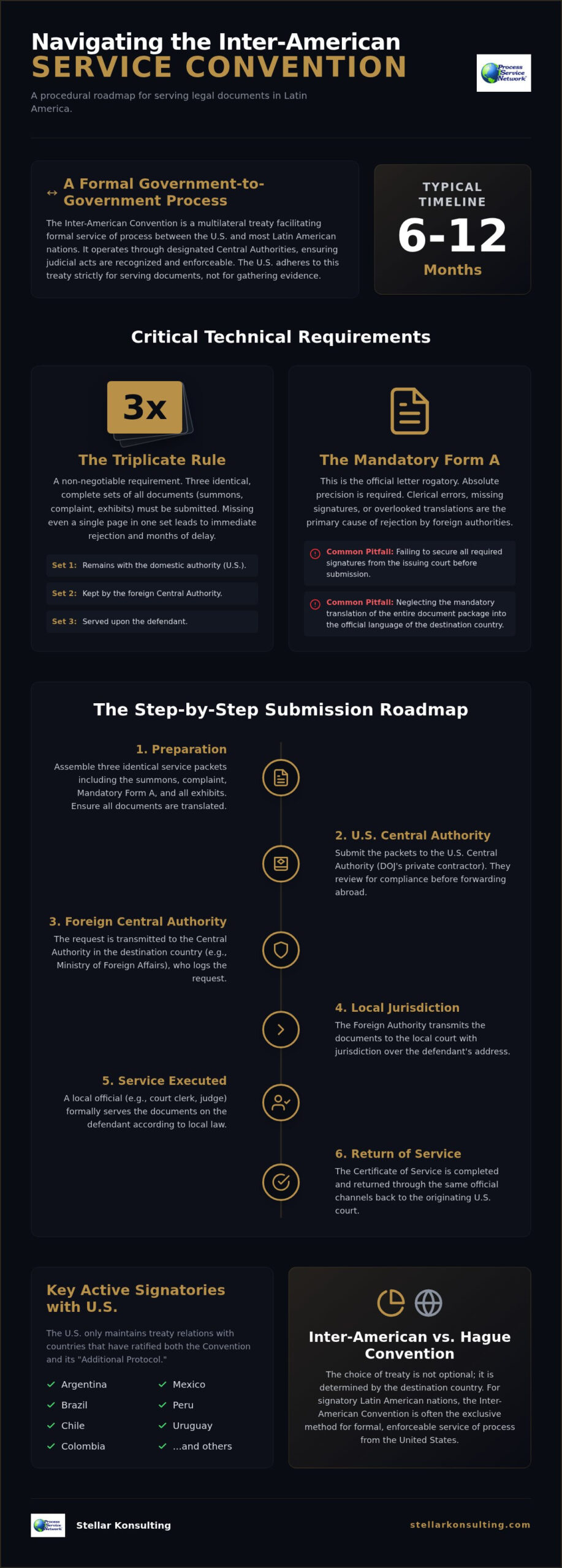
The Inter-American Convention on Letters Rogatory serves as a specialized multilateral treaty designed to facilitate the service of legal documents across international borders. It functions as the primary mechanism for formal service between the United States and the majority of Latin American nations. While the treaty’s title covers a broad range of judicial acts, it’s vital for US practitioners to recognize a key historical limitation. The United States only recognizes and adheres to this treaty for the specific purpose of serving process. It doesn’t apply to the gathering of evidence or other judicial functions. This narrow interpretation ensures that the inter-american service convention process remains a focused, procedural channel for establishing jurisdiction over foreign defendants.
The Organization of American States (OAS) maintains the framework for this treaty, acting as the depository for ratifications and declarations. This centralized oversight provides a level of standardization, yet the process remains deeply rooted in the concept of comity between sovereign states. You aren’t simply hiring a private agent; you’re engaging in a formal request for judicial assistance. To grasp the foundation of this system, one might ask: What are letters rogatory? At their core, they’re formal communications from a court in one country to the judiciary of another, requesting that a specific judicial act be performed within the foreign territory.
Signatory Countries and Jurisdictional Scope
The convention’s reach spans a vast geographic area, from Mexico to the southern tip of Argentina. However, treaty membership alone isn’t enough to establish a relationship with the United States. For US based litigation, the “Additional Protocol” is the governing document that matters most. The US only maintains treaty relations with countries that have ratified both the original convention and this protocol. Active signatories include nations such as Brazil, Chile, Colombia, Peru, and Uruguay. Before initiating the inter-american service convention process, you must determine if your target country’s legal system permits informal international service of process or if the treaty is the exclusive path. In many Latin American jurisdictions, failing to use the formal convention channel can lead to a judgment that’s entirely unenforceable locally.
The Legal Authority of the Central Authority
The treaty operates through a designated “Central Authority” in each member state. In the United States, the Department of Justice (DOJ) holds this role. They oversee the outgoing and incoming requests to ensure they meet international standards. To manage the high volume of daily administrative tasks associated with these requests, the DOJ utilizes a designated private contractor to handle processing and transmission. Foreign Central Authorities are typically situated within Ministries of Foreign Affairs or Ministries of Justice. These entities receive the request from the US and then transmit it to the local court with jurisdiction over the defendant. This hierarchical structure reflects the formal, government-to-government nature of the request. It ensures that the service is performed by a local official, such as a judge or clerk, which provides the highest level of legal certainty for your case.
Technical Requirements: The Mandatory Form and Triplicate Rule
The inter-american service convention process relies on strict adherence to technical formalities that often surprise practitioners accustomed to domestic service. The most significant hurdle is the “triplicate” rule. This is a non-negotiable requirement where every document in the service packet, including the summons, complaint, and all exhibits, must be provided in three identical, complete sets. Foreign ministries and Central Authorities will summarily reject requests that fail this standard. One set remains with the domestic authority, one is kept by the foreign ministry, and the third is served upon the defendant. Missing even a single page in one of the sets can result in the entire packet being returned without service, causing months of delay.
Navigating the Mandatory Form A
The centerpiece of the submission is the “Mandatory Form,” also known as Form A. This document functions as the official request and must be executed with absolute precision. It’s divided into distinct sections, including the “Request for Information” and the “Certificate of Service.” A common error involves leaving the Certificate of Service section blank, assuming it’s only for the foreign official; however, the entire form must be prepared correctly to move through the channel. Validity hinges on the seal of the requesting court. Without a physical or certified electronic seal from the clerk of the court where the case is pending, the form lacks legal standing under the official text of the Inter-American Convention on Letters Rogatory. Practitioners also frequently stumble when describing the nature of the lawsuit. Vague descriptions lead to delays, as foreign officials need to categorize the matter within their local civil or commercial codes.
Certified Translation Standards
While the Mandatory Form itself doesn’t technically require translation, every document intended for the defendant does. This includes the summons, the full complaint, and every page of every exhibit attached to the filing. It’s not enough to provide a simple summary; the foreign defendant must receive a complete, translated version of the allegations against them in their official language. Accuracy is paramount. A standard translation often misses the nuance of legal terminology, which can lead to a challenge of service in the foreign jurisdiction. Utilizing professional legal document translation ensures that the terminology aligns with the specific civil law requirements of the recipient nation. We integrate these translation services into our workflow to prevent the procedural delays that occur when a foreign court finds a translation to be insufficient or linguistically inaccurate. This turnkey approach maintains the integrity of the inter-american service convention process from the initial filing to the final return of service.
Inter-American Convention vs. Hague Convention
Deciding between international treaties requires a strategic assessment of jurisdictional rules. When a country like Mexico is a signatory to both the Hague and the Inter-American treaties, you must navigate the “Convention of Choice” rule. Generally, the Hague is the preferred route due to its established efficiency, but the inter-american service convention process remains a vital alternative if specific local requirements demand it. While both serve the same ultimate goal, their procedural DNA differs significantly. Choosing the wrong path doesn’t just waste time; it can result in a total lack of jurisdiction that isn’t discovered until the enforcement stage.
The Inter-American treaty is characterized by its rigid reliance on the Mandatory Form and the triplicate document rule, whereas the hague convention service of process often allows for more flexible methods, such as service by mail or through private agents, depending on the recipient nation’s reservations. We often find that practitioners prefer the Hague for its relative speed, yet the Inter-American process is the only formal option for several Latin American nations that haven’t yet joined the Hague system. Understanding these distinctions is crucial for maintaining the momentum of your litigation.
Procedural Speed and Reliability
Service under the Inter-American Protocol typically requires a significant time investment, with average completion ranging from six months to a full year. This timeframe is often longer than Hague service because the request must move through multiple layers of government bureaucracy before a local judge or official executes the task. Reliability in the inter-american service convention process is high, provided every technicality is met, but it lacks the streamlined tracking available in some Hague jurisdictions. Cost is another factor to consider. While the U.S. Central Authority doesn’t charge a fee for these requests, foreign authorities may require a nominal payment, whereas Hague service costs vary widely based on the use of private versus government agents.
When to Use Letters Rogatory Instead
There are instances where neither treaty applies. While many nations are covered, gaps in treaty relationships still exist. If a target country hasn’t ratified the Inter-American Additional Protocol or the Hague Convention, you must rely on traditional letters rogatory legal services. This diplomatic channel is the most time-consuming method of service, as it involves the U.S. Department of State and the foreign ministry’s diplomatic pouch. It’s the option of last resort when formal treaty protections aren’t available to bridge the gap between legal systems. When no treaty framework applies and you must rely on the Department of State to deliver legal documents abroad, understanding the full scope of service of process via diplomatic channels becomes essential to managing timelines and avoiding case dismissal. Even in these complex scenarios, our team provides the steady guidance needed to ensure your documents eventually reach the intended defendant through the proper diplomatic channels.
The Step-by-Step Submission Roadmap
Executing the inter-american service convention process requires navigating a specific sequence of bureaucratic checkpoints. Once the packet is assembled, it is submitted to the United States Central Authority. The Department of Justice currently manages this through a designated private contractor responsible for reviewing and forwarding requests to signatory nations. This government-to-government exchange elevates the request from a private legal matter to a formal act of international judicial assistance. Final delivery is usually performed by a local judge or judicial clerk, which provides the highest level of legal authority to the service.
Preparing the Legal Packet
Precision during the initial assembly prevents months of administrative waste. A critical detail involves the summons expiration date. Given that the average timeframe for execution is between six months and one year, a standard 60-day summons will likely expire before the foreign official attempts service. You must secure a summons with an extended or indefinite expiration to satisfy foreign judicial standards. The packet must also include the “Essential Information for the Addressee” form. This document summarizes the defendant’s rights and is a mandatory component for treaty compliance. Before submission, we verify the defendant’s current address to ensure the Central Authority doesn’t spend months searching for an outdated location. For a broader understanding of how these foundational documents must be prepared for cross-border delivery, our guide on international summons and complaint service provides a comprehensive procedural framework that complements the treaty-specific requirements covered here.
Tracking and Managing the Request
Managing expectations is a key part of the inter-american service convention process. Tracking these requests requires a delicate balance; excessive inquiries with the Central Authority can lead to administrative friction. Our team manages these communications, utilizing our established professional network to monitor progress through foreign ministry layers. Upon successful execution, you’ll receive a “Certificate of Service” or a comparable return document. These documents often use local civil court formats and require professional translation before they’re ready for filing in your domestic court. If a service is returned unexecuted, we evaluate the foreign official’s notes to determine if the issue was a jurisdictional error or a bad address. If you’re ready to initiate this process, contact our international specialists to ensure your submission is correct from day one.
Ensuring Compliance and Avoiding Procedural Dismissal
The consequences of procedural errors in international litigation extend far beyond simple administrative delays. Bypassing the formal inter-american service convention process in favor of “informal” methods often results in a judgment that is entirely unenforceable in the target country. While domestic courts might occasionally overlook minor service defects, foreign ministries and civil law judiciaries typically view strict adherence to treaty channels as a matter of national sovereignty. If the service isn’t performed by the authorized local official through the designated Central Authority, the defendant can easily challenge the jurisdiction of the resulting judgment, rendering months of litigation effort futile.
Local knowledge is particularly critical in jurisdictions with complex internal requirements, such as when serving legal documents in Mexico. Each signatory nation maintains its own specific internal protocols for how a judge executes a letter rogatory. Our team mitigates the risk of rejection by performing a rigorous audit of every document packet before it ever reaches the US Central Authority. We ensure that seals are legible, translations are precise, and the triplicate sets are perfectly mirrored, providing a level of document integrity that domestic firms often struggle to maintain in-house.
The Role of Skip Tracing in International Service
A stale or inaccurate address is the primary cause of failure within the inter-american service convention process. Because the formal channel involves a timeline that typically exceeds six months, starting with an unverified location is a high-risk strategy. If the local judicial official in Brazil or Colombia attempts service at an outdated address, the request is returned unexecuted, forcing the plaintiff to restart the entire bureaucratic cycle from day one. Integrating professional skip tracing into the pre-litigation phase is essential for efficiency. We utilize specialized investigative techniques to locate elusive defendants abroad, ensuring that the address provided to the Central Authority is current and verifiable before the legal clock begins to run.
Why Professional Management is Non-Negotiable
Managing the complexities of tripartite documentation across international borders places a heavy burden on law firm staff. The precision required to satisfy both US and foreign Central Authorities demands more than just clerical attention; it requires a deep understanding of international judicial assistance. With over 30 years of experience, Stellar Konsulting acts as a steady partner, handling the administrative weight of these sensitive tasks. This allows your team to focus on the core legal strategy while we navigate the procedural nuances of the treaty. Outsourcing this management ensures that your case moves through the international system with the highest degree of professional confidence and reliability. Contact Stellar Konsulting for expert Inter-American Convention service to secure your international jurisdiction today.
Securing Jurisdiction Through Procedural Precision
Successfully navigating the inter-american service convention process requires a meticulous commitment to technical detail that leaves no room for clerical error. Success hinges on more than just document delivery; it requires the coordination of court seals, certified translations, and strict adherence to the triplicate documentation rule. It’s essential to prioritize formal treaty channels and verify defendant locations early through skip tracing to protect the long-term enforceability of your resulting judgment.
Stellar Konsulting brings over 30 years of international legal support experience to your litigation strategy. Our specialized expertise in both Inter-American and Hague protocols ensures your requests satisfy the demanding standards of foreign Central Authorities. With in-house translation and skip tracing capabilities, we provide a seamless, turnkey solution for complex cross-border requirements. Secure Your International Service with Stellar Konsulting today. You can move forward with the confidence that your international service is being handled by seasoned global facilitators.
Frequently Asked Questions
Which countries are signatories to the Inter-American Service Convention?
Active signatories include Argentina, Bolivia, Brazil, Chile, Colombia, Ecuador, El Salvador, Guatemala, Mexico, Panama, Paraguay, Peru, the United States, Uruguay, and Venezuela. For a valid treaty relationship with the US, the destination country must have ratified the Additional Protocol. This requirement ensures a standardized framework for the inter-american service convention process. Always verify the current status of a nation before filing, as treaty relations can change based on diplomatic updates.
How long does the Inter-American service of process typically take?
The typical timeframe for completion is between six months and one year. This duration is necessary because the request moves through multiple government layers, including the US Central Authority and the foreign ministry of the recipient nation. Unlike domestic service, which is often completed in days, this formal channel requires patience. We recommend ensuring your summons has an extended expiration date to accommodate these international bureaucratic timelines.
Is translation required for the Inter-American Service Convention?
Translation is mandatory for all documents intended for the defendant, such as the summons and complaint. These must be translated into the official language of the destination country to satisfy due process requirements. While the Mandatory Form itself is often bilingual and doesn’t require separate translation, the underlying legal documents do. Inaccurate translations are a leading cause of procedural delays or challenges to the validity of service in foreign courts.
What is the difference between Form A and Form B in the convention?
Form A is the Request for Judicial Assistance, which you prepare and have sealed by your local court to initiate the process. Form B is the Certificate of Execution, which is returned by the foreign judicial authority after service is attempted or completed. Form B serves as your official proof of service for the inter-american service convention process. You’ll need this document to move forward with your litigation in the United States.
Can I serve a corporation under the Inter-American Convention?
You can serve corporations and other legal entities under this convention. The process remains the same as serving an individual, though you must ensure the defendant’s name and registered office address are precisely stated. Identifying a specific officer or legal representative within the corporation can often help the local judicial official execute the service more efficiently. It’s vital to confirm the entity’s active status before starting the formal request.
What happens if the defendant’s address is incorrect on the form?
If the defendant’s address is incorrect, the foreign judicial official will typically return the request unexecuted. This results in a significant loss of time, as you’ll have to restart the entire submission cycle from the beginning. To avoid this, we integrate skip tracing into our pre-litigation workflow. Verifying the address before you file the initial packet is the most effective way to prevent these costly procedural resets.
Is the Inter-American Convention the same as the Hague Convention?
These are separate and distinct treaties. The Hague Convention is a global treaty with over 80 members, while the Inter-American Convention is limited to member states of the Organization of American States. Some countries, like Mexico and Brazil, are signatories to both. In these cases, the “Convention of Choice” rule applies, and practitioners often choose the Hague for its relative speed and established efficiency in international service.
Can I use a private process server instead of the Central Authority?
No, the convention doesn’t allow for service by a private process server. It requires a formal, government-to-government channel where the service is executed by a local judge or judicial clerk in the recipient country. Attempting to use a private agent in a convention country can lead to an unenforceable judgment. Adhering to the Central Authority channel is the only way to ensure your service is legally recognized abroad.