
Nearly one third of all Hague Service Convention requests fail to meet the standard two month execution benchmark, often due to preventable clerical errors. For legal professionals, the decision to utilize informal international service of process isn’t merely a matter of convenience; it’s a strategic choice that can either accelerate your timeline or leave your judgment unenforceable. You’re likely balancing the need for speed against the persistent fear that a foreign court won’t recognize your efforts, potentially leading to a vacated default judgment.
We’ll help you navigate these complexities by defining when informal service offers a tactical advantage and when it poses an unacceptable risk to your litigation. This article provides a clear framework for choosing between formal and informal methods while ensuring full compliance with international law. We’ll explore the latest 2026 procedural updates, the impact of recent court rulings on electronic service, and the specific requirements for successful delivery in a shifting global legal environment.
Key Takeaways
- Distinguish between formal treaty-mandated channels and informal delivery methods like personal service or international registered mail to determine the best fit for your timeline.
- Evaluate whether your case requires the speed of informal international service of process or the long-term security of formal Hague service for judgment enforcement.
- Mitigate the risk of case dismissal by verifying country-specific objections to Article 10 before attempting service outside Central Authorities.
- Implement a tactical execution plan that includes thorough jurisdictional research and certified translation to ensure service is recognized by foreign courts.
- Balance administrative efficiency with legal compliance by utilizing a hybrid serving strategy tailored to the specific requirements of the destination country.
Understanding Informal International Service of Process
In cross-border litigation, the term informal international service of process refers to the delivery of legal documents through channels other than the centralized, treaty-mandated authorities. While “informal” might imply a lack of rigor, these methods are often strictly regulated by the rules of the forum court. Understanding Service of Process on a global scale requires distinguishing between merely providing notice and achieving legally sufficient service that a foreign jurisdiction will respect. Common methods include:
- Personal service via a private process server or local agent
- Service by international registered mail with a return receipt
- Direct service through judicial officers in the destination country
Attorneys often prioritize these methods to bypass the bureaucratic delays inherent in Central Authority channels, where processing times can stretch to six months or longer. However, providing “actual notice” isn’t always enough. The legal landscape is constantly tightening; for example, a 2025 U.S. Second Circuit ruling clarified that the Hague Service Convention prohibits service by email on defendants in mainland China. If the method used doesn’t align with the destination country’s specific objections, any resulting judgment could be unenforceable abroad.
The Legal Basis for Informal Delivery
The authority for informal service often stems from the forum court’s procedural rules. In the United States, Federal Rule of Civil Procedure 4(f) provides the framework for serving individuals in foreign countries. It allows for service by any internationally agreed means, but also permits other methods if no international agreement applies or if the agreement allows for alternatives. Comity, the legal principle where courts recognize the judicial acts of another nation, plays a significant role here. If the receiving country’s local laws permit private process servers, the forum court is more likely to uphold the service as valid and sufficient.
Informal Service vs. Formal Treaty Methods
The primary distinction between formal and informal methods lies in the “Certificate of Service.” Under the Hague Service Convention, a Central Authority provides a formal certificate that carries significant weight in both domestic and foreign courts. Informal methods, while faster, lack this official government imprimatur. In certain Latin American jurisdictions, the Inter-American Service Convention process may take precedence, requiring a more rigid administrative path. While informal international service of process offers agility, it doesn’t provide the same bedrock of enforceability as a formal Hague certificate, especially in countries that have filed specific objections to Article 10 alternative methods.
Strategic Comparison: Informal vs. Formal Service
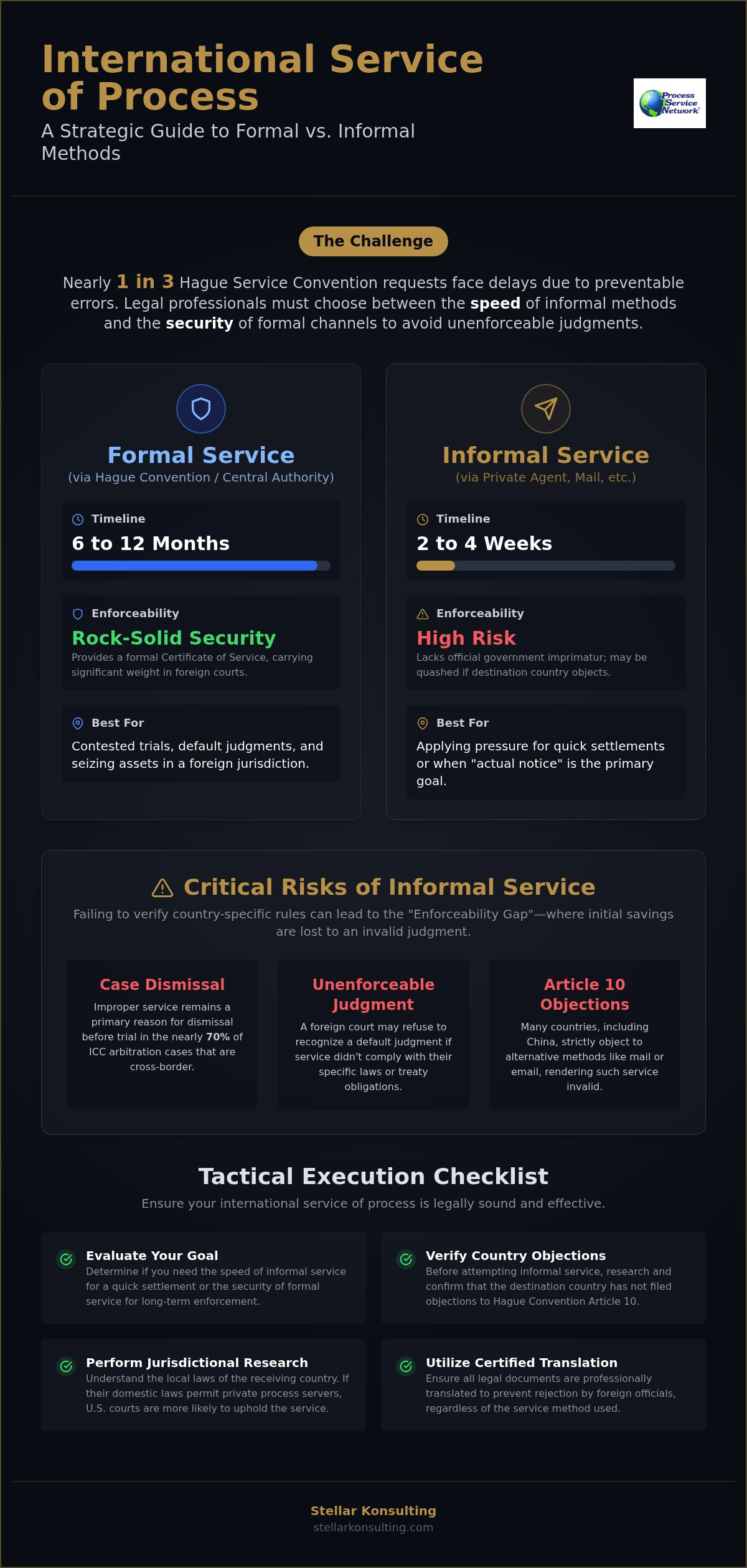
Selecting the appropriate method for document delivery requires a clear assessment of the litigation’s ultimate objective. In 2026, cross-border disputes represent nearly 70% of ICC arbitration cases, yet improper service remains the primary reason for case dismissal before trial. If your strategy prioritizes a quick settlement, the speed of informal international service of process may provide the necessary leverage. However, if the case proceeds to a contested trial where you must eventually seize assets in a foreign jurisdiction, formal service is often the only viable path.
The timeline discrepancy is the most immediate factor for legal teams. Informal methods typically conclude within 2 to 4 weeks, whereas formal Hague Service Convention requests often require 6 to 12 months for execution. While the U.S. Central Authority fee for incoming requests is currently $95.00, the total cost of formal service includes significant administrative overhead and mandatory legal document translation to prevent rejection by foreign officials. This creates an “Enforceability Gap” where the money saved on initial service might be lost later if a foreign court refuses to recognize a default judgment due to a lack of formal treaty compliance.
Pros and Cons of Informal Service
The primary advantage of informal service is the rapid notification of the defendant, which triggers response deadlines and prevents the case from stagnating. It involves a lower initial administrative burden, as it bypasses the rigid document requirements of national Central Authorities. The significant disadvantage is the inherent legal fragility. Many countries strictly object to Article 10 alternative methods; utilizing them in such jurisdictions risks having the service quashed or the final judgment declared null and void during enforcement proceedings.
Pros and Cons of Formal Treaty Service
Formal treaty service provides a bedrock of legal certainty. Because it follows the standardized procedures of the Hague Convention or the Inter-American Convention, the resulting Certificate of Service is virtually immune to motions to vacate for improper service. It guarantees that the service is recognized under international law, which is essential for collecting assets abroad. The drawbacks are the significant delays and the lack of control over the process once the documents are in the hands of a foreign government body. To mitigate these risks, many firms partner with Stellar Konsulting to ensure every procedural detail is handled with the precision required to avoid the clerical errors that cause one third of Hague requests to fail.
The Risks of Informal Service in Hague Convention Countries
Relying on informal international service of process within a Hague signatory nation is a calculated gamble. As of 2026, the Hague Service Convention has expanded to include over 75 member countries, with Algeria and Vietnam being the most recent additions. While Article 10 of the Convention theoretically permits service by mail or judicial officers, the reality depends entirely on the specific “Declarations” filed by the destination country. If a nation has formally objected to Article 10(a), attempting service by mail renders the entire proceeding null and void in that jurisdiction. This isn’t just a procedural hurdle; it’s a structural failure that often leads to the dismissal of high-stakes cases before they ever reach trial.
Beyond treaty compliance, due process remains a critical concern for legal professionals. US courts require that service is reasonably calculated to provide actual notice, but foreign jurisdictions often view service as a sovereign act. Performing an unauthorized private service in a country that considers service a government function can be seen as a violation of international law. This conflict frequently results in a foreign court refusing to recognize a US judgment, effectively insulating the defendant’s overseas assets from collection. Even if you secure a default judgment at home, it becomes a hollow victory if it cannot be enforced where the assets reside.
Article 10 Objections Explained
Many countries, including major trading partners, explicitly forbid service by mail or private agent to protect their judicial sovereignty. When a country joins the Hague Convention, they submit a Declaration outlining which alternative methods they accept. Ignoring these objections is a common clerical error that contributes to the high failure rate of international service requests. For a deeper analysis of these specific pitfalls, see our guide on Hague Convention Article 10 Service: Understanding the Risks. It’s essential to verify these objections before every filing, as a country’s stance can shift with new judicial rulings or legislative updates.
Navigating Service in Non-Hague Jurisdictions
In jurisdictions where no treaty exists, informal international service of process might be the only practical starting point. However, attorneys must still demonstrate to the forum court that they’ve made a good-faith effort to comply with local standards. In these instances, Letters Rogatory Legal Services offer a more traditional, albeit slower, formal alternative. When even these options are unavailable or have been exhausted, attorneys may need to consider service of process via diplomatic channels as a method of last resort that routes delivery through the Department of State and foreign government authorities. Documentation is key here. You must meticulously record every attempt at informal service to satisfy the requirements for “alternative service” under rules like FRCP 4(f)(3). This evidence is vital when asking a judge to permit unconventional methods after traditional channels have been exhausted.
Tactical Execution: How to Perform Informal Service Correctly
Executing informal international service of process requires a methodical approach to survive judicial scrutiny. Success isn’t just about handing over documents; it’s about creating a record that withstands a motion to quash. When speed is the priority, attorneys must ensure that every tactical step aligns with both the forum court’s rules and the practical realities of the destination country. A lapse in procedure at this stage can lead to months of wasted litigation and significant cost overruns.
Follow this five step framework for effective execution:
- Step 1: Conduct thorough research on the destination country’s stance on private service to ensure the method isn’t explicitly prohibited by local law.
- Step 2: Utilize professional legal document translation services to ensure the defendant fully understands the summons and the nature of the proceedings.
- Step 3: Hire a process serving firm with a verified local network in that jurisdiction to handle personal delivery with cultural and legal sensitivity.
- Step 4: Secure an affidavit of service that meets both US evidentiary standards and local requirements for authentication.
- Step 5: Prepare a “safety net” plan for formal service. If the defendant challenges the informal method, you should be ready to initiate formal Hague channels immediately to protect your timeline. For cases involving Latin American defendants, understanding the inter-american service convention process and its mandatory triplicate rule is essential to executing this fallback strategy correctly.
The Role of Translation in Informal Service
Serving documents only in English often constitutes a violation of due process in the eyes of many foreign courts. Even if the defendant is believed to speak English, certified translations are typically required to satisfy international standards of notice. A certified translation prevents the defendant from claiming they were unaware of the legal consequences of the documents. It also demonstrates to the forum court that you’ve taken every necessary step to ensure the defendant’s rights were protected, which is vital when defending the validity of informal international service of process during later enforcement stages.
Locating the Defendant: Skip Tracing for International Service
Informal service efforts frequently fail because of inaccurate or outdated location data. In cross-border litigation, defendants may be elusive or reside in jurisdictions with complex residency registration systems. Utilizing professional skip tracing services is essential to find parties who have moved or are actively avoiding service. Verifying a defendant’s current residency before attempting personal delivery saves time and ensures the affidavit of service is beyond reproach. For a comprehensive strategy that balances speed with legal precision, contact Stellar Konsulting to manage your international document delivery needs.
The Stellar Konsulting Advantage in International Process Serving
Stellar Konsulting leverages over 30 years of international experience to provide a level of reliability that matches the precision of the legal field. Our firm operates as a global facilitator, maintaining a verified network of process servers in over 100 countries to ensure local expertise is applied to every case. While the choice to utilize informal international service of process often stems from a need for efficiency, our role is to ensure that speed never compromises legal standing. We provide a hybrid approach that balances the immediate tactical benefits of informal methods with the long-term necessity of judicial recognition.
Our comprehensive support structure integrates proprietary skip tracing for locating elusive defendants with certified legal document translation. This unified service model eliminates the clerical errors that contribute to the high failure rate of international requests. By managing every variable internally, we provide a seamless transition between informal attempts and formal treaty filings when the litigation strategy shifts. Our deep knowledge of both the Hague and Inter-American conventions ensures that your documents are handled with the authority required for cross-border enforcement.
Expertise Beyond Document Delivery
Our consultants don’t merely act as couriers; they serve as strategic partners who advise on the most effective method for your specific jurisdiction. We understand the nuances of country-specific objections and the varying evidentiary standards required by foreign courts. If our initial assessment indicates that informal methods pose a high risk to your final judgment, we manage the complex logistics of Hague Convention Service of Process to ensure your case remains on solid ground. This commitment to procedural accuracy is why major law firms rely on our expertise to survive the rigors of foreign judicial scrutiny.
Partnering for Litigation Success
We provide tailored solutions designed for the high-pressure environments of law firms and corporate legal departments. Our communication rhythm is methodical and thorough, providing transparent reporting throughout the lifecycle of the service request. This organized flow allows your team to retrieve information easily and maintain confidence in the status of cross-border document delivery. Our seasoned experts understand the gravity of international law and the necessity of successful delivery. Contact Stellar Konsulting for an International Service Consultation to secure a partner capable of handling your most sensitive and high-stakes legal tasks.
Strengthening Your Global Litigation Strategy
Success in cross-border litigation hinges on your ability to balance procedural speed with the long-term enforceability of a final judgment. While utilizing informal international service of process can provide a significant tactical advantage by accelerating timelines, it also introduces substantial risks if not executed with precision. You’ve learned that verifying country-specific objections and ensuring certified translations are critical steps to prevent a foreign court from declaring your service null and void. A strategic approach requires more than just document delivery; it demands a deep understanding of international treaties and local judicial standards.
Stellar Konsulting offers the deep-rooted reliability needed to navigate these sensitive legal tasks. With over 30 years of global legal support experience and specialized expertise in the Hague and Inter-American Conventions, we ensure your documents meet every evidentiary requirement. From proprietary skip tracing to professional legal translations, our team manages the complexities of international law so you can focus on the merits of your case. Secure Your International Litigation with Expert Process Serving and move forward with the confidence that your service is beyond reproach. We look forward to facilitating your global legal success.
Frequently Asked Questions
Is informal international service of process legally binding in the US?
Informal international service of process is legally binding in the United States if it adheres to the Federal Rules of Civil Procedure, specifically Rule 4(f). While US courts may recognize this service as sufficient to establish personal jurisdiction, it doesn’t guarantee that the resulting judgment will be enforceable in a foreign country. Attorneys must ensure the method used is reasonably calculated to provide actual notice and doesn’t violate specific international treaties or local laws.
Can I serve a foreign defendant via international registered mail?
You can serve a foreign defendant via international registered mail only if the destination country is not a signatory to the Hague Convention or has not filed a specific objection to Article 10(a). Many nations, including Germany and Switzerland, explicitly object to this method. Attempting service by mail in an objecting country often results in the service being quashed by the forum court or the judgment being refused recognition by foreign authorities.
What happens if a country has objected to Article 10 of the Hague Convention?
If a country has objected to Article 10, any attempt to use informal methods like mail or private agents is considered a violation of that nation’s sovereignty. In these jurisdictions, formal service through the designated Central Authority is the only legally recognized path. Utilizing an objected-to method renders the service null and void; this typically leads to the dismissal of the case or a successful motion to vacate a default judgment during the enforcement phase.
How long does informal international service typically take compared to formal methods?
Informal international service of process typically concludes within 2 to 4 weeks, providing a significant speed advantage for urgent litigation deadlines. In contrast, formal Hague Service Convention requests frequently require 6 to 12 months for execution by a foreign Central Authority. While the informal route is faster, the time saved must be weighed against the potential for long-term enforcement challenges if the destination country requires formal treaty compliance for judgment recognition.
Will a foreign court enforce a US judgment if service was informal?
Foreign courts are often reluctant to enforce a US judgment if the initial service was performed informally. Many civil law jurisdictions view service of process as a sovereign judicial act that must be performed by government officials. If the service method bypasses formal treaty channels or violates local procedural laws, the foreign court may refuse to recognize the judgment. This effectively prevents the seizure of assets located within that country’s borders.
Do I need to translate my legal documents for informal service?
You should always translate your legal documents into the official language of the destination country, even for informal service. Providing documents only in English risks a successful “lack of notice” defense by the defendant. Most jurisdictions require certified translations to ensure the recipient understands the legal consequences of the summons. This step is vital for demonstrating to the forum court that you’ve satisfied both US and international standards of due process.
What is the difference between informal service and service via Letters Rogatory?
Informal service involves delivery through private channels like process servers or mail, while Letters Rogatory are formal requests from a US court to a foreign court. Letters Rogatory are typically utilized in non-treaty countries and involve a lengthy diplomatic process through the Department of State. While informal methods offer speed and lower costs, Letters Rogatory provide a higher level of official recognition in jurisdictions where no formal international service treaty exists or is currently active. In the most challenging cases where even Letters Rogatory face obstacles, attorneys may need to pursue service of process via diplomatic channels under 22 C.F.R. § 92.85 as the final procedural option.
Can a private process server legally deliver papers in a foreign country?
A private process server can legally deliver papers in a foreign country only if local laws permit private service and the country hasn’t objected to Article 10(b) of the Hague Convention. In some nations, performing private service is considered an unauthorized exercise of judicial power and can lead to legal complications for the server. It’s essential to partner with a firm that maintains a verified local network to ensure compliance with specific jurisdictional regulations.