
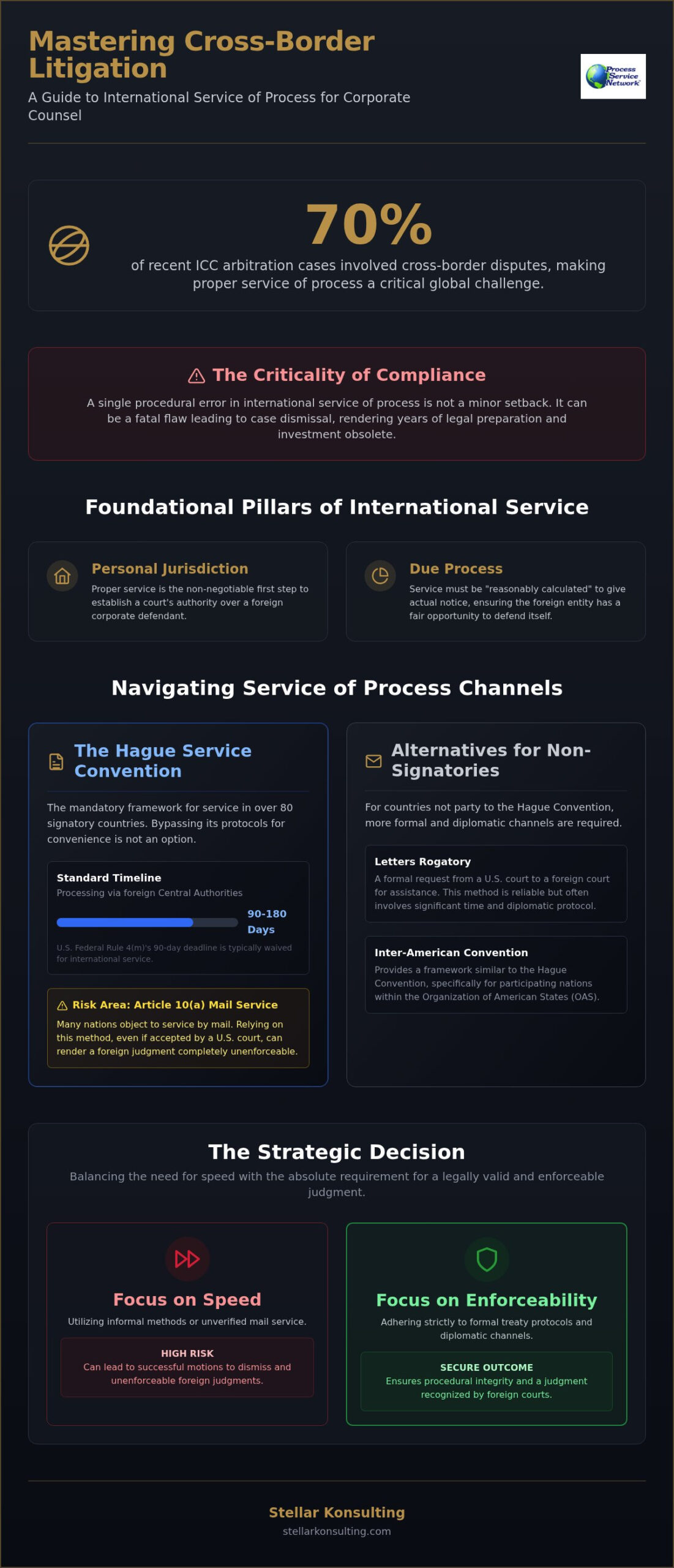
Did you know that cross-border disputes represented nearly 70% of ICC arbitration cases in 2026? This significant volume highlights that international service of process for corporate litigation is no longer a secondary concern. It’s a jurisdictional safeguard that dictates the enforceability of your entire case. A single procedural error in a foreign jurisdiction can lead to a motion to dismiss, rendering years of legal preparation obsolete. Whether you’re utilizing the Hague Service Convention or seeking service in a non-signatory state, the complexities are substantial and the stakes are high.
We recognize the challenges presented by long delays in foreign central authorities and the uncertainty of local laws in diverse jurisdictions. This article provides the specialized knowledge required to master cross-border document delivery, ensuring your litigation remains procedurally sound and your foreign judgments remain enforceable. We’ll outline the essential protocols for formal service, the strategic application of Letters Rogatory, and the necessity of precise legal translations. By following these established frameworks, you can minimize litigation delays and secure the integrity of your legal proceedings on a global scale.
Key Takeaways
- Understand how establishing personal jurisdiction through proper service is the essential foundation for any successful cross-border claim.
- Identify the specific scenarios where the Hague Service Convention’s protocols are mandatory to prevent jurisdictional challenges and case dismissals.
- Discover how to effectively manage international service of process for corporate litigation in non-treaty countries through Letters Rogatory and the Inter-American Convention.
- Don’t overlook the “Enforceability Test” when determining if your chosen service method will result in a judgment that foreign courts recognize and respect.
- Learn to balance the competing demands of procedural speed and long-term legal validity so you’re selecting the most appropriate service channel for each specific jurisdiction.
The Complexity of International Service of Process for Corporate Litigation
In the context of global commerce, international service of process for corporate litigation refers to the formal delivery of legal documents to a foreign business entity. It’s a critical procedural step that serves two primary functions: establishing the court’s personal jurisdiction over the defendant and satisfying the constitutional requirement of due process. For corporate counsel, the stakes are exceptionally high. Unlike individual service, which might focus on a single residence, corporate service involves complex hierarchies of subsidiaries, officers, and registered agents across multiple borders. The process must be meticulous. A single procedural error isn’t just a minor delay; it’s a fatal flaw. If service fails to comply with both domestic rules and international treaties, the case faces immediate dismissal. Even if a U.S. court allows the case to proceed, any resulting judgment may be unenforceable in the foreign jurisdiction where the defendant’s assets are located.
Due Process and Constitutional Requirements
U.S. courts adhere to the standard set in Mullane v. Central Hanover Bank, which requires notice to be reasonably calculated to apprise interested parties of the pendency of the action. When litigation crosses borders, this standard intersects with Rule 4 of the Federal Rules of Civil Procedure. Rule 4(f) specifically outlines the methods for serving individuals and corporations in foreign countries, prioritizing the Hague Service Convention when applicable. The court’s primary concern is ensuring the foreign entity has a fair opportunity to defend itself. This requirement remains constant regardless of geographic distance. Courts will scrutinize whether the method used provided actual notice or if it was merely a perfunctory attempt that ignored local legal realities.
Corporate Entities vs. Individuals: Unique Challenges
Serving a multinational corporation presents hurdles that individual service does not. Identifying the correct party is the first obstacle. Litigants must distinguish between a registered agent, who may only be authorized for domestic service, and officers or directors located in a foreign headquarters. Additionally, the corporate structure itself can be a shield. Serving a domestic subsidiary doesn’t always constitute service on a foreign parent company unless specific agency criteria are met. Counsel must also navigate foreign “doing business” statutes. These local laws often dictate who is authorized to receive service on behalf of a company. This makes a thorough understanding of local registration requirements essential for valid international service of process for corporate litigation. Failure to identify the precise legal entity can lead to a successful challenge of the court’s jurisdiction months or even years into the discovery phase.
Navigating the Hague Service Convention Framework
The Hague Convention on the Service Abroad of Judicial and Extrajudicial Documents in Civil or Commercial Matters is the definitive treaty for cross-border legal delivery. Its application isn’t discretionary. In the case Volkswagenwerk AG v. Schlunk, the U.S. Supreme Court established that the Convention is mandatory when the method of service involves transmitting documents abroad. For international service of process for corporate litigation, this means you can’t bypass treaty protocols for the sake of convenience.
Standard processing through foreign Central Authorities typically spans 90 to 180 days. While Rule 4(m) of the Federal Rules of Civil Procedure generally requires service within 90 days, counsel must recognize that international service is typically exempt from this deadline. You should account for these administrative timelines during the initial phases of the case to avoid unnecessary procedural friction.
Article 10 and the Risks of Mail Service
Article 10(a) permits the “sending” of judicial documents by mail if the destination state doesn’t object. A long-standing legal debate exists over whether “sending” constitutes valid service. Many nations have filed formal objections to this provision. Corporate counsel should rarely rely on mail service. Even if a U.S. court accepts the method, the judgment often becomes unenforceable in the defendant’s home jurisdiction. If the goal is asset seizure or long-term enforcement, skipping formal channels is a tactical error.
The Role of the Central Authority
Signatory nations designate a Central Authority to process service requests. This body ensures the request aligns with both treaty standards and local regulations. Rejections are frequent and often occur due to technical errors. Common pitfalls include:
- Inaccurate completion of the required Model Forms.
- Lack of professional legal document translation into the host country’s official language.
- Incorrect identification of the corporate entity’s legal seat or registered office.
Upon successful delivery, the authority provides a Hague Convention Certificate of Service. This certificate serves as authoritative proof that service was executed properly. It’s the primary document used to satisfy a U.S. court that jurisdiction has been established. Managing these filings requires precision to ensure valid international service of process for corporate litigation across diverse legal landscapes.
Alternatives to the Hague Convention: Letters Rogatory and Informal Service
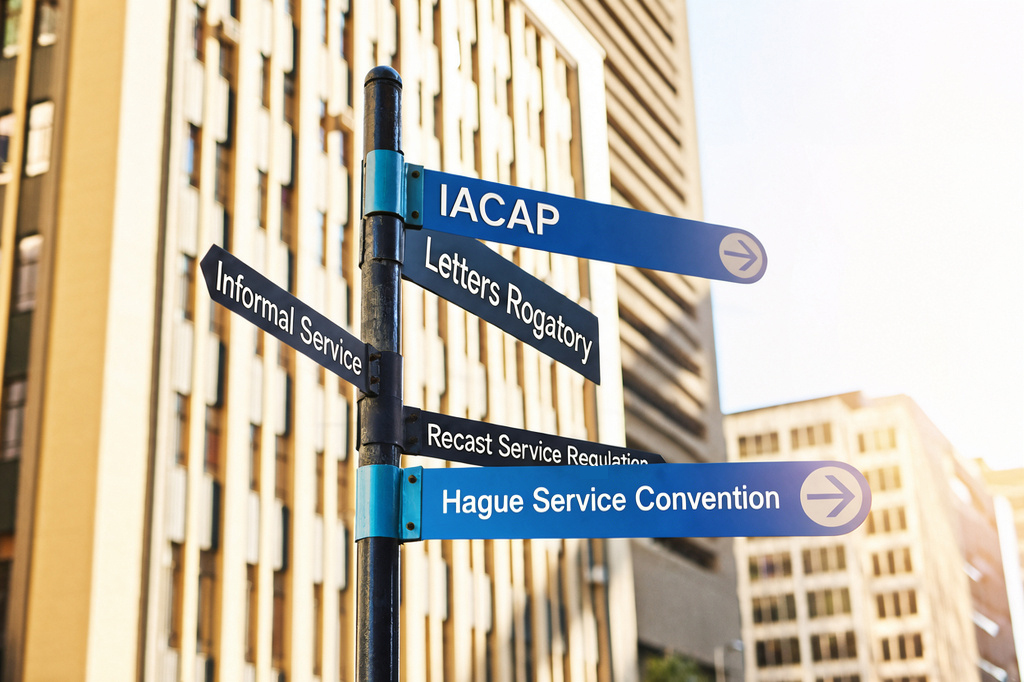
When litigation involves a jurisdiction that isn’t a signatory to the Hague Convention, the procedural landscape shifts toward more traditional diplomatic and judicial channels. In these scenarios, international service of process for corporate litigation requires a deep understanding of sovereign protocols. Counsel must choose between formal judicial requests and, where permitted, informal methods that leverage local networks. Each path carries distinct risks regarding timeline and eventual judgment enforceability.
The Letters Rogatory Process
Letters Rogatory represent a formal request from a U.S. court to a foreign tribunal, asking for judicial assistance in delivering legal documents. This method is the primary “last resort” for service in non-treaty countries. It’s a complex, multi-stage process where documents move through the U.S. Department of State, the foreign ministry of the receiving nation, and finally the local court system. Timelines are extensive, typically ranging from 6 to 12 months. For litigation in Latin America, the Inter-American Convention on Letters Rogatory offers a specialized framework. While it provides more structure than standard diplomatic channels, it still demands rigorous adherence to specific country-level requirements to ensure the resulting service is recognized by both the foreign and domestic courts.
Informal and Personal Service Abroad
In jurisdictions where the foreign state doesn’t object, informal service of process via private servers or local agents may be an option. This is often significantly faster than formal judicial requests. However, some countries view the activities of private process servers as an infringement on judicial sovereignty. In certain civil law jurisdictions, service must be performed by a court-appointed official or a specific “agent of the court” to be valid. Counsel must ensure the local agent provides a detailed affidavit of service that meets U.S. evidentiary standards. This document must clearly state how the service was performed and why it complied with local law. Without this level of precision, the service may be challenged, jeopardizing the entire litigation strategy. Leveraging a professional network with over 30 years of experience ensures that these local nuances are managed with the necessary authority and care for high-stakes international service of process for corporate litigation.
Strategic Considerations for Corporate Counsel: Speed vs. Enforceability
Selecting a method for international service of process for corporate litigation requires a clear understanding of the ultimate legal objective. If the goal is a rapid settlement or a domestic default judgment, informal methods might suffice. However, if the strategy involves seizing assets in a foreign jurisdiction, the “Enforceability Test” becomes the primary metric. Foreign courts won’t recognize a U.S. judgment if the service didn’t comply with their local sovereignty. Counsel must evaluate whether a shortcut taken today will render the final judgment a “paper judgment”—legally valid in the U.S. but practically worthless abroad. A methodical approach ensures that the foundation of the case is strong enough to withstand international scrutiny.
Translation and Compliance
Translation isn’t just a courtesy; it’s a jurisdictional mandate. Many Central Authorities will reject a request immediately if the documents aren’t provided in the official language of the receiving state. It’s why professional legal document translation is a non-negotiable step in the process. Simple machine translations fail to capture technical legal terminology or specific regional dialects. A translation must be certified and formatted to meet the precise standards of the foreign court. Any ambiguity in the translated summons can be used by the defendant as grounds to challenge the validity of the notice. Meticulous translation prevents these avoidable administrative hurdles.
Global Skip Tracing in Corporate Litigation
Corporate defendants often prove elusive when litigation is imminent. Directors and officers frequently relocate across borders, or parent companies may shift their registered offices to avoid service. In these cases, effective international service of process for corporate litigation relies on sophisticated skip tracing. This involves more than just finding an address; it requires identifying operational headquarters and active corporate assets. Our team leverages a global network to conduct skip tracing that adheres to international data privacy laws. Identifying the correct physical location of a corporate officer is the first step in ensuring that the subsequent service is both legally defensible and procedurally sound. If you’re struggling to locate a foreign defendant, request a professional skip tracing consultation to secure the necessary data for valid service.
Ensuring Compliance with Stellar Konsulting’s Global Network
Managing international service of process for corporate litigation requires more than standard courier capabilities. It demands a sophisticated understanding of international law and a network capable of executing tasks within diverse legal frameworks. Stellar Konsulting brings over 30 years of professional experience to every case, providing a foundation of deep rooted reliability and global competence. Our approach is defined by a meticulous adherence to international treaties and local mandates. We provide a comprehensive suite of services, including formal Hague compliance, Letters Rogatory, and skip tracing, ensuring your legal documents reach their destination without procedural friction or jurisdictional risk.
Expertise in Complex Jurisdictions
Different regions present unique procedural obstacles that can derail a case if not handled with precision. For instance, serving legal documents in Mexico requires addressing a specific civil law structure that differs significantly from U.S. expectations. In non-Hague jurisdictions across Asia and the Middle East, where diplomatic channels are often the only viable option, our established relationships facilitate a more predictable and authoritative outcome. High-stakes corporate litigation doesn’t allow for trial and error. We develop customized strategies based on the specific jurisdiction and the precise nature of the corporate entity being served, ensuring every action stands up to judicial scrutiny.
The Value of a Single-Point Global Facilitator
Law firm paralegals and attorneys often face a heavy administrative burden when coordinating with multiple foreign agencies and translation services. Acting as a single-point global facilitator, we streamline this process to improve efficiency and clarity. You receive real-time updates and transparent procedural guidance throughout the service cycle. This centralized approach eliminates the communication gaps that often occur when dealing with foreign central authorities directly. We provide the documentation necessary to satisfy U.S. judges that every effort was made to provide valid notice, reducing the likelihood of successful challenges to the court’s jurisdiction.
To initiate a request, counsel should provide the summons and complaint along with any known details regarding the defendant’s location. Our team performs a preliminary jurisdictional review to determine the most reliable method for your specific case. Before dispatching, we verify your international summons meets a final compliance checklist:
- Is the corporate entity correctly identified by its full legal name and registered seat?
- Has the document package been translated by a professional into the host nation’s mandatory language?
- Does the chosen method of service satisfy both U.S. constitutional due process and the sovereignty of the foreign state?
- Are all Model Forms and certificates prepared according to the latest treaty requirements?
Securing valid international service of process for corporate litigation starts with a partner who understands the nuances of the global legal field. Our commitment to results ensures your litigation remains procedurally sound from the first filing to the final judgment.
Securing Procedural Integrity in Global Disputes
Success in cross-border litigation depends on the precision of your initial procedural steps. International service of process for corporate litigation is the foundation upon which your entire case is built. Relying on shortcuts or informal methods often leads to unenforceable judgments and costly delays. Counsel must prioritize methods that satisfy both domestic due process and the sovereign requirements of the foreign jurisdiction. Whether you’re navigating the Hague Service Convention or the complexities of Letters Rogatory, meticulous attention to translation and corporate entity identification is mandatory.
With over 30 years of legal support experience, Stellar Konsulting provides the authoritative guidance needed to manage these sensitive tasks. Our global network covers both Hague and non-Hague jurisdictions, supported by specialized skip tracing and legal document translation capabilities. We handle the administrative complexities so your team can focus on the substantive legal strategy. Contact Stellar Konsulting for Authoritative International Process Serving to ensure your documents are delivered with the precision your high-stakes matters require. Establishing valid jurisdiction is the first step toward a successful resolution.
Frequently Asked Questions
What is the fastest way to serve a corporate defendant internationally?
The fastest method for international service of process for corporate litigation is typically informal service through local agents, provided the foreign state doesn’t object. While formal Hague channels can span 90 to 180 days, private agents can often complete delivery within weeks. However, speed shouldn’t compromise legal validity. Counsel must verify that local laws permit private delivery to ensure the resulting judgment remains enforceable in the defendant’s home jurisdiction and survives jurisdictional challenges.
Do I always have to use the Hague Service Convention if the country is a member?
Yes, the Hague Service Convention is mandatory when it applies to a signatory nation. The U.S. Supreme Court confirmed this in Volkswagenwerk AG v. Schlunk, stating the treaty is the exclusive means of service when transmitting documents abroad. Attempting to bypass these protocols for convenience often results in a motion to dismiss. Adhering to the formal Central Authority mechanism is the only way to guarantee the court’s personal jurisdiction is established correctly.
Can a US judge authorize alternative service via email for a foreign corporation?
U.S. courts may authorize service by email under Federal Rule of Civil Procedure 4(f)(3) if traditional methods are impractical. This authorization requires that the method isn’t prohibited by an international agreement. If a country is a Hague signatory and hasn’t explicitly objected to electronic notice, a judge might allow it. It’s often used when a defendant’s physical address is unknown or when foreign authorities are unresponsive, ensuring the litigation doesn’t stall indefinitely.
What happens if a foreign Central Authority refuses to serve my documents?
If a Central Authority refuses your request, you’ll typically receive a notice detailing the procedural deficiency. Common reasons for rejection include inaccurate Model Forms or a lack of professional legal translation. You must correct these technical errors and resubmit the package. If the refusal is based on a fundamental jurisdictional conflict, you might need to pursue Letters Rogatory. This process involves a formal judicial request through diplomatic channels to secure assistance from the foreign court.
Is service of process via international registered mail valid for corporate litigation?
Service via international registered mail is only valid if the destination country hasn’t filed an objection to Article 10(a) of the Hague Convention. Even when permitted, it’s rarely recommended for high-stakes corporate matters. Many foreign courts don’t recognize mail delivery as valid service, which can render a U.S. judgment unenforceable abroad. For international service of process for corporate litigation, formal delivery through the Central Authority provides the most robust and defensible jurisdictional foundation.
How much does international service of process typically cost for law firms?
Costs for international service vary significantly based on the jurisdiction, the volume of documents requiring translation, and the chosen method. For incoming service requests to the United States, the processing fee is $95 payable to the authorized contractor for the U.S. Central Authority. Law firms should also account for potential fees from foreign judicial officers or private agents. These expenses are a necessary investment to ensure the procedural integrity and long-term enforceability of the litigation.
What is the difference between formal and informal international service?
Formal service involves using established treaty channels, such as the Hague Convention or the Inter-American Convention. This method provides the highest level of legal certainty and sovereign recognition. Informal service relies on private process servers or local agents to deliver documents directly. While informal methods are often faster, they lack the sovereign backing of a Central Authority. Choosing between them requires balancing the need for speed against the goal of asset seizure or judgment enforcement.
How do Letters Rogatory differ from Hague Service Convention requests?
Letters Rogatory are formal requests from one court to another in a non-treaty jurisdiction, moving through diplomatic channels. This process is time-consuming, often taking 6 to 12 months for completion. In contrast, Hague Service Convention requests are transmitted directly to a designated Central Authority, bypassing the Department of State. The Hague process is more streamlined, typically concluding within 3 to 6 months, and provides a standardized certificate of service that U.S. courts readily accept.