What if the only barrier to your international judgment is a single document sitting in a diplomatic pouch for over twelve months? You likely recognize that cross-border litigation is a test of patience and precision. The frustration of facing extreme delays in foreign courts or having documents rejected due to improper formatting is a common hurdle for firms operating globally. Utilizing professional letters rogatory legal services becomes essential when you must navigate jurisdictions outside the reach of the Hague Convention.
This guide will help you master the complexities of these requests, providing an authoritative roadmap for diplomatic legal service and judicial assistance. We’ll detail the multi-agency process, including the procedural role of the Department of State and the critical importance of certified translations in securing a successful service of process. By understanding the diplomatic timeline and the specific requirements of foreign ministries, you can ensure your sensitive judicial documents are handled with the professional care your case demands.
Key Takeaways
- Identify when letters rogatory are the mandatory method for judicial assistance in jurisdictions without international treaty agreements.
- Understand the multi-step diplomatic transmission process involving the U.S. Department of State and foreign ministries.
- Eliminate the risk of document rejection by prioritizing certified legal document translation and rigorous formatting standards.
- Distinguish between the Hague Service Convention and traditional letters of request to optimize your international litigation strategy.
- Leverage authoritative letters rogatory legal services to manage the complex administrative requirements and extended timelines of global process serving.
Understanding Letters Rogatory in International Litigation
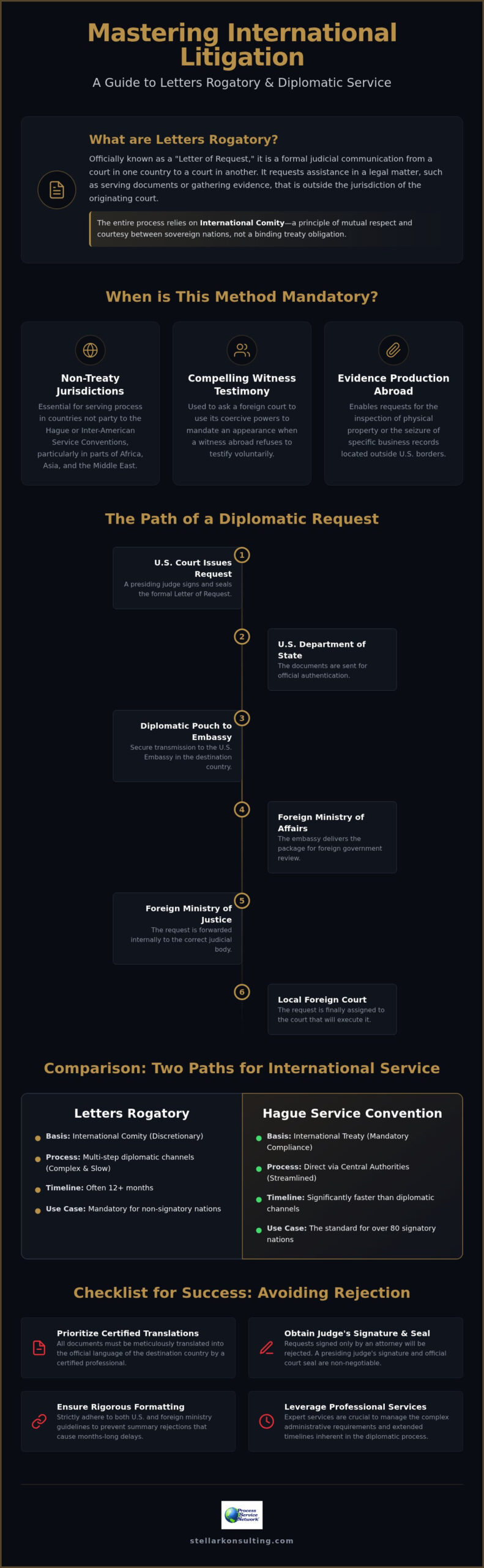
A judicial request for assistance across international borders is a formal act of diplomacy. Known officially as a Letter of Request, Letters Rogatory represent a direct communication from a court in the United States to a foreign court. This mechanism asks the foreign judiciary to perform a specific legal act, such as serving process or compelling testimony, that would otherwise fall outside the domestic court’s jurisdiction. Because no international treaty mandates compliance in these instances, the process relies entirely on the principle of comity.
The Legal Basis of Judicial Assistance
International comity is the recognition that one nation allows within its territory the legislative, executive, or judicial acts of another nation. It’s not a matter of absolute obligation but a gesture of courtesy and mutual respect between sovereign powers. When a U.S. court issues a request, the foreign court evaluates it based on its own local laws and public policy. This discretionary nature makes the process inherently unpredictable. Professional letters rogatory legal services are necessary to ensure the request is phrased and formatted in a way that respects the foreign court’s sovereignty, increasing the likelihood of execution.
When Are Letters Rogatory Required?
Legal professionals typically view this method as a last resort. It’s utilized primarily when the destination country isn’t a party to the Hague Service Convention or the Inter-American Service Convention. While treaty-based methods are streamlined, letters rogatory move through slow diplomatic channels. They’re indispensable in specific high-stakes scenarios:
- Service in non-treaty jurisdictions: Many nations in Africa, Asia, and the Middle East require formal diplomatic channels for the service of process to be recognized as valid in a U.S. court.
- Compelling witness testimony: If a witness abroad refuses to testify voluntarily, a letter of request can ask the foreign court to use its coercive powers to mandate an appearance.
- Evidence production: This includes requests for the inspection of physical property or the seizure of specific business records located outside U.S. borders.
With over 30 years of experience, Stellar Konsulting understands that success depends on more than just filing paperwork. It requires a deep understanding of how various ministries of justice interpret these formal requests. Utilizing expert letters rogatory legal services ensures that your documents meet the exacting standards of foreign officials, preventing the months-long delays that follow a summary rejection. This methodical approach is vital when dealing with jurisdictions where the rule of law is strictly interpreted through local procedural lenses.
The Procedural Mechanics of Diplomatic Service
The execution of letters rogatory is a methodical journey through multiple layers of government bureaucracy. Unlike domestic service, where a process server might deliver papers in days, diplomatic service involves a chain of custody that spans continents and agencies. Specialized letters rogatory legal services provide the necessary oversight to manage this multi-agency coordination effectively, ensuring that each step adheres to both U.S. and foreign protocols.
Drafting a Compliant Letter of Request
A letter of request is not a standard motion; it’s a formal petition from one sovereign to another. The document must include the identity of the requesting court, the nature of the legal proceedings, and a precise description of the assistance required. Most importantly, the request must bear the signature and seal of a presiding judge. Foreign ministries won’t recognize documents signed only by an attorney. Adhering to the U.S. Department of Justice guidance on Letters Rogatory ensures that the terminology used aligns with international expectations and local laws, which is critical for successful execution.
The Path of the Diplomatic Pouch
Once the U.S. court approves the request, the documents move to the U.S. Department of State for authentication. From there, they’re transmitted via diplomatic pouch to the U.S. Embassy in the destination country. The embassy staff then delivers the package to the foreign Ministry of Foreign Affairs. This ministry reviews the request before forwarding it to the foreign Ministry of Justice, which finally directs it to the appropriate local court. Each of these hand-offs requires meticulous tracking to prevent the request from stalling in an administrative backlog. If you’re managing a complex case, seeking professional guidance on international service can help you navigate these bureaucratic layers efficiently.
Timeline and Expectation Management
The use of diplomatic channels is inherently slow. Legal professionals should prepare their clients for a timeline that often takes a year or more to complete. These durations are standard because the request must pass through at least four high-level government agencies before reaching a local judge. If you require letters rogatory legal services, it’s vital to begin the process as early as possible in the litigation cycle. Minor errors in formatting or translation can lead to a summary rejection, forcing the entire process to start over from the beginning. This methodical approach is the only way to ensure that the eventual service of process holds up under the scrutiny of a U.S. court.
Letters Rogatory vs. Hague Convention Service
Choosing the correct avenue for international service is a strategic decision that directly impacts the viability of your litigation. While the legal definition of letters rogatory establishes them as a formal request for assistance, they’re distinct from the streamlined procedures of the Hague Convention. As of 2026, there are 129 contracting parties to the Hague Apostille Convention, including recent additions like Vietnam and Algeria. When a country is a member, the treaty provides a predictable, centralized path that bypasses the diplomatic pouch. In contrast, letters rogatory legal services are essential when the destination country hasn’t joined these international agreements.
Choosing the Right Path for Your Case
Determining whether to use the Hague Convention or traditional letters rogatory begins with identifying the treaty status of the destination country. For member nations, the process is significantly faster, often concluding in months rather than a year or more. You can explore these efficiencies in our Definitive Guide to Hague Convention Service of Process. However, when a jurisdiction hasn’t signed these treaties, professional letters rogatory legal services are the only reliable way to ensure a U.S. court recognizes the service as valid. Relying on informal service in non-treaty countries carries the risk that a final judgment won’t be enforceable, as the defendant can argue they weren’t served according to local sovereign laws. Understanding when informal international service of process offers a tactical advantage versus when it poses an unacceptable risk is a critical part of building a sound cross-border litigation strategy.
Challenges Unique to non-Hague Jurisdictions
Non-Hague jurisdictions present unique hurdles, specifically regarding sovereignty objections. Some foreign ministries view direct service by a private process server as an infringement on their judicial authority. This is why specialized knowledge of serving legal documents in Mexico and other civil law jurisdictions is vital. In these regions, the court itself often performs the service, and any deviation from their local procedure can lead to the total rejection of the request. Utilizing a sophisticated guide to navigate these local court systems is the only way to avoid these pitfalls.
The financial investment also differs between these methods. The U.S. Department of State charges a $2,275 fee for processing letters rogatory, a cost that doesn’t apply to most Hague requests. Despite the higher cost and extended timeline, letters rogatory provide a level of judicial comity that informal methods lack. This comity is essential if you ever need to domesticate a judgment in the foreign country. By utilizing expert assistance, you ensure that the method chosen aligns with the long-term goals of your case, protecting your client’s interests from the initial filing to the final recognition of the judgment.
Avoiding Common Pitfalls in International Service
The margin for error when utilizing letters rogatory legal services is remarkably slim. Because these requests pass through multiple layers of state and foreign bureaucracy, a single administrative oversight can lead to an automatic rejection. This often results in a loss of twelve months or more in litigation time. Success requires a meticulous approach to document preparation that accounts for the specific procedural quirks of the destination country’s judicial system. Many firms find that the initial investment in professional oversight prevents the much higher costs of a failed service attempt.
The Role of Professional Legal Translation
General translation services are insufficient for judicial assistance. Legal concepts in the United States often don’t have direct equivalents in foreign civil law jurisdictions. For example, translating discovery requests or specific service of process instructions requires a translator who understands both legal systems. If a foreign judge finds the terminology ambiguous or culturally inappropriate, they may refuse the request on sovereignty grounds. Ensuring your documents undergo certified legal document translation is a non-negotiable step in preventing service rejection. The translation must be accurate, formal, and certified by a professional recognized by the receiving court.
Authentication and the Apostille Process
Proper authentication is the foundation of document acceptance abroad. While the Hague Apostille Convention simplifies this for member nations, letters rogatory often target non-treaty countries. In these cases, documents must undergo a complex chain of authentication. This typically involves the local court, the state secretary of state, and the U.S. Department of State before reaching the foreign embassy. Failing to provide the correct number of copies or missing a single required seal will halt the process immediately. This administrative failure can lead to the dismissal of a case if the court determines the plaintiff failed to exercise due diligence in serving the defendant.
Inaccurate identification of the defendant or their precise location is another frequent cause of failure. Foreign courts won’t investigate the whereabouts of a person; they only execute the service at the address provided. If the defendant has moved, the request is returned unexecuted, forcing you to restart the diplomatic chain. Verifying the current address through professional skip tracing before drafting the letter of request is a critical prerequisite. Understanding international skip tracing costs and what drives them helps you budget appropriately for this essential due diligence step. By addressing these technical details with precision, you protect the integrity of your international litigation and ensure your letters rogatory legal services achieve the desired outcome. For expert assistance with these requirements, you can secure professional support for international judicial requests to ensure your filings are compliant from the start.
Expert Facilitation of Letters Rogatory Legal Services
Managing international judicial assistance is a logistical challenge that extends far beyond the initial drafting of the request. While government resources provide the basic procedural steps, they don’t offer the active monitoring required to ensure a document doesn’t sit idle on a foreign clerk’s desk for months. Stellar Konsulting fills this gap by providing authoritative letters rogatory legal services backed by over 30 years of experience in the international legal support industry. Our firm functions as a global facilitator, providing end-to-end management from the moment a judge signs the request to the final delivery of the certificate of service.
Why Legal Professionals Partner with Stellar Konsulting
Law firm staff often find the administrative burden of diplomatic service overwhelming. The process requires constant coordination with the U.S. Department of State, foreign ministries, and local agents. By outsourcing these tasks, firms can focus on the core legal strategy of their case while we handle the procedural minutiae. Our established relationships with international agents allow us to mitigate the risk of service-related case dismissals. We understand the specific formatting and authentication requirements that foreign courts demand, ensuring that your filings move through the system without unnecessary friction. This steady, matter-of-fact approach to complex requirements provides the reliability that high-stakes litigation requires.
Comprehensive Support Beyond the Filing
Our capabilities extend into specialized areas that government agencies simply don’t cover. For instance, we provide comprehensive skip tracing to locate defendants who may be intentionally evading service in foreign jurisdictions. Without a verified address, a letter of request is likely to be returned unexecuted after a year of waiting. We ensure the request reaches the correct party by verifying their location before the diplomatic process begins. Additionally, we manage the specific logistics of the inter-american service convention process for cases targeting member states in the Americas.
Throughout the lengthy diplomatic process, we provide methodical status updates. You won’t be left wondering where your documents are in the chain of custody. Our global network monitors progress within foreign ministries, allowing us to identify and resolve bottlenecks before they lead to significant delays. This level of oversight is essential for maintaining the momentum of your litigation. By choosing professional letters rogatory legal services, you’re securing a partner capable of handling the most sensitive judicial tasks across diverse and challenging jurisdictions.
Advancing Your International Litigation Strategy
Success in cross-border disputes requires a move beyond simple administrative filing toward a comprehensive diplomatic strategy. You’ve seen that navigating the multi-layered requirements of non-Hague jurisdictions demands absolute precision in both formatting and certified translation. By prioritizing these technical details early in the litigation cycle, you protect your case from the summary rejections and extreme delays that characterize unmanaged filings. Master the complexities of the diplomatic pouch by utilizing authoritative letters rogatory legal services designed for the modern legal landscape.
Stellar Konsulting brings 30+ years of expertise in international process serving to your most challenging cases. Our integrated approach combines specialized skip tracing to locate elusive defendants with precise legal translation services that satisfy foreign judicial standards. We maintain a proven track record of successful service in non-Hague jurisdictions, acting as a sophisticated guide through every stage of the diplomatic process. When you require deep-rooted reliability and global competence, consult with Stellar Konsulting for international judicial assistance. We’re here to ensure your documents are executed with the professional care your case demands.
Frequently Asked Questions
How long does the letters rogatory process typically take?
Execution typically takes a year or more due to the complexity of diplomatic transmission. Your request must pass through the U.S. Department of State and the destination country’s Ministry of Foreign Affairs before reaching a local court. Utilizing professional letters rogatory legal services helps manage these expectations by ensuring every document is prepared correctly the first time. This reduces the risk of administrative restarts that can double the total processing time.
What is the difference between a letter of request and letters rogatory?
The terms are often used interchangeably, but “letters rogatory” specifically refers to the formal request from a U.S. court to a foreign judiciary. A “letter of request” is the terminology used under the Hague Evidence Convention for similar tasks. In jurisdictions where no treaty exists, the process relies on the traditional framework. Both documents serve the same purpose of requesting judicial assistance based on international comity rather than a treaty obligation.
Can I use letters rogatory to obtain evidence from a foreign witness?
You can use this mechanism to obtain physical evidence or compel testimony from a witness located abroad. When a foreign court receives the request, it applies its own local laws to facilitate the production of documents or the examination of witnesses. This is the standard procedure when the witness resides in a country that is not a party to international evidence treaties. It remains the most authoritative way to secure evidence admissible in U.S. courts.
Is professional translation mandatory for letters rogatory?
Professional translation is a critical requirement for any request sent to a non-English speaking jurisdiction. Foreign ministries will summarily reject documents that are not accompanied by a certified translation in their official language. Our firm provides specialized legal document translation to ensure that complex terminology is correctly adapted for foreign civil law systems. Inaccurate translations are among the most common reasons for significant delays and document rejections in international litigation.
What happens if a foreign court refuses to honor a letter rogatory?
If a foreign court refuses the request, the U.S. court has no power to compel that sovereign nation to comply. Rejections often occur because the request violates local public policy or fails to meet strict formatting standards. Because the process is based on comity rather than a binding treaty, the foreign court has full discretion. This highlights why it is vital to work with experts who understand the specific procedural nuances of the destination country.
Can letters rogatory be used for service in Hague Convention countries?
You generally cannot use letters rogatory for service in countries that are contracting parties to the Hague Service Convention. The U.S. Supreme Court has held that the Convention is the exclusive and mandatory channel for service between member nations. As of August 2026, there are 129 contracting parties to the Convention. Letters rogatory are reserved for non-treaty jurisdictions or for specific judicial acts that fall entirely outside the scope of the Hague agreements.
Do I need a local attorney in the foreign country to use letters rogatory?
A local attorney is frequently necessary to move the process forward once the request reaches the foreign court system. While the diplomatic pouch delivers the documents to the Ministry of Justice, a local representative often needs to pay local fees or follow up with the clerk. Professional letters rogatory legal services simplify this by leveraging an established global network of agents. This ensures your case doesn’t stall once it leaves the hands of U.S. officials.
How much does it cost to process letters rogatory through the State Department?
The U.S. Department of State fee for processing letters rogatory is $2,275 as of August 2026. This fee is required for the Department to provide the necessary seals and certificates for diplomatic transmission. It is important to note that this cost does not include local foreign court fees or the administrative costs associated with drafting and translation. These fees must be paid upfront to avoid immediate rejection by the Office of Consular Affairs.