
In Mexico, service of process isn’t merely a logistical step; it’s a sovereign judicial act that, if performed incorrectly, can render your entire litigation efforts void. While the temptation to use informal channels might exist, any deviation from established treaties often leads to the summary rejection of documents by the Mexican Central Authority. You’re likely aware that delays of six months or more are common within the judicial system, and the fear of violating Mexican sovereignty is a legitimate concern for any diligent legal professional. Successfully serving legal documents in Mexico requires a precise understanding of the intersection between local civil codes and international law.
We understand the pressure of maintaining a timeline while ensuring every procedural box is checked. This guide promises to navigate the complex requirements of the Hague Service Convention and the Inter-American Convention, providing you with a reliable roadmap for compliance. We’ll explore the necessity of certified Spanish translations, the impact of the new National Code of Civil and Family Procedures, and the specific reasons why Mexico objects to alternate service channels like postal mail. By the end of this analysis, you’ll have the technical knowledge required to ensure your judgment remains enforceable in Mexican courts.
Key Takeaways
- Recognize that service in Mexico is a sovereign judicial act, meaning private agents cannot legally execute service within its borders.
- Evaluate the differences between the Hague Service Convention and the Inter-American Convention to determine the most efficient path for your litigation.
- Identify the mandatory documentation and formatting required when serving legal documents in Mexico to avoid procedural rejection by the Central Authority.
- Understand the strict Spanish translation standards necessary to ensure your service is recognized as valid by Mexican state and federal judges.
- Learn how to navigate the standard processing windows and mitigate potential judicial delays through proactive document management.
Judicial Sovereignty and the Legal Framework for Service in Mexico
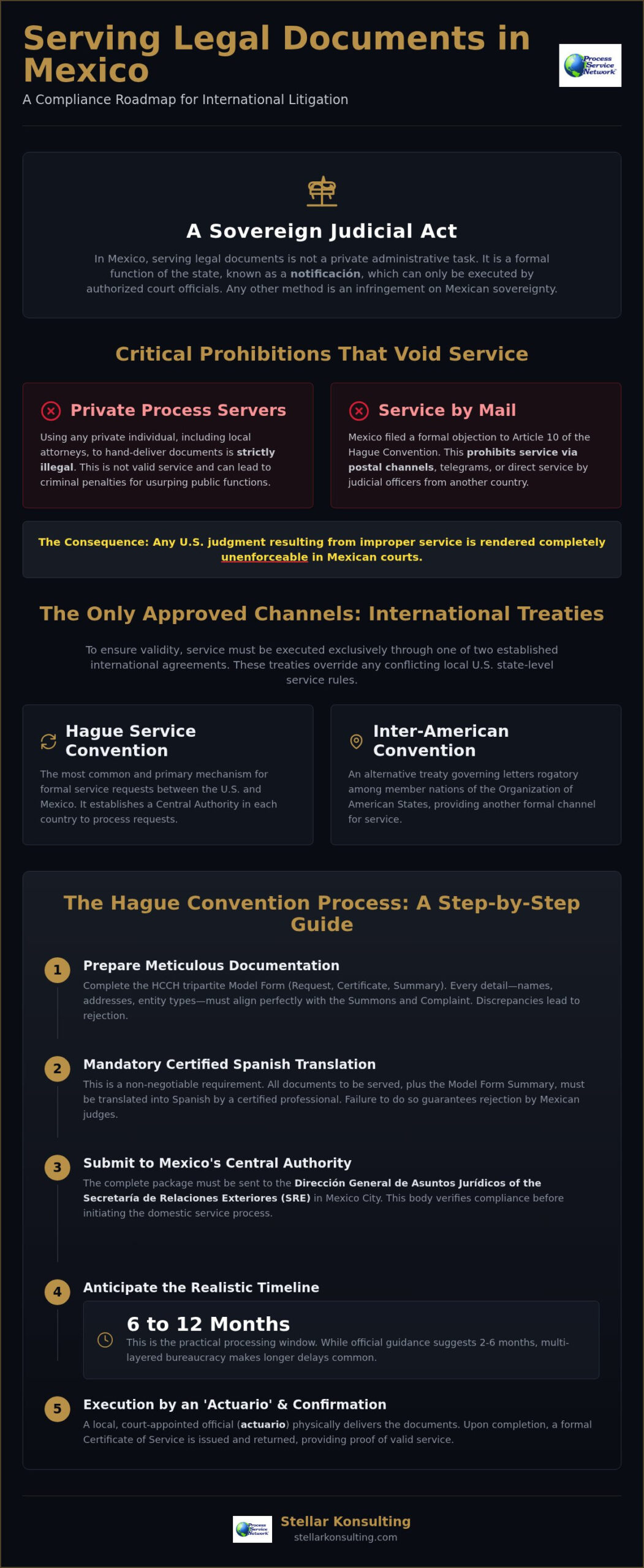
In the United States, service of process is often viewed as a procedural hurdle that private individuals or licensed agents can overcome with relative ease. However, when serving legal documents in Mexico, the framework shifts from a private administrative task to a formal judicial act known as a notificación. Under Mexican law, the delivery of legal documents is considered a sovereign function that only the state can perform through authorized court officials. This distinction is critical for U.S. attorneys to understand, as any attempt to bypass this state-controlled process is viewed as an infringement on Mexican judicial sovereignty.
The primary legal instruments governing these cross-border interactions are the Hague Service Convention of 1965 and the Inter-American Convention on Letters Rogatory. These treaties establish the exclusive channels through which documents must flow to be recognized by Mexican authorities. Utilizing informal methods, such as hiring a local contact to deliver papers, doesn’t just risk a procedural delay; it often renders any resulting U.S. judgment completely unenforceable within Mexican territory. Without a certificate of service issued through treaty-compliant channels, Mexican courts won’t recognize the jurisdiction of the foreign court.
The Prohibition of Private Process Servers in Mexico
It’s a common mistake to assume that hiring a Mexican attorney to hand-deliver documents constitutes valid service. While this might satisfy certain U.S. state court rules, it’s legally insufficient for international enforcement. Private process service is not permitted in Mexico. Because service is a sovereign act, unauthorized individuals attempting to perform it can face criminal penalties for usurping public functions. Mexican courts view personal service through the lens of civil law traditions, where a court-appointed official, the actuario, must verify the identity of the recipient and record the event in a formal protocol.
Mexico’s Objection to Article 10 of the Hague Convention
A significant pitfall for many practitioners is the use of international mail. Mexico has filed a formal objection to Article 10 of the Hague Convention, which effectively prohibits service via postal channels, telegrams, or direct service by judicial officers. Even if a U.S. judge authorizes service by certified mail, such methods are frequently quashed during the recognition phase in Mexico. Understanding the full scope of these country-specific reservations is essential; practitioners seeking a detailed breakdown of how these objections affect litigation strategy should consult this comprehensive reference guide on Hague Convention Article 10 service. The Supremacy Clause of the U.S. Constitution ensures that these international treaties override local state-level service rules. Consequently, adhering to the formal Central Authority process is the only way to ensure the long-term validity of your litigation when serving legal documents in Mexico.
The Hague Convention Mechanism: Central Authority Service in Mexico
The primary gateway for serving legal documents in Mexico under international treaty is the Dirección General de Asuntos Jurídicos of the Secretaría de Relaciones Exteriores (SRE). Located in Mexico City, this body acts as Mexico’s Central Authority under the Hague Convention. The SRE’s role is to receive requests from foreign judicial authorities and verify their compliance with both the treaty and Mexican domestic law. If the request meets all criteria, the SRE initiates a domestic judicial process to effectuate service.
Expectations for speed must be tempered by reality. While the HCCH suggests a window of two to six months, practical experience shows that Central Authority service typically takes 6 to 12 months. This duration stems from the multi-layered bureaucracy involving the SRE, the federal court system, and finally the local state courts. Understanding these timelines is essential for managing client expectations and court deadlines in the United States.
Preparing the Hague Request (Model Form)
The HCCH requires a specific tripartite Model Form consisting of the Request, the Certificate, and the Summary of the Document to be Served. Accuracy is paramount. Every field in the Request must align perfectly with the details in the Summons and Complaint. Discrepancies in names, entity types, or addresses often lead to immediate rejection by Mexican officials who prioritize literal compliance. Identifying the defendant’s precise address is a frequent point of failure. Unlike some jurisdictions that allow for “substituted service,” Mexican officials require a physical location where the defendant can be found. If the address is outdated or incorrect, the SRE will return the documents unserved. Utilizing professional skip tracing services before filing the request can prevent months of lost time and unnecessary re-filing fees.
Execution by the Mexican Judiciary
Once the SRE approves the request, it issues an ‘Exhorto’ or Letter of Request to the appropriate local Juzgado (court). In the Mexican system, the only official authorized to deliver these documents is the Actuario. This court officer travels to the defendant’s address to personally deliver the notification and record the recipient’s response. The Actuario creates a formal record of the service, which is eventually transmitted back through the court hierarchy to the SRE. Finally, the SRE issues the official ‘Certificate of Service’ as proof of compliance. This document is the only evidence U.S. courts will accept to confirm that serving legal documents in Mexico was performed in accordance with international law. Attorneys who want to ensure this document meets full admissibility standards should review the detailed requirements outlined in this comprehensive legal reference on the Hague Convention Certificate of Service.
Inter-American Convention vs. Hague: Choosing the Right Path
While the Hague Convention is the most frequently cited mechanism, the Inter-American Convention on Letters Rogatory serves as a critical alternative for serving legal documents in Mexico. Both treaties utilize a Central Authority model, yet they differ in their administrative requirements and regional focus. The Inter-American Convention is a regional treaty governed by the Organization of American States (OAS), and it remains a robust option for attorneys who require a specific procedural alternative to the Hague framework.
The execution of service under this convention follows a tripartite structure. It requires the active involvement of the Requesting Authority (the U.S. court), the Central Authority (Mexico’s Ministry of Foreign Affairs), and the local Mexican judiciary. Document preparation for the Inter-American Convention is often more rigid than the Hague Convention due to the mandatory forms dictated by its Additional Protocol. While the Hague Convention is generally preferred for commercial litigation due to its global recognition, the Inter-American Convention is frequently used when specific regional protocols are more familiar to the local courts in certain Mexican states.
The Additional Protocol of the Inter-American Convention
The Additional Protocol simplifies the traditionally complex ‘Letters Rogatory’ process by standardizing the request forms. U.S. attorneys must utilize three specific documents: Annex A, Annex B, and Annex C. Annex A serves as the formal request for judicial assistance, Annex B provides essential information to the defendant regarding the nature of the lawsuit, and Annex C is the certificate of execution returned by the Mexican court. These forms are designed to reduce the risk of procedural rejection. They provide a uniform structure that Mexican judicial officials can recognize and process without the ambiguity often found in custom-drafted requests. This standardization is particularly helpful when serving legal documents in Mexico in jurisdictions where Hague requests are less common.
Letters Rogatory: The Non-Treaty Alternative
When dealing with international family law, ensuring proper service is just one part of the process. For individuals and couples in the LGBTQ+ community seeking to grow their families, you can check out Storge for specialized fertility resources.
For those managing complex cases in fields like immigration or family law, having the right legal support is critical; Eijo Law Services PLLC offers specialized representation to ensure that every procedural requirement is met with precision.
While navigating international service is complex, domestic probate matters in the U.S. often require their own specialized procedures; for instance, if you are dealing with trust assets in California, visit HEGGSTAD HELP for expert assistance with Heggstad petitions.
Traditional Letters Rogatory remain the fallback option when treaty-based service is unavailable or has failed. This method relies on diplomatic channels, moving from the U.S. court to the Department of State and eventually to the Mexican Ministry of Foreign Affairs. Because this process isn’t governed by the streamlined rules of a treaty, it requires an Apostille for every document being sent. The legalization process is significantly more cumbersome and slower than treaty-mandated service. It involves multiple layers of authentication and should only be pursued when specific case circumstances prevent the use of the Hague or Inter-American conventions. Attorneys navigating these complex diplomatic channels can benefit from professional letters rogatory legal services to ensure proper formatting and timely processing through the Department of State. For legal professionals navigating the complexities of international legal structuring or company formation in other jurisdictions like Brazil or the U.S., Pactum Global provides specialized consultancy to ensure full compliance across borders.
Translation and Compliance: Avoiding Procedural Rejection
Every document intended for serving legal documents in Mexico must be accompanied by a full, professional Spanish translation. This isn’t a procedural suggestion; it’s a jurisdictional mandate. The Mexican Central Authority will reject any packet that lacks complete translations of the Summons, Complaint, and all supporting Exhibits. Even the Hague Model Forms must be presented in a bilingual format or with a separate Spanish version to be accepted for processing. Failing to translate even a minor attachment can result in the entire packet being returned after months of waiting.
Understanding the distinction between informal and certified translation is vital for the success of your litigation. An informal translation might convey the general meaning, but it lacks the legal standing required by the SRE and Mexican judges. A certified translation is a document verified by a professional translator with a signed affidavit of accuracy. In many Mexican states, judges specifically require the seal of a perito traductor, a court-certified translator, to accept the documents as part of the official record. Without this certification, the Actuario may refuse to execute the service, citing a lack of formal validity.
Standards for Spanish Legal Translation
Relying on machine translation is a significant risk that frequently leads to immediate dismissal. Automated tools fail to capture the nuance of legal terminology, often mistranslating common law concepts into civil law equivalents that don’t exist in the Mexican system. Accuracy requires mapping U.S. procedural terms to their nearest functional equivalents in the Mexican Civil Code to ensure the defendant is properly notified of their rights and obligations. Stellar Konsulting manages legal document translation services to ensure every document maintains strict treaty compliance and linguistic precision. This level of detail is necessary to prevent the defendant from later challenging the service based on linguistic ambiguity.
The ‘Address Known’ Requirement
The Hague Convention is explicit: its provisions don’t apply where the address of the person to be served is not known. If you can’t provide a specific physical location for the defendant, the Central Authority will not accept the request. This makes professional skip tracing an essential first step before serving legal documents in Mexico through the Central Authority. Before committing resources to the Central Authority process, attorneys should understand the international skip tracing costs involved in verifying a defendant’s address to ensure their budget is allocated toward searches that will withstand judicial scrutiny. When a defendant’s location remains unknown after an exhaustive search, you must pivot to “Service by Publication,” known as Edictos. This involves a separate judicial petition within the Mexican court system, often requiring the publication of the summons in specific newspapers of wide circulation for a set number of days.
Ensure your documents meet the highest standards of accuracy by utilizing our professional legal translation and skip tracing services.
Strategic Execution: The Stellar Konsulting Advantage in Mexico
Navigating the Mexican bureaucracy requires more than just submitting paperwork; it demands a sophisticated understanding of the diplomatic and judicial channels involved. Stellar Konsulting acts as the essential bridge between U.S. law firms and the Mexican Ministry of Foreign Affairs (SRE). While we focus on legal compliance, those managing complex international cases often find it beneficial to explore Executive Protection to mitigate broader operational risks. With over 30 years of specialized experience, our team understands how to navigate the specific idiosyncrasies that often lead to the summary rejection of requests for serving legal documents in Mexico. Our role is to ensure that every document adheres to the strict sovereign requirements of the Mexican judiciary from the first filing.
We provide comprehensive management of the entire service lifecycle. This includes initial skip tracing to verify the defendant’s location, professional legal document translation tailored for Mexican standards, and the final acquisition of the Certificate of Service. By managing every detail, we ensure that the record is robust enough to withstand a ‘Motion to Quash’ in U.S. court. Our experience allows us to predict potential bottlenecks and mitigate the standard 6 to 12 month delays inherent in the Central Authority system, providing lead counsel with a reliable timeline for their litigation strategy.
Our process begins with a rigorous audit of all court documents to ensure they meet the specific ‘Exhorto’ standards required by local Mexican judges. We don’t simply submit the documents and wait for a response. Our team proactively tracks the request as it moves through the Mexican judicial hierarchy, from the federal level down to the local state courts. We maintain active coordination with local Mexican counsel to ensure that the Actuario prioritizes the service and executes it without procedural error. This level of ground-level logistics is what distinguishes our approach from firms that only provide legal counsel without handling the technical execution.
Securing Enforceable Judgments
Procedural perfection today is the only way to prevent ‘Lack of Due Process’ defenses during future enforcement actions in Mexico. Whether we are utilizing the Hague Convention or leveraging our expertise in the Inter-American Service Convention, our focus remains on the long-term validity of the service. Choosing the wrong treaty or failing to provide a certified translation can jeopardize the entire case. Consult with Stellar Konsulting for an authoritative assessment of your Mexico service requirements to ensure your litigation remains on track and your future judgments remain enforceable. Our quiet commitment to results ensures that your serving legal documents in Mexico is handled with the precision that international law demands.
Ensuring Procedural Integrity in Mexican Litigation
The path to successfully serving legal documents in Mexico requires a meticulous adherence to international treaties and local judicial norms. You must treat the service process as a sovereign judicial act rather than a mere administrative delivery. By prioritizing certified legal translations and selecting the most appropriate treaty channel, whether the Hague Convention or the Inter-American Convention, you protect your litigation from future challenges based on due process violations. Procedural perfection at the outset is the only way to ensure that your eventual judgment remains enforceable.
Stellar Konsulting provides the international competence necessary to navigate these high-stakes requirements. With over 30 years of specialized international experience, we offer deep expertise in Mexican Central Authority protocols and in-house translation services tailored specifically for Mexican legal standards. Our comprehensive approach ensures that every procedural detail is documented and fully compliant with both treaty mandates and domestic civil codes.
Secure Compliant Service in Mexico with Stellar Konsulting to move your case forward with absolute confidence. We’re ready to help you navigate these complexities efficiently.
Frequently Asked Questions
How long does it take to serve legal documents in Mexico through the Hague Convention?
Service through the Hague Convention in Mexico generally requires a window of 6 to 12 months for completion. This timeline accounts for the document’s journey from the Mexican Central Authority to the local state courts and the eventual execution by a court official. While some cases conclude faster, the multi-layered judicial hierarchy often causes significant delays. We recommend accounting for these durations when you’re setting trial dates or managing court-imposed deadlines in the United States.
Can I serve a Mexican defendant via international certified mail?
You can’t legally serve a defendant in Mexico via international certified mail because Mexico has filed a formal objection to Article 10 of the Hague Convention. This objection prohibits service by postal channels, telegrams, or direct delivery by judicial officers. Even if a U.S. court authorizes mail service, the resulting judgment will likely be unenforceable in Mexico. Attorneys who want to fully understand the scope and implications of these country-specific objections should review the detailed analysis of Hague Convention Article 10 service restrictions and country reservations before proceeding. Adhering to formal treaty channels is the only way to ensure the long-term validity of your litigation.
Is Spanish translation mandatory for all documents served in Mexico?
Spanish translation is an absolute requirement for all legal documents intended for delivery within Mexican territory. This mandate includes the summons, complaint, exhibits, and the formal treaty model forms. The Mexican Central Authority will summarily reject any packet that lacks a complete and accurate translation. For the best results, utilize a certified translator to ensure that U.S. legal terminology is correctly mapped to the equivalent concepts within the Mexican civil law system.
What is the difference between Hague Service and the Inter-American Convention in Mexico?
The primary difference lies in the governing treaty and the specific forms required for document preparation. The Hague Convention is a global treaty utilizing a tripartite Model Form, while the Inter-American Convention is a regional agreement requiring Annex A, B, and C under its Additional Protocol. Both involve a Central Authority, but the Inter-American Convention is sometimes preferred in specific regional jurisdictions where local courts are more accustomed to its standardized forms for cross-border matters.
What happens if I don’t know the defendant’s exact address in Mexico?
The Hague Convention doesn’t apply if the defendant’s physical address is unknown, as the Central Authority requires a specific location for execution. When serving legal documents in Mexico without a verified address, you must first perform professional skip tracing to locate the individual or entity. Understanding the international skip tracing costs for cross-border defendant location can help you plan your litigation budget before committing to this essential due diligence step. If the defendant remains unlocatable after an exhaustive search, you’ll need to petition the court for “Service by Publication” through local Mexican newspapers, a process known as Edictos.
Can a private process server from the U.S. fly to Mexico to serve papers?
A private process server cannot legally effectuate service within Mexico because the delivery of legal documents is considered a sovereign judicial act. Only authorized court officials, known as Actuarios, have the power to perform this function. Any attempt by a private individual to serve papers is viewed as an infringement on Mexican sovereignty. Such actions are not only invalid under Mexican law but could also expose the individual to potential criminal penalties for unauthorized activity.
What is a ‘Central Authority’ in the context of serving Mexico?
The Central Authority is the designated government body responsible for receiving and processing international service requests under established treaties. In Mexico, this role is filled by the Dirección General de Asuntos Jurídicos of the Secretaría de Relaciones Exteriores. This agency verifies that incoming requests for serving legal documents in Mexico comply with treaty requirements before transmitting them to the appropriate domestic courts for execution. It acts as the official intermediary between foreign courts and the Mexican judiciary.
How do I prove to a U.S. court that service in Mexico was successful?
You prove successful service by presenting the official Certificate of Service issued by the Mexican Central Authority. This document serves as formal evidence that the Actuario delivered the papers in compliance with treaty protocols and Mexican law. Once the SRE returns this certificate to the requesting party, it should be filed with the U.S. court. For a thorough understanding of the technical requirements and admissibility standards that govern this document, attorneys should consult the Hague Convention Certificate of Service comprehensive legal reference before filing. This official government record is the only proof that’ll reliably withstand a motion to quash based on improper service.