
Hague Convention compliance isn’t just a procedural checkbox; it’s a strategic shield that protects your litigation from jurisdictional challenges. When your case crosses international borders, the stakes for proper document delivery rise exponentially. A single misstep in the Hague Convention service of process can lead to months of delays or, worse, a complete dismissal of your case. It’s a logistical reality that demands precision, especially when dealing with the nuanced requirements of 84 different contracting parties.
You’ve likely felt the frustration of waiting for a Central Authority to respond or the confusion of varying country-specific requirements. We understand that managing these bureaucratic hurdles often presents a critical risk to your litigation timeline and objectives. This guide will help you master the complexities of international document delivery and ensure your cross-border litigation remains fully compliant with the 1965 Hague Convention. We’ll examine the formal service process, clarify mandatory translation requirements, and outline the reliable path to obtaining a valid Certificate of Service.
Key Takeaways
- Identify the primary purpose of the 1965 Convention and how it serves as a standardized shield for your international litigation.
- Master the mandatory use of the Model Form to ensure your hague convention service of process satisfies the rigorous demands of foreign Central Authorities.
- Avoid common pitfalls like the “Translation Trap” and understand the high risks associated with alternative methods like Article 10(a) postal service.
- Follow a clear procedural roadmap to verify country-specific declarations and prepare a compliant legal package for transmission abroad.
- Leverage professional expertise to manage complex logistics and secure a valid Certificate of Service without unnecessary delays.
Understanding the Hague Convention on Service of Process
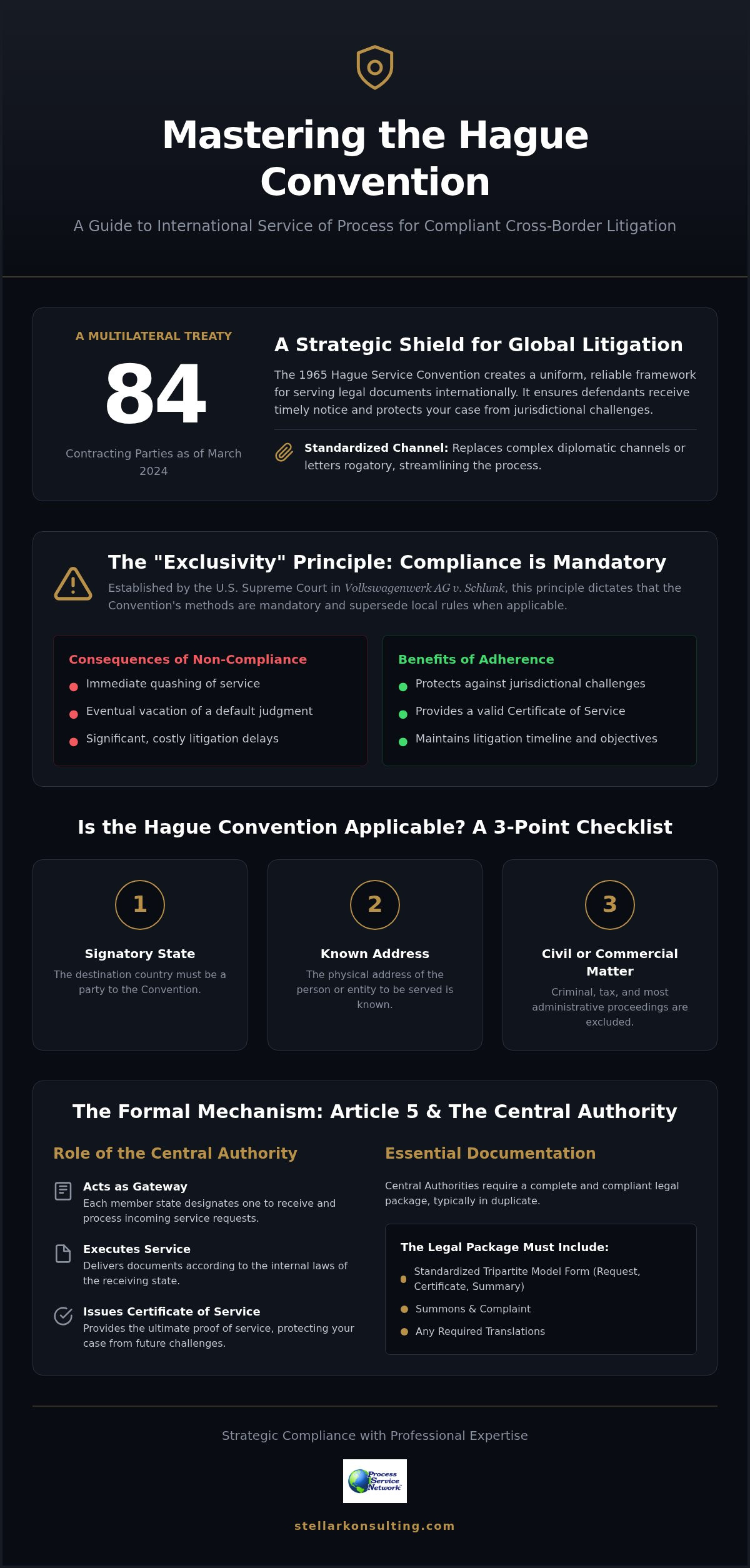
The 1965 Convention on the Service Abroad of Judicial and Extrajudicial Documents in Civil or Commercial Matters is a multilateral treaty designed to create a uniform method for document transmission between member states. As of March 2024, there are 84 contracting parties to this treaty. It establishes a reliable framework for the hague convention service of process that ensures defendants receive timely notice of legal actions while streamlining the often cumbersome process of international service. By providing a standardized channel, the treaty eliminates the need for complex diplomatic channels or letters rogatory in most instances.
In the United States, the Hague Service Convention occupies a position of legal supremacy. The U.S. Supreme Court clarified this in the landmark case Volkswagenwerk AG v. Schlunk, establishing the “Exclusivity” principle. This principle dictates that where the Convention applies, its methods are mandatory and supersede local rules of civil procedure. Litigators can’t bypass the treaty in favor of state or federal service rules when the target resides in a signatory nation. Failure to adhere to these mandatory protocols often results in the immediate quashing of service or the eventual vacation of a default judgment.
When is the Hague Convention Applicable?
Determining whether to utilize the hague convention service of process depends on three specific criteria. First, the destination country must be one of the current signatory states. Second, the physical address of the person or entity to be served must be known. The Convention doesn’t apply if the defendant’s location is unknown, in which case alternative methods like service by publication may be required. Finally, the legal matter must be civil or commercial in nature. In civil cases involving family law or child welfare, you can visit Stars Assessment Program to learn about developmental assessments for young children. Criminal proceedings are strictly excluded from the scope of this treaty, as are most tax and administrative matters depending on the jurisdiction.
The Role of the Central Authority
Each member state designates a specific entity, known as the Central Authority, to act as the primary gateway for incoming service requests. This body is responsible for receiving documents from foreign applicants and executing service according to the internal laws of the receiving state. In many countries, this involves the local police or judicial officers personally delivering the documents. Stellar Konsulting leverages over 30 years of experience to manage these interactions with Central Authorities, ensuring that your requests are processed without the administrative delays that frequently plague unassisted filings.
Once service is successfully completed, the Central Authority issues a formal Certificate of Service. This document serves as the ultimate proof of service in your domestic court, providing a level of certainty that informal methods lack. It’s the most robust way to protect your case from future jurisdictional challenges. Because each Central Authority has its own specific operational nuances, having a seasoned partner to navigate these bureaucratic channels is essential for maintaining your litigation schedule.
The Formal Mechanism: Requirements and Article 5
The administrative protocol for the hague convention service of process relies on a standardized, tripartite Model Form. This document consists of three distinct sections: the Request, the Certificate of Service, and the Summary of the Document to be Served. Central Authorities across the 84 contracting states require duplicate sets of the entire legal package. This package must include the Model Form, the summons, the complaint, and any required translations. While the treaty generally prohibits member states from charging fees for the service of judicial documents, exceptions exist. Some jurisdictions apply additional costs if a specific method of service is requested or if a private judicial officer or “huissier” must be employed to complete the task.
Essential Documentation for a Valid Request
The Request for Service must be completed in English, French, or the official language of the receiving state. While the Request itself is standardized, the “Summary of the Document to be Served” requires meticulous attention. This section must provide a clear, concise description of the legal action, the parties involved, and the nature of the claims. Clarity in the summary prevents the receiving Central Authority from rejecting the application due to a lack of understanding regarding the underlying litigation. Practitioners must also ensure that all summons and complaints are properly attached and authenticated according to the specific declarations of the destination country. Managing these administrative nuances is a core component of the formal Hague service support we offer to global legal teams.
Article 5(a) and 5(b): Methods of Execution
Article 5 defines the specific mechanisms the Central Authority uses to deliver documents. Under Article 5(a), the default method is service according to the internal law of the receiving state. This often mirrors how domestic defendants are served in that country. However, Article 5(b) permits an applicant to request a “particular method” of service. This is only allowed if the requested method is not incompatible with the laws of the receiving state. For example, a US litigator might request personal service even if the destination country typically allows service by mail.
The choice between 5(a) and 5(b) often impacts the speed and cost of the process. Some Central Authorities also facilitate “voluntary acceptance,” where the defendant is invited to pick up the documents or accept them without formal compulsion. If the defendant refuses this voluntary approach, the Central Authority must then proceed with formal, compulsory service. Understanding these distinctions is vital for ensuring that the resulting proof of service is indisputable in your home court. Our team applies 30 years of experience to help you select the most effective execution method for your specific jurisdiction.
Common Pitfalls: Translation and Article 10(a)
The hague convention service of process requires more than just administrative accuracy; it demands a deep understanding of local sovereign rights. Many litigators fall into the trap of assuming that the Model Form alone satisfies the treaty’s requirements. This oversight often leads to the immediate rejection of the request by the foreign Central Authority. Beyond simple rejection, improper service creates a “paper tiger” judgment. While a U.S. court might grant a default judgment based on informal or technically deficient service, that judgment is frequently unenforceable in the defendant’s home country. Relying on informal service methods in high-stakes litigation is a high-risk strategy that often invites jurisdictional challenges years after the initial filing.
Strict Translation Requirements by Jurisdiction
Translation is often the most significant hurdle in the service process. Many signatory states, including Mexico, France, Germany, and Japan, have filed specific declarations requiring all documents to be translated into their official local language. This requirement isn’t limited to the summons and complaint; it often extends to every exhibit and attachment. It’s essential to utilize certified legal translators who understand the technical terminology of both jurisdictions. A minor linguistic error in a complex commercial contract can provide the defendant with a valid excuse to contest the service’s legitimacy. Translation errors or omissions in the legal text can lead a Central Authority to return the request as incomplete, effectively invalidating the prospects of receiving a valid Certificate of Service. For practitioners targeting defendants south of the border, our detailed resource on serving legal documents in Mexico outlines the precise translation and procedural standards required by the Mexican Central Authority.
The Problem with Service by Mail
Article 10(a) of the Convention mentions the “freedom to send judicial documents, by postal channels, directly to persons abroad.” This has sparked a long-standing linguistic debate in international law regarding whether the word “send” is synonymous with “serve.” While some countries permit this, many major jurisdictions, such as China, India, and South Korea, have explicitly objected to Article 10. In these nations, service by mail is legally invalid. Even in countries that don’t object, relying on international mail is a precarious choice. Proof of delivery via standard mail rarely meets the evidentiary standards required to withstand a motion to quash. For US litigators targeting defendants in the United Kingdom, understanding how Article 10 postal service intersects with the updated King’s Bench Division requirements is especially critical — our guide on serving legal documents in the UK from the US provides a detailed breakdown of the current 2026 landscape.
Experienced litigators generally avoid mail service even when it’s technically permitted by the receiving state. The lack of a formal Certificate of Service from a Central Authority makes the entire process vulnerable. If the defendant claims they never received the documents, the plaintiff has little recourse to prove otherwise. Stellar Konsulting prioritizes formal transmission methods because they provide an indisputable record of compliance. We ensure that our clients don’t waste months on a service method that won’t hold up under the scrutiny of a foreign court or during the judgment enforcement phase.
Initiating International Service: A Procedural Overview
Successfully executing the hague convention service of process requires a disciplined, methodical approach. It’s not enough to simply dispatch forms to a foreign capital; you must follow a specific workflow to ensure the resulting service is legally sound. We recommend following this five-step checklist to maintain procedural integrity:
- Step 1: Status Verification. Confirm the target country is one of the 84 current contracting parties and review their specific declarations regarding Article 10 or translation requirements.
- Step 2: Package Preparation. Assemble the mandatory Model Form (Request, Summary, and Certificate) alongside the summons and complaint.
- Step 3: Translation. Translate the entire legal package into the destination’s official language using certified legal translators to avoid rejection.
- Step 4: Formal Submission. Transmit the duplicate sets to the appropriate Central Authority or their designated agent.
- Step 5: Active Monitoring. Address any Central Authority inquiries promptly and track the transmission until completion.
Managing the International Timeline
Timelines for international service vary significantly by jurisdiction. While recent data from June 2024 indicates that 75% of document requests through Central Authorities are completed within two months, many practitioners should still prepare for a window of 4 to 12 months. Factors such as bureaucratic backlogs, remote recipient locations, and incomplete initial filings often extend these periods. To minimize delays, it’s vital to submit a perfect document package on the first attempt. If you need detailed benchmarks by country — from Germany’s efficient three-month window to China’s more complex cycles — our comprehensive guide on how long Hague service takes provides jurisdiction-specific estimates to help you plan accordingly. If your case demands a faster resolution, you can consult with Stellar Konsulting to leverage our established network and streamline the transmission process.
Obtaining the Certificate of Service
The formal Certificate of Service is the gold standard of proof for U.S. courts. This document, signed and returned by the foreign Central Authority, provides indisputable evidence that service was executed in accordance with the treaty and the receiving state’s internal laws. If the Central Authority returns a “Certificate of Non-Service,” it’s usually because the defendant has relocated or is actively evading delivery. In such instances, you’ll need to verify the address and re-initiate the process. Always ensure the final Certificate is properly authenticated for your local jurisdiction to prevent any future challenges to the court’s authority.
Strategic Compliance with Stellar Konsulting
Navigating the hague convention service of process requires more than a basic understanding of treaty text; it requires a partner who understands the operational realities of foreign ministries. Stellar Konsulting applies over 30 years of international experience to protect your litigation from the procedural errors that lead to rejections. We provide a comprehensive service model that manages every phase of the project, from certified legal document translation to the formal transmission of the request. For organizations that also require general global logistics support, you can discover Parcel International to learn about their shipping solutions across 220 countries. By centralizing these tasks, we eliminate the communication gaps that often occur when multiple vendors are involved. This integrated approach is essential for maintaining compliance with the hague convention service of process while managing the expectations of the court.
Legal teams rely on our meticulous review process to safeguard their timelines. Before any document package is dispatched, we conduct a thorough audit to verify that all translation requirements and country-specific declarations are satisfied. This proactive approach prevents the costly cycle of re-submission and helps mitigate the risk of case dismissal. Our firm maintains direct experience with diverse diplomatic channels and the Inter-American Convention, offering a level of reliability that matches the high stakes of cross-border litigation. When your target jurisdiction falls outside the reach of the Hague Convention entirely, professional letters rogatory legal services provide the essential diplomatic pathway for judicial assistance through the Department of State. We prioritize transparency, providing steady communication so you remain informed of your case’s status across every time zone.
Ready to Initiate International Service?
The most effective strategy for international document delivery begins long before the first form is filed. Early consultation allows us to align the service method with your specific litigation goals, whether that involves formal Hague service or alternative diplomatic routes. Our global network is built on decades of professional relationships, ensuring that even the most complex jurisdictions are handled with precision. When you partner with us, you gain a sophisticated guide capable of navigating the nuances of international law efficiently. Don’t leave your case’s foundation to chance.
Ensure your international service is compliant with Stellar Konsulting
Securing Jurisdictional Integrity for Your International Litigation
Mastering the hague convention service of process is essential for any legal team operating in a globalized environment. By prioritizing formal transmission channels and ensuring meticulous document translation, you protect your case from future jurisdictional challenges and judgment enforcement hurdles. We’ve examined the necessity of adhering to Article 5 requirements and the high risks associated with informal methods like postal service. These procedural safeguards aren’t merely administrative hurdles; they’re the foundation of a valid international judgment.
Stellar Konsulting brings over 30 years of international legal support experience to every assignment. Our specialized expertise in both the Hague and Inter-American Conventions, combined with integrated legal document translation and skip tracing, ensures your process is executed with precision. We handle the complex logistics of Central Authorities so you can focus on the core merits of your litigation. Proper preparation today prevents procedural failure tomorrow, and we’re here to facilitate that success at every step.
Consult with Stellar Konsulting for Global Service of Process
Frequently Asked Questions
Is the Hague Convention mandatory for all international service of process?
The Convention’s protocols are mandatory whenever the destination country is a signatory and the defendant’s address is known. The U.S. Supreme Court established in the Schlunk decision that these methods are exclusive in such circumstances. It’s not an optional framework; bypassing the treaty in favor of local state rules often leads to the immediate dismissal of your case or an inability to enforce a judgment abroad.
What happens if I serve a defendant in a Hague country without using the Convention?
Service will likely be considered legally invalid, and the court may quash the proceedings upon a motion from the defendant. Even if a domestic court allows the case to proceed, any resulting judgment will be unenforceable in the foreign jurisdiction. Most Central Authorities refuse to recognize service performed outside treaty channels. This risk makes a proper hague convention service of process essential for high-stakes litigation.
How long does it typically take to complete service under the Hague Convention?
Timelines generally range between 3 and 12 months, though 2024 data indicates that 75% of requests through Central Authorities are completed within two months. Specific country backlogs and remote recipient locations can extend this period significantly. Some jurisdictions might take a full year due to internal bureaucratic requirements. For a detailed breakdown of how long Hague service takes across key jurisdictions, including country-specific benchmarks and strategies to minimize delays, consult our 2026 comprehensive guide. Planning for a minimum of six months is a prudent strategy for managing litigation schedules and court deadlines.
Which countries are currently members of the Hague Service Convention?
As of March 2024, there are 84 contracting parties to the Convention. This list includes major global economies such as China, Japan, Germany, France, and the United Kingdom. It’s vital to verify the current status of the destination country before initiating service, as new nations join periodically. Each member state may also have unique declarations regarding the specific articles they choose to follow or object to.
Can I serve process via email or social media under the Hague Convention?
A 2024 Special Commission concluded that service by email is permissible under Article 10(a) if it’s allowed by the laws of both the originating and receiving states. However, many countries maintain strict objections to Article 10, which prohibits this method. You must confirm the specific declarations of the receiving state before attempting electronic service. Failure to do so can invalidate your entire service attempt and delay your case.
What is the difference between formal and informal service of process?
Formal service involves the use of the Central Authority and results in a Certificate of Service, providing the highest level of legal certainty. Informal service refers to alternative methods like international mail or private process servers where permitted. While informal methods might seem faster, they lack the treaty-backed protections of a formal request. Most seasoned litigators prefer the formal hague convention service of process to ensure their judgment is globally enforceable.
Do all documents really need to be translated for Hague Service?
Translations are required if the receiving state has made a specific declaration demanding them. Many countries require a full translation of the summons, complaint, and all attachments into their official local language. Failing to provide these certified translations usually leads to the Central Authority returning the documents without service. It’s a common point of failure that can set a litigation timeline back by several months or more.
What is a Central Authority in the context of international law?
A Central Authority is the government entity designated by each signatory state to receive and execute service requests from other member nations. They act as the official gateway for judicial document transmission. In the United States, the Department of Justice utilizes a contracted central authority to handle incoming service requests. This entity is responsible for ensuring that all incoming documents meet treaty standards and are served according to the internal laws of the receiving jurisdiction. For jurisdictions that fall outside the Hague framework, understanding the role of letters rogatory legal services in navigating international judicial assistance is essential for maintaining a viable path to valid service abroad.