
Family law proceedings can become more complicated when the parties involved live in different countries. A divorce may be initiated in the United States while the other spouse resides in Portugal. A parental responsibility dispute may involve parents living in separate jurisdictions. In other situations, a court may require formal delivery of an application, summons, notice, or other judicial document to an individual who has relocated overseas.
These circumstances introduce an important cross-border consideration: international service of process.
When family law proceedings originate outside Portugal and a party must be formally notified within Portuguese territory, the documents may need to be transmitted through an applicable international service procedure. This involves more than simply mailing court papers to a foreign address. The country of origin, destination country’s requirements, applicable international conventions, language requirements, and proof of service all need to be considered.
Understanding these requirements helps attorneys, law firms, and legal professionals coordinate the service of family law documents across international borders.
Types of Family Law Documents That May Require International Service
Family proceedings can involve several types of documents that must be formally communicated to another party. Depending on the nature and stage of the proceedings, these may include:
-
Divorce petitions and applications
-
Summonses and notices of court proceedings
-
Applications concerning parental responsibilities
-
Child custody and visitation-related documents
-
Child maintenance applications
-
Court orders and other judicial notices
-
Supporting affidavits, declarations, and other accompanying documents
When the recipient resides in Portugal, the service requirements may differ from those applicable to domestic proceedings in the country where the case originated.
Proper service is particularly important in family proceedings because the originating court may need to establish that the other party received appropriate notice and had an opportunity to participate. Questions concerning the validity or adequacy of service can affect the progress of proceedings, particularly where a respondent does not appear.
The Hague Service Convention and Portugal
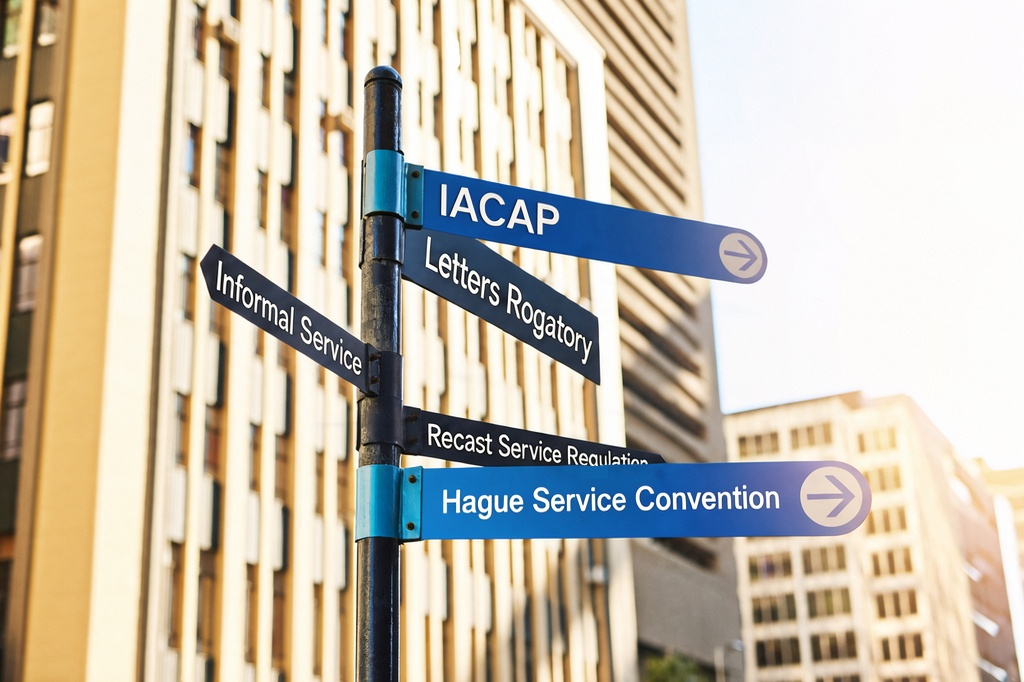
Portugal is a contracting party to the 1965 Hague Convention on the Service Abroad of Judicial and Extrajudicial Documents in Civil or Commercial Matters, commonly known as the Hague Service Convention.
The Convention establishes procedures for transmitting judicial and certain extrajudicial documents from one contracting country to another for service. Its principal channel involves sending a request to the designated Central Authority in the destination country.
For requests directed to Portugal, the designated Central Authority is the Directorate-General for the Administration of Justice (Direção-Geral da Administração da Justiça), operating under Portugal’s Ministry of Justice.
The Central Authority receives requests and arranges for service in accordance with the Convention and applicable Portuguese procedures. The Convention also provides for a certificate confirming whether service was completed. If service cannot be accomplished, the certificate records the reasons.
An important distinction is that the Hague Service Convention establishes a framework for the transmission and service of documents. It does not determine which country’s courts have jurisdiction over the underlying divorce, custody, or other family dispute. That question is governed by separate jurisdictional rules.
The Convention’s application must also be considered in light of its civil and commercial scope and the countries involved. It should not be assumed that every document connected with a family matter automatically falls within its coverage.
Portuguese Translation Requirements
Language is an important consideration when arranging service in Portugal.
For requests made through the Hague Service Convention, documents intended for service in Portugal must comply with the Convention’s language provisions and Portugal’s applicable requirements. Under Article 5, the destination country’s Central Authority may require documents to be written in or translated into its official language. Portugal’s published Central Authority information specifies Portuguese translations for documents submitted through its Hague Convention procedure.
This is particularly relevant when proceedings originate in English-speaking jurisdictions or countries where court documents are prepared in another language.
Depending on the case, the service package may contain an originating application, summons, supporting affidavits, exhibits, and other accompanying materials. Missing translations or incomplete documentation can result in requests for correction and additional administrative work.
Preparing the complete document package, including the required translations, before transmission helps reduce avoidable complications.
How the Central Authority Service Process Works
Under the Hague Service Convention, the Central Authority in the destination country receives a request from the competent authority or judicial officer in the country where the documents originate.
The request generally uses the Convention’s prescribed Model Form and includes the documents to be served. The Central Authority then serves the documents itself or arranges for service through an appropriate agency in accordance with the destination country’s procedures.
Article 5 of the Convention provides for service using a method prescribed by the destination country’s domestic law or, where permitted, a particular method requested by the applicant. A requested method cannot be used if it is incompatible with the law of the destination country.
Once service has been completed, Article 6 provides for a certificate recording relevant details, including the method, place, date, and person to whom the documents were delivered. If service is unsuccessful, the certificate should state the reasons.
For international family proceedings, this documentation is important because the originating court or the parties may need evidence demonstrating how and when the respondent was served.
Service Between Portugal and Other European Union Countries
International Service of Process in Portugal may follow a different framework when documents are transmitted between European Union Member States.
Regulation (EU) 2020/1784 establishes procedures for the service of judicial and extrajudicial documents in civil and commercial matters between Member States. It provides for designated transmitting and receiving agencies, prescribed forms, and other methods of transmission and service.
The Regulation has applied since 1 July 2022, replacing the earlier Regulation (EC) No. 1393/2007. Its decentralised IT system became the obligatory means of communication for covered transmissions from 1 May 2025, subject to the Regulation’s provisions and exceptions.
However, it is important to distinguish between family-law proceedings generally and documents that fall within the Regulation’s scope. Not every document connected with a divorce, child custody, or parental responsibility case automatically qualifies. The applicable framework depends on the nature of the document and the relevant legal provisions.
For legal professionals handling cases involving Portugal and another EU Member State, identifying the correct service procedure is an important preliminary consideration.
Common Challenges When Serving Family Law Documents in Portugal
Cross-border service can involve practical difficulties even when the applicable procedure has been identified.
1. Inaccurate or incomplete recipient information
An outdated residential address or incomplete identifying information can complicate service attempts. This is particularly relevant in family disputes where a spouse or parent may have moved to another country during the relationship or proceedings.
Providing the most current and complete address information available helps the receiving authorities or service personnel identify the intended recipient.
2. Missing translations or supporting documents
Documents submitted under the Hague Service Convention for service in Portugal must meet the applicable Portuguese translation requirements. Missing translations, summaries, or annexes may require correction before a request can proceed.
3. Confusion over the applicable international procedure
The procedure for serving documents in Portugal may differ depending on the country of origin and the nature of the legal matter. A request originating in another EU Member State may be governed by a different framework from one transmitted from a country outside the European Union.
Before arranging service in another country, it is important to identify the appropriate legal framework and understand the procedures that apply in the destination jurisdiction. For a broader discussion of these considerations, read our article, How to Choose the Right Route Before Documents Go Abroad.
4. Insufficient time allocated for international service
Cross-border service involves additional transmission and administrative stages. The time required can vary depending on the applicable procedure, the completeness of the request, the recipient’s location, and the circumstances of the service attempt.
Where proceedings involve court-imposed deadlines, international service should be considered early in the litigation timetable.
5. Inadequate proof of service
A record showing that documents were dispatched is not necessarily equivalent to the formal certificate or evidence required under the applicable procedure. Legal professionals should consider the type of proof needed by the originating court and ensure that the appropriate documentation is obtained.
Preparing Documents for International Service in Portugal
Careful preparation can help reduce avoidable delays when family law documents must be served in Portugal.
Before initiating an international service request, legal professionals commonly need to consider:
-
The originating jurisdiction: Identify where the proceedings were commenced and which international service framework applies.
-
The destination address: Confirm the respondent’s current and complete address in Portugal.
-
The documents involved: Identify the originating process, summons, notices, orders, and accompanying materials that must be served.
-
Translation requirements: Arrange Portuguese translations in accordance with the applicable procedure.
-
Request documentation: Check the required forms, copies, and supporting information.
-
Service evidence: Establish what certificate or other proof of service will be required by the originating court.
-
Time considerations: Allow for international transmission, administrative handling, and the possibility of unsuccessful service attempts.
These considerations are relevant whether the underlying matter concerns divorce, parental responsibilities, child maintenance, or another family-related proceeding.
The Importance of Coordinating International Service
Family law proceedings involving parties in different countries require coordination between the originating jurisdiction and the country where the respondent is located.
For attorneys and law firms, this means considering international service requirements at an early stage rather than treating overseas notification as a routine domestic mailing exercise.
The Hague Service Convention and applicable European Union procedures provide established frameworks for transmitting documents internationally. However, each request must still meet the requirements relevant to its country of origin, destination, and type of proceeding.
Accurate recipient information, complete documentation, appropriate translations, and reliable proof of service are important elements of an organised cross-border process.
Professional process servers play an important role in ensuring that legal documents are delivered accurately and that the details of service are properly documented. For further insight into their responsibilities and contribution to the legal process, explore The Importance of Process Servers.
International Service of Family Law Documents in Portugal
When divorce proceedings, parental responsibility disputes, child maintenance cases, or other family-related matters require documents to be served on an individual in Portugal, understanding the applicable international procedure is an essential part of coordinating the case.
Stellar Konsulting supports attorneys, law firms, and legal professionals with international service of process and cross-border document delivery. Whether documents originate in the United States or another jurisdiction, arranging service in the destination country requires attention to local requirements and the applicable international framework.
Please call Stellar Konsulting at the phone numbers listed below or email us at operations@stellarkonsulting.com for an obligation-free quote covering the timelines, options and costs for international service of process.
📞 EMEA: +44 (20) 38905643
📞 USA: +1 (213) 786 1161
📞 Asia: +92 313-780-6280
📞 UK: +44 (20) 38905643
📞 Australia, New Zealand and Far East Asia: +61 2 7259 7299
Serve smart, with Stellar Konsulting.