
A Practical Guide to Serving Legal Documents Across Borders
Legal disputes do not always remain within the borders of one country. A defendant may reside overseas, a witness may be located in another jurisdiction, or a business involved in litigation may operate internationally. When legal proceedings require documents to be delivered to someone in another country, international process serving becomes an important part of the legal process.
For lawyers, attorneys, solicitors, barristers, paralegals, corporate counsels, and private individuals, understanding how international service works can help avoid procedural complications and unnecessary delays.
Unlike domestic process serving, cross-border service involves additional considerations, including international agreements, foreign procedural laws, language requirements, and acceptable methods of delivery. Understanding these fundamentals is essential before arranging service in another jurisdiction.
1. What Is International Process Serving?
International process serving refers to the delivery of legal documents to individuals or entities located outside the country where legal proceedings have been initiated.
Its purpose is to provide formal notice of legal proceedings or other legal requirements to the intended recipient. Depending on the circumstances, documents may include:
-
Summonses and complaints
-
Statements of claim and other originating court documents
-
Divorce petitions and family court applications
-
Subpoenas and witness-related documents
-
Court orders and injunctions
-
Bankruptcy and insolvency notices
-
Other judicial and extrajudicial documents requiring formal service
For example, an attorney in the United States may need to serve a defendant residing in Germany. A solicitor in England may need to arrange service of divorce proceedings on someone living in Australia. Similarly, a corporation pursuing a commercial claim may need to serve legal documents on an overseas business partner.
In each situation, simply delivering documents to the recipient may not be sufficient. The service must comply with the applicable legal requirements governing the particular countries and proceedings.
2. Understanding the Hague Service Convention
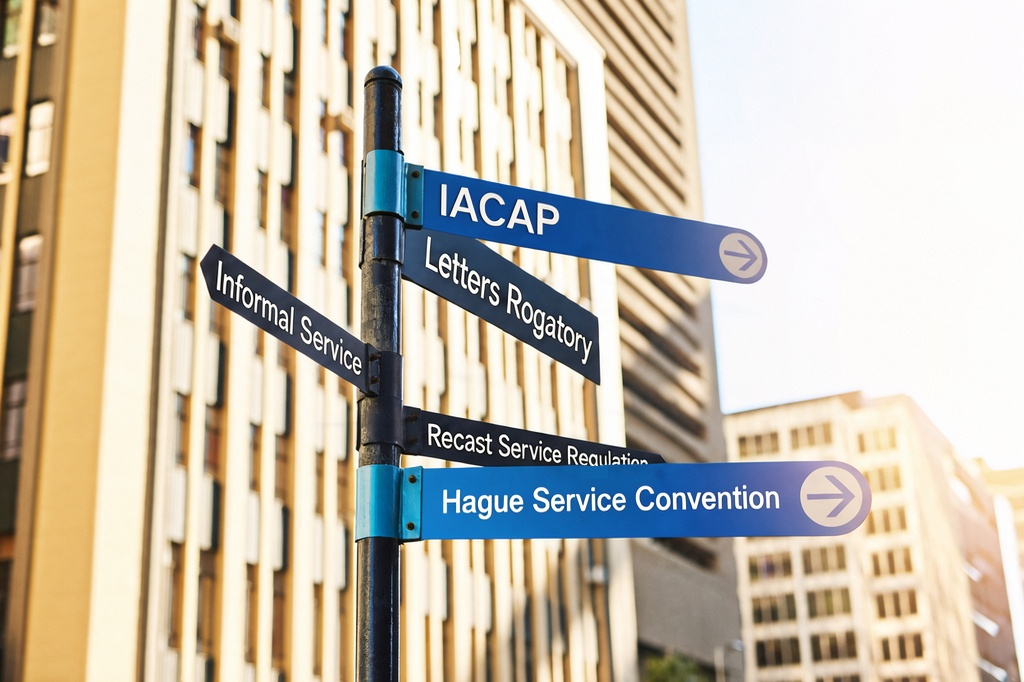
One of the most important international instruments governing cross-border service is the Hague Convention of 15 November 1965 on the Service Abroad of Judicial and Extrajudicial Documents in Civil or Commercial Matters, commonly known as the Hague Service Convention.
The Convention establishes procedures for transmitting certain judicial and extrajudicial documents from one contracting state to another for service in civil or commercial matters.
A central feature is the Central Authority system. Each contracting state designates an authority responsible for receiving incoming requests and arranging service in accordance with the Convention and its domestic law.
Under Article 5, the Central Authority may arrange service through a method prescribed by its internal law or through a particular method requested by the applicant, provided that the requested method is compatible with local law.
The Convention also provides for other channels in certain circumstances, including diplomatic or consular channels and postal channels, subject to the applicable provisions, declarations, and objections of the countries concerned.
An important point is that membership alone does not mean every method is automatically available. Some countries have made declarations or objections that affect how service may be carried out.
Before proceeding, legal professionals should verify whether both countries are parties to the Convention, whether the Convention applies to the particular matter, and what requirements the destination country has established.
3. What Happens When the Hague Convention Does Not Apply?
Not every country is a party to the Hague Service Convention. Furthermore, certain matters or circumstances may fall outside its scope.
When the Convention does not provide an applicable route, service may need to be arranged through other procedures recognized by the relevant jurisdictions.
One commonly used mechanism is Letters Rogatory.
Letters Rogatory are formal requests issued by a court in one country to a court or competent judicial authority in another country, seeking assistance with a judicial act. In international service matters, this may involve requesting that documents be served on a person within the receiving country’s jurisdiction.
Depending on the countries involved, the process may require:
-
Preparation and issuance of a formal judicial request.
-
Compliance with the requesting court’s requirements.
-
Translation of documents into the required language.
-
Authentication or legalization, where applicable.
-
Transmission through designated judicial or diplomatic channels.
-
Service by the receiving authority in accordance with local procedures.
-
Return of official documentation confirming the outcome.
Letters Rogatory can involve several authorities and may take considerable time. Requirements differ between countries, so the appropriate procedure should be established before documents are submitted.
Other methods may also be available under domestic legislation, applicable treaties, or court orders. However, a method permitted in one country should never be assumed to be acceptable in another.
4. Common Challenges in International Process Serving
Cross-border service involves practical and legal challenges that are not always encountered in domestic proceedings.
Different legal systems and procedural requirements
Countries have different rules governing who may serve legal documents, how service must be completed, and what constitutes valid proof. A method accepted in the originating jurisdiction may not be recognized in the destination country.
Language and translation requirements
Some jurisdictions require documents to be translated into an official language or another language understood by the recipient. Translation requirements may also apply to certificates, requests, and supporting documentation.
Locating the intended recipient
An outdated address or incomplete location information can complicate service. Identifying the correct recipient and verifying available address information can help reduce unsuccessful attempts.
Government processing times
Where service must pass through a Central Authority, court, ministry, or diplomatic channel, processing times may be affected by administrative procedures, workload, and local requirements.
Proof of service
Obtaining appropriate evidence is essential. Depending on the applicable procedure, this may take the form of a certificate, affidavit, return of service, or other official documentation. The requesting court’s requirements should be considered from the beginning.
Careful preparation and an understanding of local requirements can help address these challenges before they become significant obstacles.
5. Choosing the Right International Process Serving Approach
Selecting an appropriate service method requires more than identifying the country where the recipient lives. The nature of the document, the applicable international agreements, the destination country’s declarations, and the procedural rules of the originating court must all be considered.
Before initiating international service, consider the following:
-
Identify the destination jurisdiction. Confirm the recipient’s country and obtain the most accurate available address.
-
Determine the applicable legal framework. Establish whether the Hague Service Convention applies or whether another procedure is required.
-
Check local service requirements. Determine whether translations, specific forms, authentication, or other supporting documents are necessary.
-
Confirm the acceptable method. Verify that the proposed method is permitted under the applicable international and domestic rules.
-
Establish the expected documentation. Identify what proof of service the requesting court will require.
-
Allow sufficient time. Account for translations, government processing, attempted delivery, and potential additional requirements.
Working with professionals experienced in international process serving can help coordinate these requirements and reduce avoidable procedural errors.
International Process Serving: Why Professional Coordination Matters
International process serving is an important component of cross-border litigation. Whether a law firm is pursuing a commercial claim, a solicitor is handling international family proceedings, corporate counsel is addressing a dispute involving an overseas party, or a private individual needs court documents delivered abroad, the correct service procedure matters.
Each jurisdiction presents its own requirements. Understanding the applicable international framework, selecting an appropriate service route, and obtaining reliable proof of service are essential considerations throughout the process.
Stellar Konsulting provides international process serving and cross-border litigation support, assisting attorneys, lawyers, solicitors, barristers, paralegals, corporate counsels, law firms, businesses, and private individuals with legal document service worldwide.
From Hague Service Convention requests and Letters Rogatory to other legally appropriate service arrangements, Stellar Konsulting helps coordinate the requirements involved in serving documents across international borders.
Please call Stellar Konsulting at the phone numbers listed below or email us at operations@stellarkonsulting.com for an obligation-free quote covering the timelines, options and costs for international service of process.
📞 EMEA: +44 (20) 38905643
📞 USA: +1 (213) 786 1161
📞 Asia: +92 313-780-6280
📞 UK: +44 (20) 38905643
📞 Australia, New Zealand and Far East Asia: +61 2 7259 7299