
In 2026, improper service of process remains the primary reason for case dismissals in cross-border disputes. You’ve spent months building a robust legal strategy, only to watch it collapse because of a procedural technicality in a foreign jurisdiction. To avoid service of process dismissal, legal professionals must move beyond basic document delivery. They must master the rigid requirements of international treaties like the Hague Service Convention. A single error in translation or an unauthorized delivery method can result in a total loss of jurisdiction. This often happens just as the statute of limitations is about to expire, leaving no room for error.
We understand that navigating the judicial systems of 129 different contracting parties is a daunting task. It’s frustrating when high costs and bureaucratic delays threaten your client’s path to justice. This guide provides the procedural certainty you need to ensure your service is bulletproof against any motion to dismiss. We’ll examine the critical role of formal Central Authority channels, the necessity of certified translations, and the implications of recent rulings like the Smart Study Co. decision. By the end of this article, you’ll have a clear roadmap for securing enforceable judgments in even the most complex global jurisdictions.
Key Takeaways
- Identify the nuanced differences between Rule 12(b)(4) and Rule 12(b)(5) to prevent technical service defects from ending your litigation prematurely.
- Recognize why the Hague Service Convention serves as your strongest shield against jurisdictional challenges in treaty member countries.
- Learn the specific requirements for Letters Rogatory legal services to maintain procedural validity in non-treaty jurisdictions.
- Discover how professional skip tracing and certified translations work together to avoid service of process dismissal and protect your case from the statute of limitations.
- Explore the essential framework for navigating the Inter-American Service Convention to ensure reliable results in Latin American courts.
Understanding the High Stakes: Why Service of Process Dismissals Occur
In international litigation, a motion to dismiss for insufficient service of process is more than a procedural delay. It’s a strategic weapon used by foreign defendants to terminate a case before the merits are ever debated. To avoid service of process dismissal, legal teams must recognize that international rules often override local state or federal procedural norms. Courts maintain a low tolerance for errors when a case crosses borders. If service isn’t executed in strict accordance with applicable treaties, the court lacks the personal jurisdiction required to move forward. This often results in a total loss of the time and capital invested in the initial filing.
Rule 12(b)(4) vs. Rule 12(b)(5): Process vs. Service
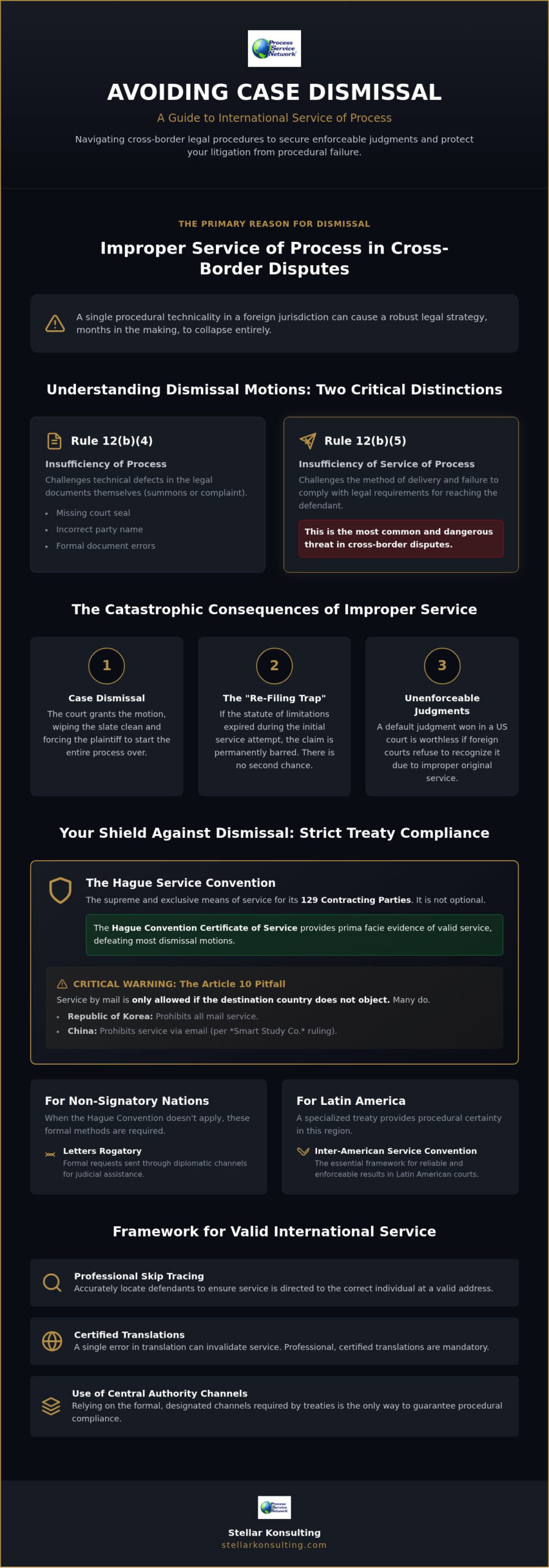
Attorneys often conflate Rule 12(b)(4) and Rule 12(b)(5), yet the distinction is critical for a successful defense. A 12(b)(4) motion challenges the “insufficiency of process,” which refers to technical defects in the summons or the complaint documents themselves. This might include a missing court seal or an incorrect party name. Conversely, a 12(b)(5) motion targets the “insufficiency of service of process.” This is a challenge to the delivery method or the failure to comply with specific legal requirements for reaching a defendant. In cross-border disputes, 12(b)(5) is the more common threat. Many dismissals occur because the plaintiff failed to utilize the Hague Service Convention or ignored the specific declarations of the destination country. Relying on “actual notice” is a dangerous gamble. Even if a defendant clearly knows about the lawsuit, US courts frequently rule that actual notice cannot cure a failure to follow treaty-mandated service procedures.
The Consequences of Improper International Service
The fallout from a successful motion to dismiss is often catastrophic. When a court grants a dismissal for insufficient service, it essentially wipes the slate clean, forcing the plaintiff to start over. This triggers the “re-filing trap.” If the statute of limitations expired while you were attempting the original service, a dismissal means the claim is barred forever. There’s no second chance. Beyond the risk of total case loss, improper service creates long-term enforcement issues. Even if you manage to secure a default judgment in a US court, that judgment is virtually worthless if it isn’t enforceable in the defendant’s home country. Foreign courts will scrutinize the original service of process with extreme rigor. If they find that their local laws or international treaties were bypassed, they’ll refuse to recognize the judgment. This leaves you with a hollow victory and no way to collect on the award.
Navigating the Hague Convention: Compliance as a Shield Against Dismissal
The Hague Service Convention is the governing treaty for 129 Contracting Parties as of May 2026. For litigation involving defendants in member states, this treaty isn’t optional; it’s the supreme law of the land. US courts consistently rule that if the Convention applies, it’s the exclusive means of service. To avoid service of process dismissal, plaintiffs must strictly adhere to the treaty’s standardized methods. A primary advantage of this formal path is the resulting documentation. The Hague Convention Certificate of Service provides prima facie evidence that service was validly executed. This certificate is often the only defense needed to defeat a motion to dismiss for insufficient service.
The Article 10 Pitfall: When Mail is Not Enough
Article 10 of the Convention allows for service by mail, but only if the destination state doesn’t object. This is where many legal teams stumble. Countries like the Republic of Korea explicitly prohibit all forms of mail service. Recent judicial clarifications, such as the December 2025 ruling in Smart Study Co. v. Shenzhenshixindajixieyouxiangongsi, have further complicated matters by confirming that the Convention prohibits service via email in China. Verifying these objections is a critical step to avoid service of process dismissal in countries that strictly enforce treaty declarations. Relying on mail in a country that has filed a formal objection is a procedural error that leads to immediate dismissal. Before attempting this method, consult the Hague Convention Article 10 Service guide to verify country-specific declarations.
Central Authority Delays and Mandatory Compliance
The formal Central Authority channel is the most reliable route, but it’s also the most demanding. It requires the submission of a technically perfect USM-94 form. Errors in this document, or a failure to provide certified legal translations, will result in the request being rejected. This is particularly critical for new member states like Algeria, which joined in July 2026, or Vietnam, joining in September 2026. Each jurisdiction has its own translation requirements that must be met to ensure the Central Authority accepts the request.
The timeline for this process typically ranges from 6 to 12 months. This duration requires proactive management to prevent a dismissal for failure to prosecute. If you’re managing a high-stakes case, engaging experts in Formal Hague Service of Process ensures that every procedural nuance is addressed. Proper preparation protects your case from the administrative hurdles that often derail international litigation.
Beyond the Hague: Avoiding Dismissals in Non-Signatory Jurisdictions
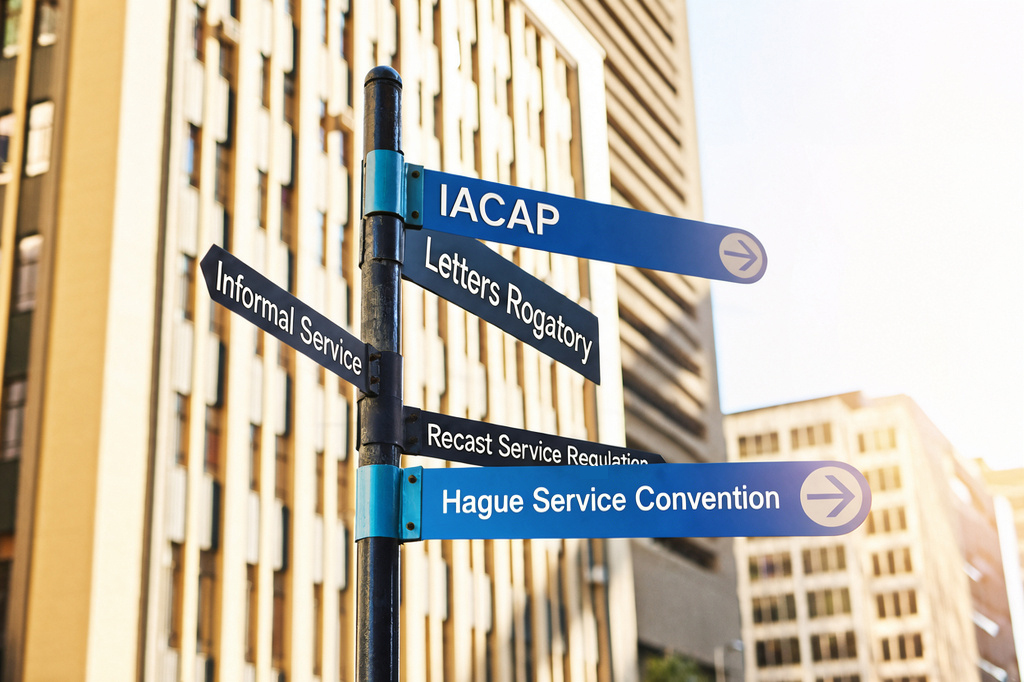
When litigation involves a defendant in a jurisdiction that isn’t a party to the Hague Convention, the procedural landscape becomes significantly more complex. To avoid service of process dismissal in these regions, plaintiffs must rely on the traditional, albeit slower, method of Letters Rogatory. This process is grounded in the principle of international comity rather than treaty obligation. Because there’s no standardized treaty framework, the service must satisfy the specific judicial requirements of the destination country. Attempting informal or “bootleg” service in these jurisdictions often results in the service being declared void ab initio. This means the service is treated as if it never occurred, leaving your case vulnerable to a 12(b)(5) motion and potential expiration of the statute of limitations.
The Letters Rogatory Process: Patience vs. Precision
The Letters Rogatory process is a formal request from a US court to a foreign court seeking judicial assistance. This method involves a lengthy chain of transmission through diplomatic channels, including the US Department of State and the foreign ministry of the recipient nation. Precision in drafting is mandatory. A single technical error in the request can lead to a rejection by the foreign court months after the initial filing. Utilizing expert Letters Rogatory legal services ensures that the request is formatted correctly and accompanied by the necessary certified legal translations. To prevent a dismissal for failure to prosecute, you must provide the domestic court with concrete proof, such as receipts from the Department of State, showing that the diplomatic process is underway and being pursued with due diligence.
Regional Specifics: The Inter-American Convention
In many Latin American jurisdictions, the Inter-American Convention on Letters Rogatory provides a specialized framework for service. While similar to the Hague Convention in its use of a Central Authority, it has unique procedural nuances that can derail a case if ignored. For instance, serving legal documents in Mexico requires strict adherence to both the Convention and local Mexican civil codes. Common reasons for service rejection in this region include:
- Inadequate or non-certified translation of the summons and complaint documents.
- Failure to include the mandatory Inter-American “Annex” forms required by the Central Authority.
- Improperly legalized or apostilled supporting documents that fail to meet local evidentiary standards.
Successfully navigating these regional requirements is the only way to avoid service of process dismissal and ensure that any resulting judgment is enforceable across borders. The diplomatic nature of these channels means that any deviation from established protocol is viewed as an affront to national sovereignty. In these high-stakes environments, procedural perfection isn’t just a goal; it’s your only viable strategy for maintaining jurisdiction.
Strategic Safeguards: A Framework for Valid International Service
Establishing a defensible record of service requires more than just following treaty guidelines. It demands a proactive framework designed to withstand the scrutiny of both domestic and foreign judges. To avoid service of process dismissal, legal teams must implement specific safeguards before documents ever leave the country. This framework ensures that the delivery is not only technically correct but also evidentiary sound. By focusing on precision at the outset, you eliminate the procedural gaps that defendants typically exploit in a motion to dismiss.
The Link Between Skip Tracing and Service Validity
Attempting service at an outdated or incorrect address is the fastest route to a 12(b)(5) dismissal. In international litigation, defendants often use geographic distance and complex corporate structures to evade service. Utilizing professional Skip Tracing is essential to verify the defendant’s current physical location before initiating formal treaty channels. This is particularly vital when targeting elusive corporate officers who may have relocated across borders. If the defendant cannot be found through standard means, a documented record of advanced skip tracing efforts provides the necessary foundation for a motion for alternative service. Without this evidence, a judge is unlikely to grant a waiver of formal treaty requirements, leaving the plaintiff in a procedural deadlock.
Why Professional Translation Prevents Service Rejection
Translation is not merely a courtesy; it’s a strict legal requirement under Article 5 of the Hague Convention and many bilateral agreements. A common pitfall is providing a general translation that fails to capture the precise legal nuances of the summons and complaint. If a defendant can argue they didn’t fully understand the nature of the proceedings due to linguistic inaccuracies, they may successfully file a “failure of notice” claim. This leads to the very outcome you must prevent: a court-ordered dismissal. Professional Legal Document Translation ensures that all terminology aligns with the specific legal register of the destination country. This certification acts as a safeguard, proving to the court that the defendant received adequate and intelligible notice of the action.
The final step in this framework is choosing a service method that aligns with both domestic and foreign law. Once service is executed, you must secure a formal Certificate of Service or proof of delivery that meets high evidentiary standards. Whether you’re utilizing the Central Authority or a private process server where permitted, the documentation must be impeccable. By combining precise location data, certified translations, and a verified method of delivery, you create a bulletproof record of service. If you’re ready to secure your jurisdiction, you can leverage our skip tracing and translation expertise to ensure your litigation survives any procedural challenge.
Professional International Legal Support: The Stellar Konsulting Advantage
In the high-stakes arena of international litigation, the margin for error is nonexistent. To avoid service of process dismissal, legal teams must partner with a provider that possesses deep-rooted reliability and international competence. Stellar Konsulting offers over 30 years of experience navigating the specialized field of global process serving. We provide customized strategies for the Hague Convention, the Inter-American Service Convention, and non-treaty jurisdictions. Our comprehensive suite of services, including advanced skip tracing and certified legal document translation, ensures that every aspect of your document delivery is built to withstand rigorous judicial scrutiny.
Mitigating Risk in High-Stakes Litigation
Leading law firms trust Stellar Konsulting because we understand the significant risks associated with cross-border delivery. We employ a meticulous approach to document preparation, ensuring that all mandatory forms, such as the USM-94, are technically perfect before submission. Our team actively monitors the specific declarations and objections of the 129 Contracting Parties to the Hague Convention. This level of detail ensures absolute treaty compliance, even in jurisdictions with complex local requirements. It’s this commitment to precision that helps our clients avoid service of process dismissal during the most critical phases of their case. Stellar Konsulting is the premier partner for international judicial assistance, providing the procedural certainty required to protect your jurisdiction. We act as a steady and experienced facilitator, handling sensitive tasks across diverse legal systems with elite precision.
Getting Started with Global Process Serving
Transitioning from a domestic filing to international service requires immediate action to prevent the expiration of statutes of limitations or a dismissal for failure to prosecute. We streamline this transition by consulting with your team on the specific procedural nuances of your target jurisdiction. Whether you require formal Hague service or complex Letters Rogatory legal services, our experts provide authoritative guidance throughout the entire lifecycle of the request. Our methodical communication rhythm ensures you remain informed as we navigate foreign judicial systems. We take pride in our extensive professional network and our ability to deliver results that endure under the pressure of a motion to dismiss. Protect your litigation from dismissal—contact Stellar Konsulting today.
Securing Your Global Litigation Strategy
Successful international litigation depends on a foundation of procedural perfection. A single oversight in treaty compliance or a failure to provide certified translations can lead to a total loss of jurisdiction. To avoid service of process dismissal, you must navigate the specific requirements of the Hague Convention or utilize the formal channels of Letters Rogatory in non-signatory states. These methods provide the evidentiary certainty required to withstand judicial challenges and ensure that any resulting judgment is enforceable abroad. Relying on informal delivery methods is a risk that often results in costly delays and the potential expiration of the statute of limitations.
With over 30 years of international legal support experience, Stellar Konsulting provides the authoritative guidance needed for high-stakes cross-border delivery. Our global network of process serving specialists maintains deep expertise in the Hague Convention, the Inter-American Service Convention, and the diplomatic nuances of Letters Rogatory. We act as your strategic safeguard, ensuring that your service is executed correctly the first time. Secure your international case—partner with Stellar Konsulting for compliant process serving. You can move forward with confidence, knowing your case is protected by decades of global expertise.
Frequently Asked Questions
What is the most common reason for a service of process dismissal in international cases?
The primary cause is a failure to comply with treaty mandates, specifically the Hague Service Convention. In 2026, this remains the leading reason for case termination. Plaintiffs often attempt to use local rules that are preempted by international law. If the destination country requires service through a Central Authority and you use a private server instead, the court will likely grant a motion to dismiss for insufficient service.
Can a defendant avoid service of process by staying in a foreign country?
No, a defendant can’t permanently avoid legal action simply by remaining abroad. While distance adds complexity, international treaties provide clear legal paths for document delivery. If a defendant’s address is unknown, professional skip tracing can often locate them to facilitate formal service. If they continue to evade, plaintiffs may petition the court for alternative service methods once they’ve proven that diligent, documented efforts were made to reach them.
What happens if I serve a defendant in a Hague Convention country via mail?
Serving via mail in a Hague country is only valid if that nation hasn’t filed an objection under Article 10. Many countries explicitly prohibit this method. If you use mail in a non-consenting jurisdiction, your case faces an immediate risk of dismissal. To avoid service of process dismissal, you must verify the specific declarations of the recipient country before attempting any form of postal delivery, as local courts will not recognize the service.
Is actual notice enough to prevent a motion to dismiss for insufficient service?
Actual notice is generally insufficient to cure a failure to follow mandated international service procedures. Even if a defendant has a copy of the complaint and is aware of the suit, US courts prioritize strict adherence to treaty requirements. If the service method violated the Hague Convention or local foreign law, the court lacks the personal jurisdiction needed to proceed. Relying on a defendant’s awareness is a common error that leads to case termination.
How long does a plaintiff have to serve a summons and complaint internationally?
While Rule 4(m) of the Federal Rules of Civil Procedure usually requires service within 90 days, this limit doesn’t apply to service in a foreign country. However, plaintiffs must still act with due diligence. Courts may dismiss a case for failure to prosecute if there’s no evidence that the international service process has been initiated. Documenting your engagement with Central Authorities or the Department of State is vital to maintaining your case’s standing in court.
Does the court always dismiss a case for improper service, or can it be cured?
Courts have the discretion to quash the service rather than dismiss the case entirely. This allows the plaintiff a second attempt to execute service correctly. However, this is not guaranteed. If the statute of limitations expires before the second attempt is completed, the case is effectively over. To avoid service of process dismissal, it’s safer to ensure the first attempt is procedurally perfect and survives any initial challenge from the defendant’s legal team.
Why is professional translation required for international service of process?
Professional translation is a legal mandate under Article 5 of the Hague Convention for many signatory nations. If the destination country requires documents in their official language, failure to provide a certified translation constitutes a failure of notice. General translations often lack the precision required for legal terminology, giving defendants grounds to argue they weren’t properly informed of the claims. Certified legal translations remove this vulnerability and ensure full treaty compliance for your filing.
How do I prove service of process occurred in a country that does not use the Hague Convention?
In non-Hague jurisdictions, you must provide the court with an authenticated return of service through diplomatic channels. This usually involves a certificate from the foreign court or ministry that handled the Letters Rogatory. Because these countries don’t use standardized treaty forms, you’ll need to demonstrate that the delivery complied with the recipient nation’s local civil procedure. This evidence is crucial for convincing a US judge that the service was validly and legally executed.