
A single procedural oversight in cross-border service doesn’t just delay your case; it can render a hard-won judgment completely unenforceable. For many practitioners, the technical choice between letters rogatory vs hague convention requirements feels like a strategic minefield where one misstep leads to a swift dismissal. You’re likely already aware that the intersection of domestic civil procedure and international treaties is fraught with technicalities that vary significantly by jurisdiction. It’s a frustrating reality that months of effort can be undone by a minor translation error or an incorrectly formatted request.
This article provides the professional clarity needed to avoid these costly setbacks. You’ll learn the critical procedural errors that lead to service rejection and how to ensure your international legal documents are served with absolute jurisdictional validity. We’ll examine the specific nuances of various service methods, the expanding scope of global treaties, and the logistical realities of diplomatic channels. By understanding these common pitfalls, you can streamline your timelines and secure a service of process that stands up to the most rigorous judicial scrutiny.
Key Takeaways
- Identify the critical procedural differences between letters rogatory vs hague convention protocols to select the most efficient and legally sound service method for your specific jurisdiction.
- Avoid common Hague Convention errors by verifying current signatory status and correctly identifying the designated Central Authority to prevent immediate document rejection.
- Discover why complete legal document translation is mandatory for jurisdictional validity and how relying on summary translations can lead to a case dismissal.
- Learn to navigate the strict diplomatic sequences required for letters rogatory to avoid the common logistical bottlenecks that often delay international litigation for years.
- Establish a secure foundation for enforceable foreign judgments through proactive jurisdictional analysis and professional skip tracing before initiating the formal service process.
The High Stakes of International Service of Process
International service of process is the formal notification of legal action to a party located in another country. It’s a procedural bridge that connects U.S. litigation to foreign defendants. While domestic attorneys are accustomed to the flexibility of Rule 4, these best practices often fail internationally because foreign jurisdictions view service as a sovereign act. If you ignore local laws or treaty mandates, you risk more than just a delay. The ultimate danger is obtaining a judgment that you cannot enforce abroad. Most service failures stem from two primary triggers:
- Treaty Non-Compliance: Attempting to use methods not authorized by the applicable convention.
- Local Law Violations: Violating the internal laws of the destination country, which can be seen as an affront to their sovereignty.
The Consequences of Improper Service
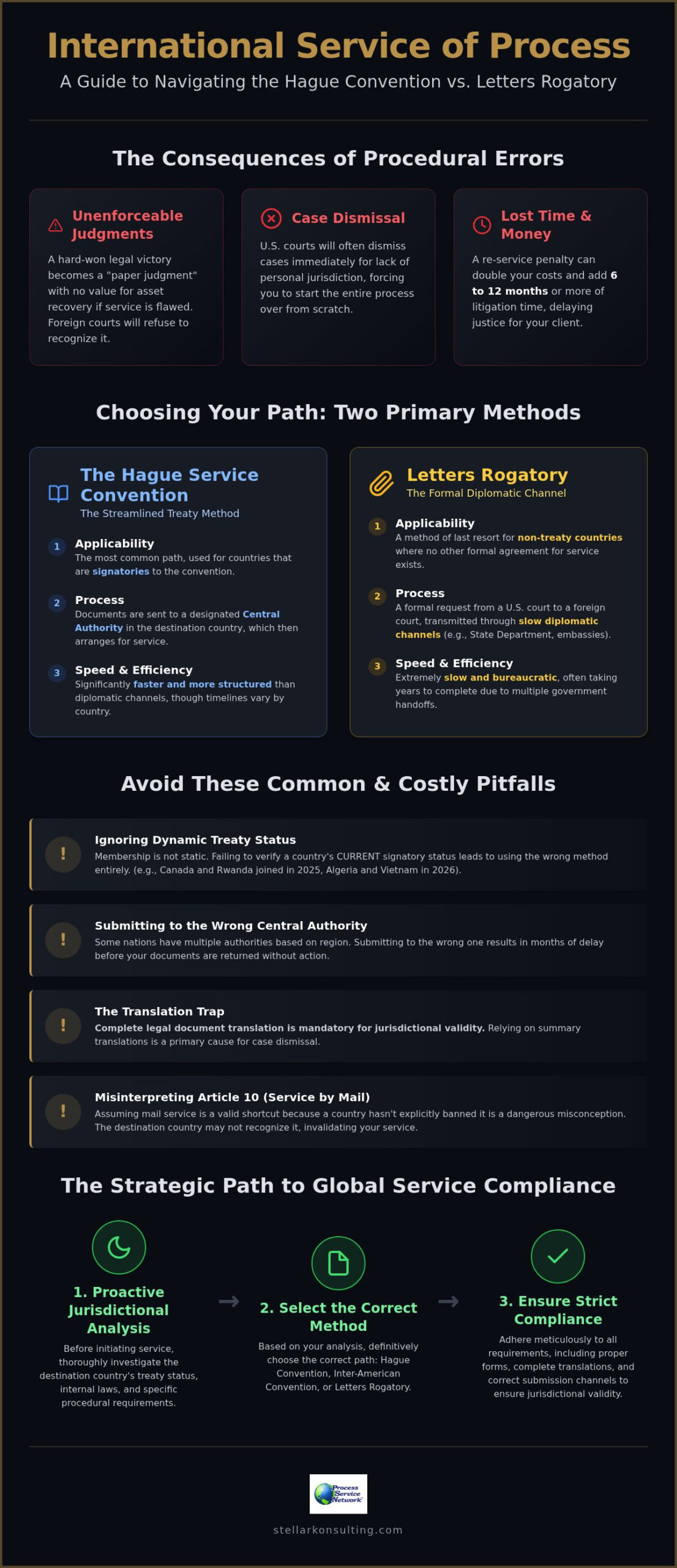
A failure to execute service correctly often results in an immediate case dismissal by the U.S. court for lack of personal jurisdiction. Even if the court allows you to proceed, the re-service penalty is severe. You’ll likely double your costs and lose six to twelve months of litigation time. Beyond the U.S. courtroom, the stakes are even higher. If a service error occurs during the initial stages, a foreign court will almost certainly refuse to recognize or enforce the resulting U.S. judgment within its borders. This renders your legal victory a “paper judgment” with no practical value for asset recovery. For those who successfully navigate these hurdles to secure a judgment, Cornerstone Real Estate Investment Services offers strategic options for reinvesting recovered funds through tax-deferred 1031 exchanges.
Due Process vs. International Comity
Navigating this field requires balancing U.S. constitutional due process with the sovereignty of foreign nations, a principle known as international comity. Many practitioners make the mistake of prioritizing speed over procedural validity. While a private process server might be faster, if the destination country requires a formal judicial channel, that speed becomes a liability. In the debate of letters rogatory vs hague convention protocols, the choice depends entirely on the treaty status of the destination nation. There are three primary pathways for service:
- The Hague Service Convention, which is the most common and streamlined method.
- The Inter-American Service Convention, typically used for specific countries in Latin America.
- Letters Rogatory, which serve as the method of last resort for non-treaty countries.
Selecting the wrong path doesn’t just complicate the case. It can permanently block your path to recovery and expose your client to unnecessary risks. Understanding these high stakes is the first step toward ensuring your international legal documents are served with absolute jurisdictional validity.
Hague Convention Pitfalls: Misinterpreting Treaty Requirements
While the Hague Service Convention provides a structured framework, its application is far from uniform. Many practitioners assume that because a country is a signatory, the process is automated. This complacency often leads to the first major mistake: failing to verify the current signatory status. Membership is dynamic. For instance, Canada and Rwanda joined in 2025, followed by Algeria and Vietnam in 2026. If you misidentify the treaty status, you may incorrectly apply the protocols of letters rogatory vs hague convention service, leading to immediate rejection by foreign officials.
Even when treaty status is confirmed, identifying the correct Central Authority is a common stumbling block. Some nations have multiple authorities based on regional or provincial jurisdictions. Submitting to the wrong office doesn’t just cause a delay; it often results in the documents being returned without action after months of waiting. Additionally, using outdated Model Forms or failing to account for specific country reservations can invalidate the entire effort. Many jurisdictions have updated their requirements for electronic submission or specific seal placements that, if ignored, trigger a formal rejection.
The Danger of Article 10 Service by Mail
A frequent error involves Article 10, which discusses service by postal channels. Many attorneys believe that if a country doesn’t explicitly ban mail service, it’s a valid shortcut. This is a dangerous misconception. While a U.S. judge might find mail service sufficient under domestic due process, the destination country may view it as a violation of their sovereignty. You may end up with a service that’s technically valid in the U.S. but completely void in the destination country, making future enforcement impossible. For a technical analysis of these treaty articles, consult The Definitive Guide to Hague Convention Service of Process.
Inter-American Service Convention Nuances
When serving documents in Central and South America, the Inter-American Service Convention often takes precedence. A common error is attempting to use Hague forms for these jurisdictions. This convention requires a distinct set of forms, specifically Annex A, and follows a different transmission path through authority channels. To ensure compliance, follow this checklist:
- Confirm the destination country is a member of the Inter-American Convention rather than the Hague.
- Prepare the mandatory three-part form set in the required language of the destination state.
- Ensure the certificate of execution is properly formatted for the specific foreign court’s requirements.
If these technicalities seem overwhelming, engaging a partner for formal Hague service of process ensures that every reservation and local requirement is met with precision.
The Translation Trap: How Language Barriers Derail Litigation
Language is not merely a tool for communication; it’s a jurisdictional requirement that determines the validity of your service. A recurring misconception in international litigation is that a summary translation of legal documents suffices for formal notification. Central Authorities almost universally reject requests that don’t include a complete, word-for-word translation of the entire Summons and Complaint. If you only translate the cover sheet or a summary, you’re handing the defendant a “lack of notice” defense that can lead to an immediate case dismissal.
Precision in legal terminology is non-negotiable. A single mistranslated term, such as confusing “notice” with “service,” can provide grounds for a defendant to challenge the court’s jurisdiction. This technical vulnerability can derail months of litigation and force a costly restart of the entire process. Whether you are weighing the procedural differences of letters rogatory vs hague convention requests, professional translation is the only way to ensure Central Authority acceptance and protect your case from future challenges.
Certified vs. Uncertified Translations
Certified translations carry an official statement of accuracy and the translator’s credentials, which is a mandatory requirement in many jurisdictions. Central Authorities in nations such as Germany or China are notorious for rejecting uncertified work without providing an opportunity for correction. Documents submitted without professional legal translation face a high frequency of rejection by foreign judicial officers. This triggers a complete restart of the service timeline and significantly increases your overall litigation costs.
Local Language Dialects and Jurisdiction
Regional variations in language also create procedural hurdles. It’s a mistake to use a generic Spanish translation for a case in Mexico if the translator used terminology specific to Spain. These nuances affect how a foreign court perceives the adequacy of the notice provided to the defendant. To understand how these regional variations impact your strategy, refer to our guide on Serving Legal Documents in Mexico: An Authoritative Procedural Guide. Ensuring the translation aligns with the defendant’s native dialect is essential for meeting the due process standards required for an enforceable foreign judgment.
Identifying the correct dialect often requires professional skip tracing to confirm the defendant’s specific location and cultural background before the translation process begins. When comparing the requirements of letters rogatory vs hague convention service, remember that the translation burden remains equally high for both. While the Hague Convention might offer a more streamlined transmission, the destination country’s right to receive documents in their official language is a sovereign prerogative that U.S. courts must respect. Investing in high-quality legal translation at the outset is the most effective way to safeguard your case against dismissal for improper service.
Methodological Errors: Letters Rogatory vs. Hague Convention
Selecting the wrong methodology can be a fatal error for your litigation. While informal service might appear efficient, it often fails to provide the necessary foundation for a future Application for Default Judgment. In many jurisdictions, using a private agent to hand-deliver documents is not just a procedural mistake; it’s a criminal offense. Countries that view service as a strictly judicial act see private service as an infringement on their sovereignty. This highlights the critical need to distinguish between letters rogatory vs hague convention requirements before initiating any contact with a foreign defendant.
Letters Rogatory remain the method of last resort when the destination country is not a signatory to a relevant treaty. The process is slow and technically demanding. You must follow a strict diplomatic channel sequence that moves from the originating U.S. court to the Department of State, and finally to the foreign embassy or ministry. Any break in this chain or an improperly drafted Request for International Judicial Assistance will result in the documents being returned without action. This request must be drafted with precise language that mirrors the destination court’s own procedural expectations, as generic templates often fail to address specific local legal standards.
When to Use Letters Rogatory
These requests are essential for non-Hague countries where diplomatic channels are the only legally recognized route. When comparing the timelines of letters rogatory vs hague convention service, you’ll need to budget significant time for the former, as execution often takes a year or more due to the layers of government bureaucracy involved. A common technical error occurs at the foreign embassy level, where missing administrative fees or incorrect document counts cause immediate rejections. Ensuring every seal and certification is in place is the only way to navigate this complex path successfully.
Informal Service: When Fast Becomes Fatal
Informal Service of Process is sometimes permissible in jurisdictions like the United Kingdom or parts of Canada. It’s faster than formal treaty methods, but it carries inherent risks. While it may satisfy U.S. due process for initial notice, it often lacks the judicial stamp of approval required for foreign enforcement or default judgments. Stellar Konsulting recommends a belt and suspenders approach. This involves using informal service for immediate speed while simultaneously initiating formal service to ensure the final judgment is ironclad.
If you are navigating these complex procedural choices, secure your case with expert Letters Rogatory assistance.
Ensuring Compliance: The Strategic Path to Global Service
Success in international litigation begins long before documents reach a foreign central authority. It starts with a comprehensive Jurisdictional Analysis. This analysis determines which treaties are in force and identifies any specific reservations the destination country has filed. Without this preliminary step, you’re effectively guessing which procedural rules apply. Choosing between letters rogatory vs hague convention protocols requires a deep understanding of the destination’s legal landscape and the specific requirements of the local judiciary.
The Value of Expert Skip Tracing
International skip tracing is the essential first step for any cross-border case. It’s significantly more complex than domestic searches; while you can learn more about Secretary of State Directory to verify U.S. business entities, international cases cannot rely on standard credit headers or U.S. postal records. Expert skip tracing identifies the defendant’s precise location and legal status, which is vital for choosing the correct service method. If you attempt service at an outdated address, the resulting null service attempt wastes months of litigation time. Professional skip tracing acts as a critical cost-saving measure, ensuring your budget is spent on valid actions that lead to a successful notification.
Managing relations with a foreign Central Authority is a nuanced task that requires local expertise. These offices often have specific, unwritten preferences for document binding, seal placement, and even the type of ink used on signatures. An expert process serving company acts as a global facilitator, navigating these bureaucratic preferences to prevent administrative rejections. Before submitting your documents, verify your strategy against this final compliance checklist:
- Comprehensive Translation: Ensure every page of the summons and complaint is professionally translated and certified.
- Treaty Compliance: Verify the specific method aligns with both U.S. due process and the destination country’s sovereignty.
- Proof of Service: Secure a certificate of service that meets the exact standard required for a U.S. court to enter an enforceable judgment.
Why Attorneys Partner with Stellar Konsulting
With over 30 years of experience, Stellar Konsulting provides a compliance-first approach to international process serving. We manage the entire lifecycle of the service request, from the initial skip trace and professional legal translation to the final delivery via formal or informal channels. Our methodology ensures that every document meets the strict Certificate of Service standards required by both domestic and foreign courts. Having a single point of contact for these complex tasks reduces the risk of communication gaps and procedural errors. Consult with our international process experts to secure your service of process today.
Securing Your Global Jurisdictional Foundation
Navigating the technicalities of international service requires a methodical approach that prioritizes treaty compliance over procedural speed. The strategic choice between letters rogatory vs hague convention protocols is only the first step in a complex series of requirements. Successful notification depends on precise jurisdictional analysis, certified legal translations, and an adherence to the sovereign laws of the destination country. Overlooking even a minor detail in the transmission chain can lead to a costly case dismissal or an unenforceable paper judgment.
With over 30 years of international legal support experience, Stellar Konsulting provides the authoritative guidance needed to manage these high-stakes tasks. Our global network of process servers specializes in the nuances of the Hague and Inter-American Conventions, ensuring your documents meet the highest standards of validity. We act as your steady partner, handling the procedural complexities so you can focus on the core of your litigation. Secure Your International Litigation with Professional Process Serving and move forward with the confidence that your service is ironclad.
Frequently Asked Questions
What is the most common reason for a Hague Convention service request rejection?
The most frequent reason for rejection is the failure to provide a complete, certified translation of the entire legal package into the destination country’s official language. Central Authorities often return requests without action if only the summary is translated. Another common cause is submitting the request to the wrong regional authority in countries with decentralized systems. Precision in these administrative details is essential for avoiding months of unnecessary delay.
Can I serve a foreign defendant by mail under the Hague Convention?
You can only serve a defendant by mail if the destination country hasn’t filed a specific objection to Article 10 of the Convention. While some nations allow postal service, many view it as an infringement on their judicial sovereignty. Even if a U.S. court accepts mail service, the resulting judgment might be impossible to enforce in the defendant’s home jurisdiction. It’s often safer to use formal channels to ensure long-term validity.
How long does international service of process typically take?
The timeline varies significantly based on the method and the destination country. Standard Hague Convention service typically requires between 90 and 180 days for completion. In contrast, when navigating the technical choice of letters rogatory vs hague convention protocols, the letters rogatory process often takes a year or more. This extended timeframe is due to the multiple layers of diplomatic channels and foreign ministry approvals required for non-treaty requests.
What happens if I serve the wrong person in a foreign country?
Serving the wrong individual renders the service void and can lead to an immediate dismissal of your case for lack of jurisdiction. This error necessitates a complete restart of the service process, doubling your costs and litigation timeline. To prevent this, professional skip tracing should be conducted before filing. Verifying the defendant’s identity and current location ensures that the formal service attempt is directed at the correct party from the outset.
Do I really need to translate the entire legal package for international service?
Yes, most jurisdictions require a word-for-word translation of the entire Summons and Complaint, not just the primary notice. Providing a partial translation is a common mistake that leads to immediate rejection by the Central Authority. This requirement ensures the defendant receives full notice of the claims against them in a language they understand. Professional translation is a non-negotiable step for maintaining the jurisdictional validity of your cross-border legal documents.
What is a Letter Rogatory and when is it required?
A Letter Rogatory is a formal request from a U.S. court to a foreign court seeking judicial assistance, such as the service of process. It’s the mandatory method for countries that aren’t signatories to the Hague Convention or other relevant treaties. Because it relies on diplomatic channels rather than a streamlined treaty framework, it’s the most time-consuming and technically demanding method available. It functions as a last resort for achieving service in non-member states.
Can a U.S. court dismiss my case if international service takes too long?
While Federal Rule of Civil Procedure 4(m) generally sets a 90-day limit for service, it provides an explicit exception for service in a foreign country. However, courts still expect plaintiffs to demonstrate reasonable diligence in pursuing service. If a judge determines that you haven’t made a good-faith effort to navigate the complexities of letters rogatory vs hague convention requirements, they can still dismiss the case for failure to prosecute.
How do I prove service was successful in a foreign jurisdiction?
Successful service is typically proven through a formal Certificate of Service issued by the destination country’s Central Authority or the executing foreign court. This document confirms that the papers were delivered in accordance with local laws and treaty requirements. You must file this certificate with the U.S. court to establish personal jurisdiction. Without this official proof, you’ll likely face challenges when attempting to secure a default judgment or enforce the final ruling abroad.