
Your local court clerk’s refusal to accept a foreign-language document could be the single point of failure for your entire international litigation strategy. When a case involves more than 80 signatory nations, the hague convention certificate of service isn’t merely an administrative formality; it’s a treaty-mandated instrument that carries the full authority of international law. You’ve likely experienced the anxiety of waiting months for a foreign Central Authority to return proof of service, only to worry that a domestic judge might find the documentation insufficient or procedurally flawed.
It’s a valid concern, as improper proof of service remains a primary catalyst for case dismissals in cross-border disputes. This reference will help you master the procedural requirements and legal authority of the Hague Certificate to ensure your service is upheld in court. We’ll examine how to secure a document that’s fully admissible under FRCP 4, clarify the technical requirements of the USM-94, and provide the knowledge needed to overcome local resistance to international forms. By understanding the legal supremacy of this certificate, you’ll proceed with the confidence that your service of process is functionally unassailable and ready for trial.
Key Takeaways
- Identify why the hague convention certificate of service is the definitive legal instrument for proving execution by a foreign Central Authority.
- Recognize the authority of Article 6 and the principle of treaty supremacy to prevent local court clerks from rejecting valid international forms.
- Master the technical anatomy of the USM-94 form to ensure every served document is properly recorded and admissible under FRCP 4.
- Discover strategies for managing non-standard proof and foreign-language certificates that often trigger case dismissals or filing delays.
Understanding the Hague Convention Certificate of Service
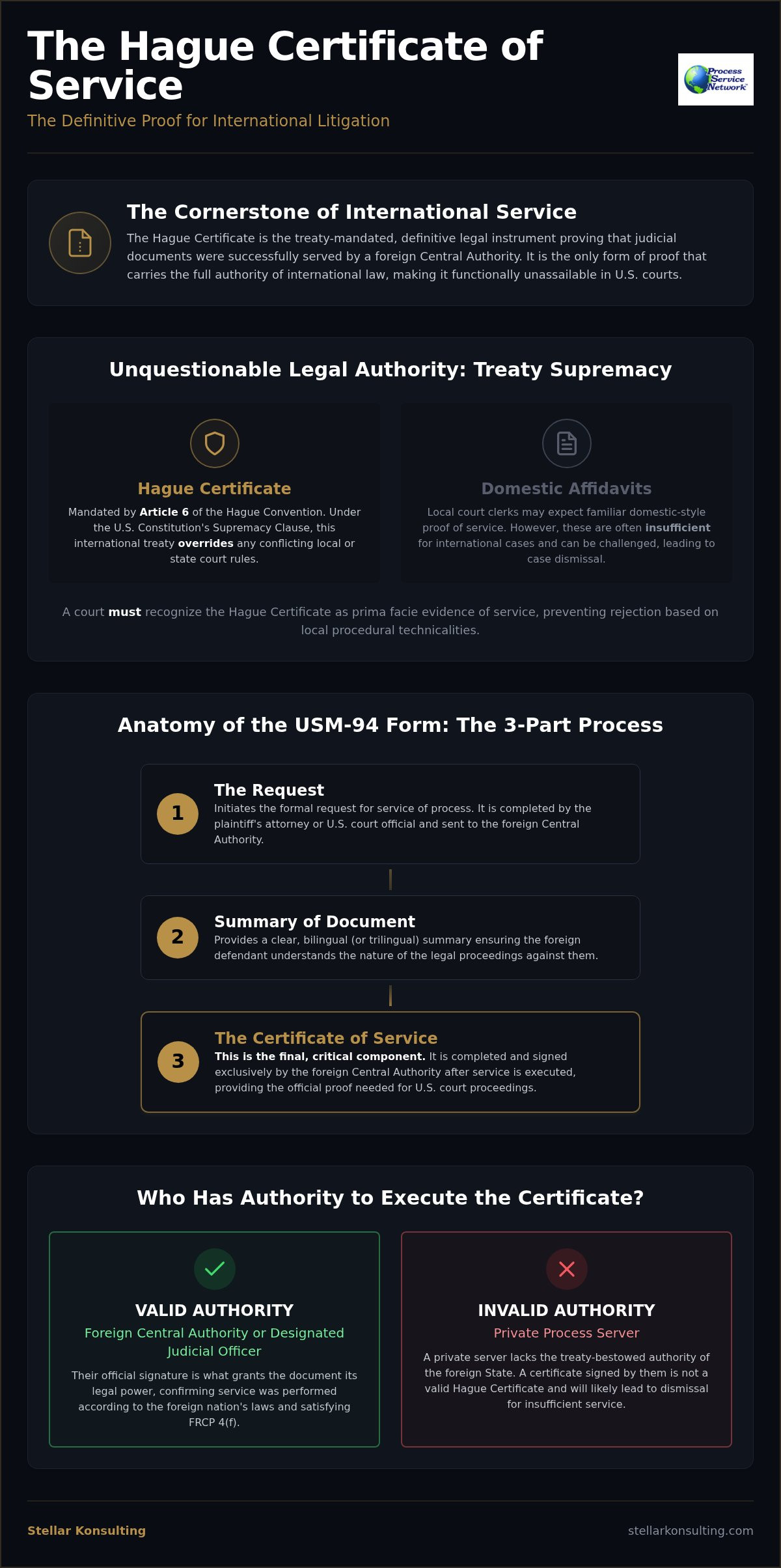
The hague convention certificate of service is the treaty-mandated proof of international judicial delivery. As the final component of the USM-94 model form, it functions as the definitive evidence that service was executed by the foreign Central Authority. Article 6 of the Hague Service Convention specifically mandates that the Central Authority of the State addressed shall complete a certificate in the form of the model annexed to the Convention. This document is the only proof of service that carries the full weight of international treaty law, providing a level of security that informal methods simply can’t match.
The Role of the USM-94 Model Form
The USM-94 form is characterized by a tripartite structure, consisting of the Request, the Summary of the Document to be Served, and the Certificate of Service. This standardized format is the required protocol for all 1965 Convention signatory nations, ensuring a uniform approach to cross-border judicial assistance. When a plaintiff initiates service through the Central Authority channel, the use of this specific form isn’t optional. It provides a clear, bilingual or trilingual roadmap for foreign officials to follow. The Request section outlines the legal basis for the service, while the Summary ensures the defendant is properly informed of the nature of the proceedings. The final section is only completed after the foreign authority has successfully delivered the documents, providing the court with a standardized record of the transaction.
Who Executes the Certificate?
One of the most common points of confusion in international litigation is the identity of the person authorized to sign the proof of service. Unlike domestic service where a private individual might suffice, the hague convention certificate of service must be executed by the foreign Central Authority or a designated judicial officer in the receiving country. A private process server can’t complete this specific certificate because they lack the treaty-bestowed authority of the foreign State.
The process creates a formal loop between the Requesting Authority, typically the attorney or court official in the U.S., and the Completing Authority, which is the official entity abroad. This official signature is what grants the document its legal supremacy in U.S. courts. It confirms that service was performed in accordance with the internal laws of the foreign nation, satisfying the rigorous requirements of FRCP 4(f). Without this official validation, a plaintiff risks having their case dismissed for insufficient service, regardless of whether the defendant actually received the papers.
The Legal Authority of Article 6: Why the Certificate is Final
Article 6 provides the cornerstone for proving service in international litigation. It stipulates that the Central Authority of the State addressed shall complete a certificate in the form of the model annexed to the treaty. This requirement is vital for compliance with Federal Rule of Civil Procedure 4(f)(1), which governs service on individuals in foreign countries. The hague convention certificate of service acts as the final, authoritative word on whether a defendant has been legally notified. For comprehensive context on the entire procedure, practitioners should refer to the definitive guide to Hague Convention service of process.
Supremacy Over Local Court Rules
Confusion often arises when a local clerk or judge expects a domestic-style affidavit of service. State-level procedural rules frequently require specific verbiage or notarization that foreign officials don’t provide. The legal principle of treaty supremacy dictates that the Hague Certificate overrides these local requirements. Because the U.S. is a signatory, the Convention’s methods are the law of the land under the Supremacy Clause. This means a judge must recognize the Certificate as prima facie evidence of service. In practice, this prevents defendants from challenging service based on minor local technicalities. Case law, such as Northrup King Co. v. Compania Productora Semillas Algodoneras Selectas, S.A., reinforces that the Central Authority’s return is sufficient to establish jurisdiction.
Mandatory vs. Recommended Formats
The treaty text is explicit about the format of the return. It mandates that the certificate be in the form of the model annexed to the Convention. This is distinct from the Summary, which is technically a recommendation under the treaty’s guidelines. If a foreign authority provides a non-standard return, such as a formal letter or a modified version of the USM-94, it can create admissibility hurdles. The U.S. Department of Justice’s Office of International Judicial Assistance monitors these variations and provides the necessary framework for U.S. litigants to argue for the document’s validity. Most courts will prioritize the treaty’s intent over rigid adherence to form, provided the Central Authority’s official seal is present.
Navigating these technicalities requires a steady hand and deep procedural knowledge. Engaging a specialized service like Stellar Konsulting ensures that your proof of service is prepared and presented to withstand the highest levels of judicial scrutiny.
Anatomy of the USM-94: Components of a Valid Certificate
A valid hague convention certificate of service requires meticulous attention to the USM-94 model form’s technical fields. Unlike domestic proof of service, the USM-94 is a rigid instrument where minor omissions can lead to significant jurisdictional challenges. The “Documents Served” section is a frequent point of failure. It must list every annex, including translations and exhibits, to prove the defendant received the complete legal package. The Hague Conference on Private International Law (HCCH) provides the framework for these fields, ensuring that the “Result of Service” field clearly distinguishes between successful delivery and a “not served” status.
The hague convention certificate of service is only legally binding if it bears the official seal and signature of the foreign Central Authority or their designated judicial officer. Without this sovereign mark, the document is merely a piece of paper, not a treaty-backed instrument. This official validation confirms that the foreign state has exercised its authority to deliver the documents, satisfying the due process requirements of both the receiving nation and the U.S. court system.
The Requesting Authority Section
The top portion of the USM-94 identifies the U.S. court and the attorney of record. Accuracy in this section is paramount. Errors here are often catastrophic, as foreign authorities may reject the request if the court information doesn’t exactly match the summons and complaint. The “Summary of the Document” must mirror the actual papers delivered. This ensures the defendant is properly informed of the legal action’s nature, which is a core requirement of the Convention’s notice provisions. If the summary is vague or incorrect, the resulting Certificate may be deemed defective during a motion to dismiss.
The Certificate of Service Completion
The “Method of Service” field is the most legally significant area of the final return. It identifies whether service occurred under Article 5(a), 5(b), or 5(c) of the Convention. Article 5(a) refers to service by a method prescribed by the internal law of the State addressed, which is the most common route. Article 5(b) involves a particular method requested by the applicant, provided it isn’t incompatible with local law. If a defendant refuses service, the foreign officer must note this on the Certificate. A documented refusal under the Convention’s protocols often counts as completed service in U.S. courts, provided the officer followed the proper local procedures. Understanding these distinctions is vital for ensuring the proof of service withstands judicial scrutiny.
Common Challenges: Rejections and Non-Standard Proof
Even with a perfect USM-94 request, the return from a foreign Central Authority isn’t always a mirror image of the original form. Some nations, particularly those with rigid bureaucratic traditions, may return a typed letter or a domestic certificate of service instead of completing the designated section of the USM-94. This non-standard proof can cause immediate friction in U.S. courts. It’s often a matter of sovereign preference; the foreign official may feel their internal certificate carries more weight than the treaty’s model form. When this occurs, you must be prepared to bridge the gap between foreign administrative habits and domestic judicial expectations.
When a hague convention certificate of service arrives in a foreign language like German or Chinese, the burden of proof shifts to the plaintiff. A raw document in a foreign tongue is rarely admissible in a U.S. court. You must secure a professional translation accompanied by a formal affidavit from the translator. This isn’t just a best practice; it’s a procedural necessity to satisfy the court’s evidentiary standards. If the translation isn’t certified, the judge may question the accuracy of the “Method of Service” or the “Identity of the Recipient.” For those dealing with proof issues outside the Central Authority channel, our guide on Hague Convention Article 10 service offers specific insights into alternative methods and their unique proof requirements.
Addressing Local Court Clerk Objections
Local court clerks often act as the first gatekeeper in the filing process. If the document doesn’t look like a standard domestic affidavit, they may reject the filing out of hand. You’ll need to educate the clerk or the court on Article 6 supremacy. Remind them that the Hague Convention is a federal treaty that overrides state-level formatting rules. If the clerk remains recalcitrant, the next step is a motion for a formal order from the judge to accept the international proof. Providing a clear “Affidavit of Translation” alongside the original certificate often resolves these disputes before they escalate to a formal hearing. It provides the clerk with a document that looks and feels familiar, even if the underlying proof is an exotic foreign instrument.
The Problem of the “Unserved” Certificate
A certificate marked “unserved” feels like a defeat, but it’s actually a critical procedural document. Foreign authorities might cite reasons such as an incorrect address, the defendant’s relocation, or a refusal to accept documents. This negative hague convention certificate of service serves as the necessary evidence of due diligence. Without it, moving for alternative service under FRCP 4(f)(3) or state equivalents is nearly impossible. The court needs to see that you’ve exhausted the treaty-mandated channels before they’ll authorize service via email or social media. An unserved certificate isn’t the end of the road; it’s the evidence you need to take the next turning. Legal professionals who want to avoid service of process dismissal must understand that even a negative return is a vital procedural asset in building the case for alternative service authorization.
If you’ve received a non-standard return or a service failure notice, contact Stellar Konsulting to evaluate your next procedural steps and ensure your case remains on track.
Ensuring Compliance with Stellar Konsulting
Securing a valid hague convention certificate of service requires more than just filling out a form; it demands a comprehensive understanding of international treaty protocols and the specific requirements of foreign Central Authorities. Stellar Konsulting provides the professional oversight necessary to navigate these complexities, ensuring that every USM-94 request is meticulously prepared. Our team handles the logistics of preparation and follow-up, reducing the risk of administrative rejection that often plagues inexperienced filers. By managing the entire lifecycle of the request, we ensure that the final return is court-ready and legally sound.
Expert Management of International Requests
Our process begins with a rigorous audit of all legal documents and translations. We coordinate directly with foreign judicial officers and Central Authorities to ensure seamless delivery across diverse jurisdictions. This level of coordination is vital because a single error in the Request section can lead to a defective Certificate months later. With over 30 years of experience, Stellar Konsulting maintains a commitment to procedural integrity that protects your litigation from the threat of dismissal due to improper proof of service. We act as a global facilitator, bridging the gap between U.S. court expectations and foreign procedural realities.
Securing Admissible Proof for US Litigation
Once the foreign authority executes the return, our role shifts to ensuring its admissibility in U.S. state or federal courts. This often involves providing certified translations of the hague convention certificate of service, particularly when dealing with non-English returns. For instance, the importance of accurate translation and local procedural knowledge is paramount when serving legal documents in Mexico, where specific linguistic and formal requirements must be met to satisfy Article 6.
We support counsel in overcoming objections from court clerks or opposing parties who may challenge the validity of international proof. Our integrated translation services ensure that the “Method of Service” and “Result of Service” fields are clearly understood by the judge. The final step in our process is delivering a document package that allows you to file proof of service and move for a default judgment with total confidence. By partnering with a specialist in Formal Hague Service of Process, you ensure that your international service is upheld, allowing your case to proceed without procedural delays.
Advancing Your Litigation with Procedural Certainty
The hague convention certificate of service is the definitive, treaty-mandated instrument that confirms your legal documents have reached their destination. It carries the weight of international law under Article 6, providing a level of procedural security that local affidavits can’t match. Success in cross-border litigation hinges on the technical accuracy of the USM-94 and the ability to resolve non-standard returns from foreign Central Authorities. Even minor administrative errors can jeopardize the admissibility of your proof in state or federal court.
Stellar Konsulting offers over 30 years of international legal expertise to ensure your service is upheld. Our global network of process serving professionals specializes in formal Hague Convention service and Letters Rogatory, providing the steady hand needed for complex jurisdictional tasks. We manage the intricate logistics of document auditing and translation so your evidence is ready for the judge. Contact Stellar Konsulting for Expert International Process Serving to secure the authoritative results your case demands. Your international process is in experienced hands.
Frequently Asked Questions
Is the Hague Convention Certificate of Service mandatory?
Yes, the hague convention certificate of service is mandatory if you’re serving documents through a foreign Central Authority. Article 6 of the treaty requires the receiving state to complete this specific form to prove service was executed. While alternative methods exist under Article 10, the Certificate is the only proof that carries the explicit seal of a sovereign authority. This makes it the most reliable evidence for satisfying FRCP 4(f)(1) requirements in federal litigation.
What happens if the foreign Central Authority does not use the USM-94 form?
U.S. courts generally accept non-standard proof if the document contains the essential details of service. While Article 6 stipulates the use of the model form, some Central Authorities provide a formal letter or a domestic certificate instead. If this occurs, you’ll need to demonstrate to the court that the document originates from the authorized Central Authority. Providing a certified translation and a copy of the treaty text often helps resolve these admissibility challenges.
Does the Certificate of Service need to be translated into English?
The final return must be translated into English before it’s filed with a U.S. court. Most domestic judges and clerks won’t accept documents in a foreign language like French, German, or Chinese. You should include a certified translation and an affidavit from the translator to ensure the proof is admissible. This step is vital for clarifying the specific method and date of service for the court record.
How long does it typically take to receive the Hague Certificate?
You can typically expect to receive the completed Certificate within two to four months after the foreign Central Authority receives your request. Some jurisdictions are more efficient, while others may take significantly longer due to local bureaucratic delays or high caseloads. It’s important to monitor the status of your request through official channels. If the process exceeds six months, you may have grounds to move for alternative service methods under FRCP 4(f)(3).
Can a local court clerk reject a Hague Convention Certificate of Service?
A court clerk might initially reject the document if they aren’t familiar with international treaty protocols. However, the Hague Convention is a federal treaty that supersedes state and local procedural rules under the Supremacy Clause. If a clerk refuses the hague convention certificate of service, you should provide a brief memorandum explaining the legal authority of Article 6. In some cases, you may need a formal order from the judge to compel the clerk to accept the filing.
What if the Certificate indicates that service was refused?
Documented refusal of service by the defendant is often treated as successful service by U.S. courts. The Central Authority will note the refusal on the Certificate, detailing the circumstances of the attempt. This official record proves that you’ve fulfilled your due process obligations. If the defendant refuses to accept the papers, the court will generally allow the case to proceed, provided the service attempt complied with the laws of the receiving country.
Does the Hague Certificate require an apostille for use in US courts?
No, the Hague Certificate doesn’t require an apostille for use in U.S. courts. The document is considered self-authenticating under the terms of the 1965 Convention. Because it’s executed by a designated Central Authority of a signatory nation, it carries its own inherent legal authority. Adding an apostille is an unnecessary step that doesn’t increase the document’s validity. Most federal and state judges recognize the official seal of the foreign authority as sufficient for authentication.
What is the difference between a Certificate of Service and an Affidavit of Service?
The primary difference lies in the authority of the person executing the document. An affidavit of service is a sworn statement by a private individual or process server. In contrast, the final Hague return is an official document issued by a sovereign state’s Central Authority. Because it’s a treaty-mandated instrument, the Certificate carries a higher level of legal weight and is harder for a defendant to challenge on procedural grounds in international disputes.