The fastest method for delivering legal documents across borders is often the one most likely to jeopardize your entire litigation strategy. While bypassing the Central Authority can save months of procedural delays, utilizing Hague Convention Article 10 service requires a meticulous understanding of country-specific reservations that many practitioners overlook. It’s a calculated risk where the penalty for error isn’t just a lost fee, but a total failure of service that can render a hard-won judgment worthless in the eyes of a foreign court.
You likely recognize the frustration of waiting on bureaucratic channels while your case remains in limbo. This guide provides the clarity needed to master these alternative service methods with precision. We’ll examine the specific objections of nations like Germany, India, and Mexico; we will also outline the procedural safeguards necessary to minimize the risk of a service-based dismissal. From the necessity of skip tracing to the impact of professional translation, you’ll gain a comprehensive roadmap for ensuring your international service is both legally valid and strategically sound.
Key Takeaways
- Learn how Article 10 serves as a vital alternative for bypassing Central Authority delays while maintaining strict treaty compliance.
- Identify the critical distinctions between postal channels and service through judicial officers to select the most effective transmission method for your jurisdiction.
- Understand the legal impact of specific reservations to hague convention article 10 service held by nations such as Germany, India, and Mexico.
- Evaluate the crucial difference between domestic service validity and the ultimate enforceability of your final judgment in a foreign court.
- Discover why specialized skip tracing and legal translation are essential prerequisites for successful execution under Article 10 protocols.
Understanding Article 10 of the Hague Service Convention
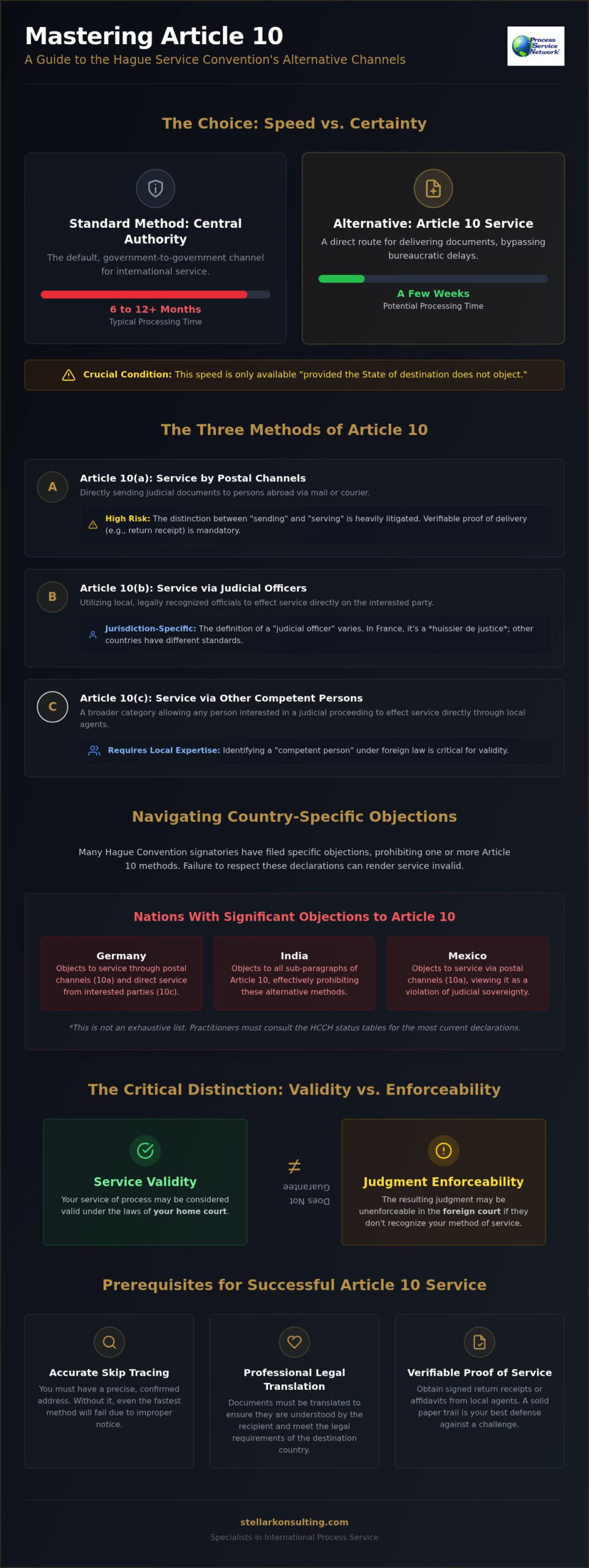
Article 10 of the Hague Service Convention provides the legal basis for using alternative channels of transmission, essentially allowing litigants to bypass the formal Central Authority process. While the Central Authority is the default mechanism for international process serving, hague convention article 10 service offers a more direct route for delivering judicial documents to parties abroad. Its primary purpose is to expedite the legal process by removing the bureaucratic layers often found in government-to-government requests. However, this flexibility is strictly governed by a conditional clause: “provided the State of destination does not object.” This single sentence has made Article 10 the most litigated and debated portion of the treaty, as it creates a patchwork of global compliance requirements.
The Legal Framework of Alternative Channels
International law maintains a sharp distinction between the mere transmission of documents and the official act of service. Article 10 addresses how documents reach their destination, but their legal validity often depends on the interaction between the internal laws of the forum state and the destination country. For a comprehensive Hague Service Convention overview, practitioners must look at how the Hague Conference on Private International Law (HCCH) tracks specific reservations. Each member nation has the right to file declarations that limit or entirely prohibit these alternative methods. The HCCH monitors these status tables, which serve as the final word on whether a specific method, such as direct mail, is legally recognized within a particular border.
Why Legal Professionals Seek Article 10 Solutions
The main driver for utilizing Article 10 is the persistent Central Authority bottleneck. In many jurisdictions, processing a formal request through government channels can take anywhere from six to twelve months. For time-sensitive filings, such as preliminary injunctions or urgent commercial disputes, such a delay is often unacceptable. Article 10 methods can reduce this timeline to just a few weeks. Beyond speed, these methods are frequently more cost-efficient for high-volume litigation or debt recovery actions. However, successful execution depends entirely on precision. Having an accurate destination is mandatory; this is why professional skip tracing services are often a prerequisite to ensure the documents reach the intended party without procedural error. Without this groundwork, even a fast service method can result in a case being dismissed for lack of proper notice.
The Three Permitted Methods of Service Under Article 10
Article 10 establishes three specific pathways for document transmission that bypass the standard Central Authority. According to the Official Text of the Hague Service Convention, these methods rely on direct contact between the sender and the recipient or a local facilitator. For hague convention article 10 service to be valid, the transmission must be direct, meaning it doesn’t pass through the foreign state’s ministry of justice. This speed comes with a high burden of proof regarding jurisdictional compliance.
Article 10(a): The Risks of Service by Mail
Article 10(a) permits sending judicial documents by “postal channels” directly to persons abroad. While this sounds straightforward, it’s a procedural minefield. The primary conflict stems from the word “send.” Some jurisdictions, and even certain U.S. courts, have historically argued that “sending” isn’t synonymous with “serving.” Although the U.S. Supreme Court clarified this in Water Splash, Inc. v. Menon, the destination country’s internal laws still dictate whether mail service is enforceable. In the modern era, “postal channels” generally include registered mail or certified couriers. You’ll need a return receipt or a signed proof of delivery to provide a verifiable paper trail for the court. Without it, your service won’t stand up to a challenge.
Article 10(b) and (c): Direct Service via Local Agents
Subsections (b) and (c) allow for service through judicial officers, officials, or “other competent persons.” Defining who qualifies as “competent” depends entirely on the legal system of the destination country. In civil law nations, such as France or Belgium, a “judicial officer” usually refers to a huissier de justice. This is a highly regulated official with exclusive authority to serve process. Conversely, common law systems might define “competent persons” more broadly, often including solicitors or professional process servers.
Article 10(c) extends this to “any person interested in the judicial proceeding.” This can include the litigants’ legal counsel, provided the destination state doesn’t object. The advantage of using a professional international process serving company is the ability to navigate these nuanced definitions accurately. A mistake in identifying who is “competent” to serve in a specific country can lead to a total failure of service. If you’re unsure which local agent meets the criteria in your target jurisdiction, consulting with a specialist at Stellar Konsulting can prevent costly procedural resets.
Navigating Country-Specific Objections and Reservations
A formal objection, or reservation, to Article 10 acts as a total bar to the methods described in that provision within the objecting state’s territory. While the Hague Service Convention Full Text provides the framework for alternative service, its practical application is entirely dictated by these declarations. It’s a common mistake to assume that silence from a destination state equals consent. While a lack of objection technically permits Article 10 methods, internal laws may still conflict with foreign service, making local verification essential. Many nations allow service through judicial officers under 10(b) while strictly prohibiting the postal channels described in 10(a). Verifying the current status of these reservations is the most critical step in planning your hague convention article 10 service strategy.
Major Jurisdictions and Their Stance on Article 10
Western Europe showcases this diversity. France generally permits Article 10 service, whereas Germany maintains a strict objection to all alternative transmission methods. The United Kingdom is notably more permissive, often allowing direct service via solicitors. In Asia, the landscape is significantly more restrictive. China and Korea have filed formal objections to Article 10 in its entirety. Japan also objects to Article 10(a) service by mail, though it may permit other methods under specific, highly regulated conditions. For those operating in the Americas, understanding these nuances is equally vital; for instance, the specific requirements for serving legal documents in Mexico involve navigating a total objection to Article 10.
What Happens if You Serve in an Objecting State?
The consequences of ignoring a formal reservation are severe. Attempting service in an objecting state typically renders the act “void ab initio,” meaning it’s legally non-existent from the outset. This isn’t just a procedural hiccup. Foreign governments often view unauthorized private service as a violation of their national sovereignty. In some jurisdictions, this can lead to diplomatic protests or even criminal liability for the process server. Perhaps most damaging is the timing. If a court determines your service was invalid months after the fact, you may find that the statute of limitations has expired, leaving you with no way to cure the defect or re-serve the defendant. To avoid service of process dismissal in these high-stakes scenarios, pre-service verification is an absolute necessity for protecting your client’s interests.
Validity vs. Enforceability: The Ultimate MOFU Dilemma
Technical compliance with the treaty doesn’t guarantee a collectible judgment. Many practitioners fall into the trap of satisfying their domestic judge while ignoring the requirements of the foreign court where they must eventually collect. While a U.S. court may rule that hague convention article 10 service was successful based on a registered mail receipt, a foreign enforcement tribunal might reach the opposite conclusion. This discrepancy creates a significant risk; you could spend years litigating a case only to find your final judgment is unenforceable in the defendant’s home country. The distinction between service that is “valid” for the forum and service that is “enforceable” for the collection phase is the most critical calculation in international litigation.
Enforcement Risks in Civil Law Jurisdictions
In many civil law nations, the act of service is considered a sovereign judicial function rather than a private administrative task. If you use Article 10 in a country that technically permits it but traditionally prefers official channels, you may encounter “public policy” (ordre public) objections during the enforcement phase. Foreign judges often require formal service to trigger the legal recognition of a foreign judgment. Case law is replete with examples where service was deemed valid by the forum court, yet the resulting judgment was declared worthless abroad because the defendant wasn’t served through the state’s preferred official channels. If your goal is the seizure of assets, you should often insist on hague convention service of process via the Central Authority to ensure the judgment is beyond reproach.
The Role of Professional Translation in Enforceability
Even when using alternative channels, the requirement for certified legal document translation remains absolute. A defendant’s most common defense in an enforcement proceeding is the “lack of notice” argument. They’ll claim they didn’t understand the nature of the documents or the legal implications of the proceedings because the paperwork wasn’t in their native language. Providing a high-quality translation at the time of service effectively neutralizes this defense. It demonstrates a commitment to due process that foreign courts respect. Without this, even a technically valid service can be dismissed as a violation of the defendant’s right to a fair hearing. Equally important is ensuring your proof of service documentation meets judicial standards; understanding the requirements of the hague convention certificate of service is essential to prevent a domestic court from rejecting your foreign-language proof of service documentation. To secure your international litigation strategy, it’s vital to consult with experts who understand these cross-border enforcement nuances and can prevent a “lack of notice” dismissal.
Optimizing Article 10 Service with Stellar Konsulting
Stellar Konsulting brings over 30 years of experience to the execution of hague convention article 10 service. We don’t simply process requests; we provide a rigorous vetting process for every case to ensure jurisdictional compliance. This proactive approach identifies potential conflicts before they become grounds for a dismissal. Our team analyzes the destination country’s specific reservations and the current posture of local courts toward hague convention article 10 service methods. This level of scrutiny is what distinguishes a successful international service from a procedural failure.
Successful execution under Article 10 often hinges on information that isn’t found in the case file. This is why we utilize professional skip tracing services to verify the current location of the defendant. In international litigation, an outdated address for a postal channel or a local agent’s visit will result in a total loss of time and resources. By confirming the target’s location first, we ensure that the transmission is directed to a verifiable point of contact. This step is a prerequisite for any service that aims to withstand a challenge in court.
Managing the logistics of local “competent persons” requires a deep global network. We coordinate with judicial officers and local agents who understand the specific procedural requirements of their home jurisdictions. Whether it’s a huissier in Europe or a solicitor in a common law state, we ensure they provide the precise proof of service required. This documentation is designed to meet the high standards of judicial scrutiny in the forum court while remaining defensible in an enforcement proceeding.
A Methodical Approach to International Service
Our firm follows a structured sequence to eliminate variables that lead to service-based dismissals:
- Step 1: Jurisdictional analysis and objection check. We verify the target country’s current stance on Article 10(a), (b), and (c) to prevent “void ab initio” service.
- Step 2: Skip tracing to ensure the defendant is locatable. We confirm the defendant’s physical presence to avoid delivery failures and wasted costs.
- Step 3: Translation of all required summons and complaints. We provide certified legal translations to neutralize “lack of notice” defenses.
Securing Your Litigation Future
Choosing the right method for international service is a strategic decision that affects the entire lifecycle of your case. Our authoritative guidance reduces the risk of case dismissal by ensuring every procedural step is documented and treaty-compliant. We understand the nuances of both formal and informal channels, allowing us to recommend the most efficient path for your specific enforcement goals. Ultimately, a partner who manages these complexities allows you to focus on the merits of your litigation rather than the mechanics of the process. We provide the steady, professional support needed to secure your judgment’s future across international borders.
Securing the Future of Your International Litigation
Mastering the nuances of hague convention article 10 service is more than a procedural convenience; it’s a critical step in ensuring your judgment remains enforceable across borders. You’ve seen how bypassing the Central Authority offers significant speed, yet this efficiency is only valuable if it respects the specific reservations of the destination state. A technical victory in a domestic court is hollow if a foreign tribunal refuses to recognize the service during the collection phase. Success requires a methodical approach that combines jurisdictional analysis with precise execution.
Stellar Konsulting provides over 30 years of expertise in navigating these complexities. Our comprehensive support includes specialized skip tracing to verify defendant locations and certified legal document translation to prevent lack of notice defenses. We don’t just facilitate document delivery; we protect your litigation strategy from procedural dismissal. Consult with Stellar Konsulting for Compliant International Service to ensure your next cross border filing is handled with the depth of experience it demands. You can move forward with confidence knowing your international interests are professionally managed.
Frequently Asked Questions
Is service by mail under Article 10(a) always legal?
No. It depends on whether the destination country has filed a formal reservation. Countries like Germany and Mexico strictly object to this method. Even if a country doesn’t object, the forum court must determine if the specific method satisfies its own due process requirements. Relying on mail without verifying the current status of the destination state can lead to a service that is legally non-existent from the outset.
What is the difference between Article 5 and Article 10 service?
Article 5 is the primary channel of transmission through a Central Authority, while Article 10 provides alternative channels that bypass that authority. Article 5 is generally more time-consuming but offers higher certainty for enforcement. In contrast, hague convention article 10 service is faster but carries higher risks regarding country-specific objections. Article 5 is the default method used when a destination state has objected to all Article 10 provisions.
Can I use a private process server in a country that objects to Article 10?
Generally, no. If a country has filed a formal objection to Article 10, using a private process server is considered a violation of that state’s sovereignty. Such service is typically viewed as legally invalid by foreign courts. In these jurisdictions, you must use the designated Central Authority under Article 5. Attempting to bypass these restrictions often results in an unenforceable judgment and potential criminal liability for the process server.
Does Article 10 service require a translation of the legal documents?
Yes, professional translation is almost always necessary to ensure enforceability. While the treaty might not explicitly mandate it for all Article 10 methods, foreign courts frequently require documents to be in their official language to satisfy due process. Providing a certified translation neutralizes the “lack of notice” defense during enforcement proceedings. It demonstrates that the defendant had a fair opportunity to understand the legal action brought against them.
What happens if the defendant refuses to sign for Article 10 mail service?
A refusal to sign usually results in a failure of service. Most courts require a signed return receipt as proof that the documents were actually delivered to the intended party. Without this verifiable paper trail, you cannot establish that the defendant received proper notice. In such cases, it’s often necessary to pivot to Article 10(b) personal service or a formal Article 5 request through the Central Authority to move the litigation forward.
How long does Article 10 service typically take compared to the Central Authority?
Article 10 service is significantly faster, often taking only two to four weeks. Transmission through a Central Authority under Article 5 can take six to twelve months depending on the country’s bureaucratic efficiency. This speed makes hague convention article 10 service an attractive option for time-sensitive filings or preliminary injunctions. However, the reduction in time must be weighed against the potential risks of non-enforcement in jurisdictions with specific legal reservations.
Which countries are known for strictly objecting to Article 10?
Several major jurisdictions maintain strict objections to all alternative transmission methods. Germany, India, and Mexico officially reject Article 10 in its entirety. Other nations, such as Japan and China, object specifically to service by postal channels under Article 10(a). Practitioners must consult the HCCH status tables for the most current data, as these reservations can change. Proceeding in these countries without using the Central Authority will jeopardize the validity of your entire case.
Can Article 10 service be used for subpoenas or only for summons and complaints?
Article 10 applies to judicial and extrajudicial documents, which technically includes subpoenas. However, serving a subpoena abroad involves complex issues of extraterritorial discovery that often go beyond simple document delivery. While you can deliver the document via Article 10, the foreign witness may not be legally compelled to comply under their local laws. For enforceable evidence collection, practitioners often need to use Letters Rogatory or the Hague Evidence Convention instead. When returning proof of that service to your domestic court, ensuring the documentation meets the standards of a proper hague convention certificate of service will be critical to establishing an admissible record of delivery.