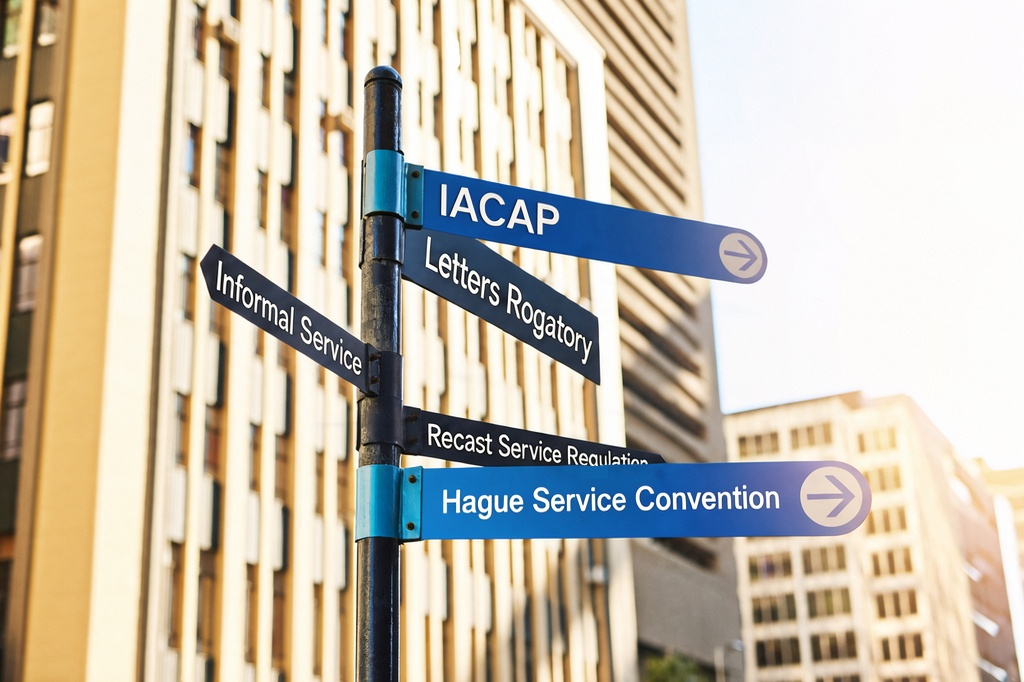

Legal proceedings do not always remain within one country’s borders. Attorneys, solicitors, barristers, paralegals, and other legal professionals may need to arrange service of legal documents in another country as part of a divorce, civil lawsuit, commercial dispute, or other legal matter.
This raises an important practical question: Who is responsible for arranging service of process — the attorney or the client?
The answer depends on the circumstances of the case, the applicable procedural rules, and the working arrangements between the legal professional and the client. Some law firms coordinate service directly, while others ask clients to assist with contacting service providers, supplying information, or arranging payment.
For legal professionals working internationally, understanding who arranges service, who carries it out, and who verifies the resulting documentation can help prevent unnecessary delays and procedural complications.
Understanding Service of Process
Service of process is the formal delivery of legal documents to notify an individual or entity of legal proceedings or another matter requiring a response. The documents involved may include a summons, statement of claim, divorce petition, court order, subpoena, or other legal papers, depending on the jurisdiction and the nature of the case.
Proper service is an important procedural requirement. It helps ensure that the person receiving the documents has appropriate notice and an opportunity to respond where required by law.
However, service requirements are not uniform worldwide. Some jurisdictions prescribe specific methods of delivery, while others permit several methods depending on the circumstances. Certain documents may also be subject to special procedures or restrictions.
For this reason, legal professionals should establish the applicable requirements before arranging service. A method accepted in one country may not be valid or sufficient in another.
Do Attorneys Arrange Service Themselves?
In many cases, attorneys coordinate service as part of their legal work. They may arrange for documents to be delivered through a process-serving company, an authorized officer, a local legal professional, or another person permitted to perform service under the applicable rules.
Law firms may have established relationships with service providers and established procedures for transmitting documents, confirming instructions, monitoring progress, and obtaining proof of service.
Other firms may delegate some administrative responsibilities to paralegals, legal assistants, or clients. The precise arrangement often depends on the firm’s practices, the client’s instructions, the fee agreement, and the complexity of the assignment.
There is generally no single worldwide rule requiring attorneys to personally arrange every service assignment. The important distinction is between coordinating the service, performing the actual delivery, and ensuring that the resulting documentation satisfies the relevant procedural requirements.
An attorney may delegate administrative tasks without transferring their professional responsibility for advising the client on the legal requirements of the case.
When Might a Client Be Asked to Arrange Service?
A client may be asked to assist with arranging service for several practical reasons.
Providing information about the recipient
Clients often possess information that helps identify or locate the person who must receive the documents. This may include a residential address, workplace, contact details, or other relevant information.
The attorney may ask the client to provide these details or confirm that the information remains current before assigning the documents for service.
Authorizing or paying service fees
Depending on the firm’s billing arrangements, the client may be asked to approve a quotation, pay a service provider directly, or authorize additional expenses associated with the assignment.
International service may involve additional costs for local coordination, document handling, translation, official fees, or multiple service attempts. These expenses should be explained and approved as appropriate before the assignment proceeds.
Contacting a service provider
An attorney may instruct a client to contact a process-serving company to initiate an inquiry, obtain a quotation, or provide preliminary information. The attorney may then review the proposed arrangements and confirm the appropriate instructions.
This does not mean the client is personally responsible for carrying out service. It simply means that some administrative work has been delegated.
Coordinating information across borders
In international cases, a client may have useful information about the recipient’s location or circumstances abroad. The attorney may ask the client to help obtain that information before selecting a suitable service provider.
Regardless of who makes the initial contact, the proposed service method should be assessed against the applicable legal requirements.
Who Actually Serves the Documents?
The person or organization authorized to perform service varies by jurisdiction and document type.
Depending on the applicable rules, service may be carried out by a professional process server, sheriff or other authorized officer, court official, or another qualified individual. In some jurisdictions, specific licensing, authorization, or eligibility requirements apply.
A professional process server may be engaged to deliver documents, make appropriate service attempts, record the relevant details, and prepare the required proof of service.
For international assignments, a service provider may also coordinate with local professionals or other authorized channels in the destination country.
Legal professionals should not assume that a person authorized to serve documents in one jurisdiction automatically has the same authority in another. Before assigning a case, they should confirm that the proposed method and individual are appropriate for the destination and the proceeding.
Divorce Proceedings: A Practical Example
Divorce cases illustrate how responsibilities may be divided between attorneys, clients, and process servers.
Consider a private attorney representing a client in a divorce proceeding in a U.S. state court. The attorney may prepare the required documents and arrange for a qualified individual to serve the respondent. The client may be asked to provide the respondent’s address, authorize the service fee, or assist with other administrative arrangements.
However, the client generally cannot personally serve the initial divorce papers where the applicable rules prohibit a party from serving their own case.
The details vary by state. California, for example, generally requires a person other than a party to serve divorce papers. Legal professionals should consult the applicable court rules rather than assume that a requirement in one state applies throughout the United States.
The same practical question can arise in other countries. A solicitor handling a divorce in England and Wales, for example, may need to arrange service on a respondent in another jurisdiction. The solicitor must consider the relevant procedural requirements and determine whether the documents can be served directly or must follow a prescribed international procedure.
In each situation, arranging service and personally delivering the documents are separate responsibilities.
What Changes When Documents Must Be Served Internationally?
Cross-border service introduces additional considerations because the law governing the proceedings may differ from the rules governing the delivery of documents in the destination country.
Before arranging international service, legal professionals should consider the following factors.
The destination country's requirements
The destination country’s laws may regulate who can serve documents, which methods are permitted, and whether particular formalities must be observed.
Some countries permit certain forms of direct service by private process servers. Others require service through designated authorities or specific official channels.
The appropriate method should be established before documents are dispatched or service attempts begin.
Applicable international agreements
International agreements may affect how documents can be served abroad.
The Hague Service Convention, formally known as the Convention on the Service Abroad of Judicial and Extrajudicial Documents in Civil or Commercial Matters, establishes procedures for international service within its scope. Each participating country’s Central Authority has a designated role in processing requests, and procedures can vary between countries. Understanding these differences can help legal professionals navigate international service requirements more effectively.
Letters Rogatory may be relevant in some cases where a judicial request must be transmitted through official channels. Their use, requirements, and expected processing times depend on the countries involved and the nature of the request.
Neither procedure should be assumed to apply universally. Legal professionals should establish which rules govern their particular assignment before selecting a service method.
Translation and document preparation
Some destinations require translations or specific supporting documents. Other requirements may include prescribed forms, copies, certificates, or additional information for the receiving authority.
Incorrect or incomplete documentation can result in requests for clarification, delays, or unsuccessful service.
Confirming document requirements early helps legal teams prepare an assignment properly and avoid preventable complications.
Timing and communication
International service may take longer than domestic service because of geographical distance, administrative requirements, local procedures, or the involvement of official authorities.
A requested completion date should not be treated as guaranteed. Legal professionals should allow sufficient time for the applicable procedure and communicate any deadlines to the service provider at the outset.
Regular updates can also help attorneys manage client expectations and determine whether further instructions are necessary.
Why Proof of Service Matters
Completing the delivery is only one part of a service assignment. The legal team must also obtain the documentation required to demonstrate what occurred.
Depending on the jurisdiction, this document may be called a proof of service, affidavit of service, certificate of service, or return of service. The terminology and legal effect are not interchangeable in every jurisdiction.
The required documentation may identify the documents served, the date and location of service, the method used, and other information required by the applicable rules.
For international assignments, the form and contents of the proof may depend on the method used and the requirements of the court handling the proceedings. Additional certification or supporting documentation may be necessary in some circumstances.
Attorneys and legal support staff should review the completed documentation to confirm that it contains the required information and arrange for filing or submission when necessary.
If the proof of service is incomplete or does not establish compliance with the applicable rules, further action may be required. Addressing documentation requirements before the assignment begins can help reduce this risk.
A Practical Checklist for Legal Professionals
Before arranging service of process, legal professionals can use the following checklist to keep the assignment organized.
-
Identify the proceeding and jurisdiction. Confirm which court or legal authority is handling the matter and which procedural rules apply.
-
Confirm the recipient’s location. Establish the country and available address details for the person or entity to be served.
-
Prepare the documents. Ensure that the correct documents and any required supporting materials are ready.
-
Determine the appropriate service method. Check the applicable rules, destination-country requirements, and any relevant international agreements.
-
Clarify responsibilities. Establish who will contact the service provider, transmit the documents, approve expenses, and monitor progress.
-
Confirm costs and timing. Obtain an estimate where appropriate and communicate deadlines, recognizing that completion times may depend on circumstances beyond the provider’s control.
-
Specify documentation requirements. Explain what proof of service or other evidence will be needed and whether additional formalities apply.
-
Review the completed assignment. Confirm that the returned documentation is complete and arrange any necessary filing or further action.
These steps provide a practical framework for managing both domestic and international service while recognizing that individual assignments may require additional measures.
Conclusion
Responsibility for arranging service of process varies according to the case, the jurisdiction, and the working relationship between the attorney and client. Attorneys may coordinate service directly, delegate administrative tasks to their legal teams, or ask clients to assist with contacting providers and arranging payment.
What remains essential is that the actual service complies with the applicable rules and that the required documentation is obtained.
For legal professionals handling cross-border matters, early planning is particularly important. Identifying the destination country’s requirements, selecting an appropriate service method, preparing the documents, and establishing clear communication can help reduce avoidable delays and procedural difficulties.
Need Assistance With International Service of Process?
When legal documents must be served abroad, navigating destination-country requirements and coordinating the assignment can require careful preparation.
Stellar Konsulting assists legal professionals with international service of process and related coordination across borders. Whether your matter involves divorce proceedings, civil litigation, commercial disputes, or other legal documents, our team can discuss your destination country and the requirements of your assignment.
Visit Stellar Konsulting to learn more about our international process-serving services or contact us to discuss your requirements.
Please call Stellar Konsulting at the phone numbers listed below or email us at operations@stellarkonsulting.com for an obligation-free quote covering the timelines, options and costs for international service of process.
📞 EMEA: +44 (20) 38905643
📞 USA: +1 (213) 786 1161
📞 Asia: +92 313-780-6280
📞 UK: +44 (20) 38905643
📞 Australia, New Zealand and Far East Asia: +61 2 7259 7299