
In international litigation, the difference between a multi-million dollar judgment and a summary dismissal often hinges on a single certificate of service. You likely recognize that serving a defendant across borders isn’t merely a logistical task. It’s a high-stakes compliance hurdle where a single procedural error can derail years of legal strategy. This guide helps you identify qualified Hague service of process providers to ensure your cross-border legal documents are served without risk of dismissal.
We’ll examine the evolving 2026 landscape, including the impact of the Smart Study Co. ruling on digital service and the necessity of integrated skip tracing and translation. You’ll learn how to select a partner that functions as a global facilitator, providing the defensible proof of service and predictable timelines required to move your case forward with confidence. By understanding the intersection of treaty law and local custom, you can secure a serving partner that mitigates risk in even the most complex foreign jurisdictions.
Key Takeaways
- Understand why the Hague Service Convention is the mandatory framework for international document delivery and how improper service leads to jurisdictional dismissals.
- Evaluate hague service of process providers based on their mastery of treaty articles and their established network of foreign legal agents.
- Recognize the necessity of integrated skip tracing to locate defendants who have moved abroad, ensuring your litigation remains on schedule.
- Learn to demand timeline transparency and jurisdictional evidence from potential partners to manage expectations for the 6 to 12 month service window.
- Discover how leveraging 30 years of specialized experience in international process serving can safeguard your cross-border legal strategy.
The Critical Role of Hague Service of Process Providers in Global Litigation
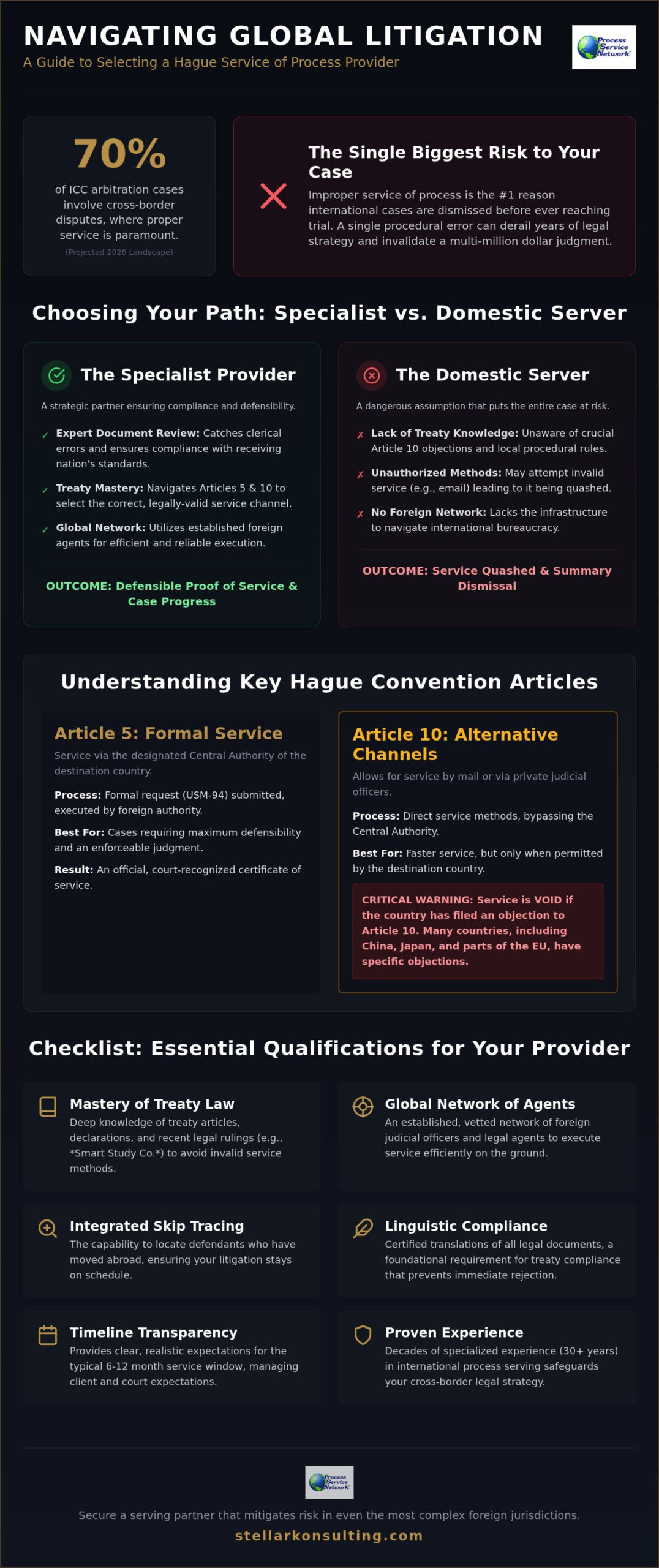
International litigation success depends on more than just the merits of a legal argument. It requires strict adherence to procedural mandates that govern how a defendant is notified of an action. The 1965 Hague Service Convention is the governing treaty for delivering judicial documents across international borders. While it provides a structured framework, relying on it without the guidance of specialized hague service of process providers often leads to significant delays or jurisdictional challenges. In 2026, where cross-border disputes represent nearly 70% of ICC arbitration cases, improper service remains the primary reason cases are dismissed before they ever reach trial.
Understanding the Hague Convention Framework
The convention was established to simplify the transmission of legal documents between signatory nations. It mandates that each country designate a Central Authority to receive and execute service requests. You can find a detailed Hague Service Convention Overview to see the full list of member states. However, the formal Central Authority process is notoriously slow. In 2026, litigation moves at a pace that these government agencies rarely match. Without professional oversight, a request might sit in a bureaucratic queue for months, only to be returned for a minor clerical error that a seasoned provider would’ve caught during the initial review. Specialized providers act as an essential intermediary, managing the preparation of the USM-94 form and ensuring that the request meets the specific standards of the receiving nation. Understanding how to navigate a hague convention central authority service request is essential to avoiding the clerical pitfalls that cause months of unnecessary delay.
Why ‘Local’ Experience Is Not Enough for International Service
Attorneys often mistakenly believe a high-quality domestic process server can handle international assignments. This is a dangerous assumption that puts the entire case at risk. Domestic servers typically understand state-specific rules but don’t possess the expertise to navigate Article 5 or Article 10 declarations. For instance, following the December 2025 Smart Study Co. ruling, the U.S. Court of Appeals clarified that email service is invalid in countries that object to postal channels, such as China. A general server might attempt unauthorized methods that result in service being quashed. Effective international service requires harmonizing the destination country’s local laws with U.S. due process requirements. Professional hague service of process providers bridge this gap, ensuring that the proof of service is defensible in any court. They understand that a successful delivery is worthless if it doesn’t result in a certificate that satisfies a judge’s scrutiny.
Essential Qualifications for International Process Serving Experts
Selecting hague service of process providers isn’t just about finding a courier. It’s about securing a legal partner who understands the Official Text of the Hague Service Convention and how it applies in practice. Expertise must extend beyond U.S. borders to include deep knowledge of both the forum court’s rules and the destination state’s sovereignty. In 2026, the litigation environment is defined by rising complexity. You need a partner who ensures every step of the process is defensible against aggressive jurisdictional challenges.
Mastery of Article 5 and Article 10 Nuances
Article 5 governs formal service through a Central Authority. It’s often the safest route when you need an enforceable judgment in the destination country, as it results in a formal certificate of service. Conversely, Article 10 provides for alternative channels, such as service by mail or private judicial officers. However, this is where many legal teams stumble. If a country has filed an objection to Article 10, any service performed through those channels is void. For example, countries like Japan and many European nations have specific declarations that limit how Article 10 can be used. A qualified expert identifies these objections before the first document is sent, saving months of wasted effort and preventing your case from being dismissed for improper service. Beyond legal documentation, if you require assistance with broader logistics or procurement from the region, you can check out Stork Japan株式會社 for reliable international shipping and proxy shopping services.
Translation isn’t a secondary concern. It’s a foundational requirement for treaty compliance. Most Central Authorities will reject a request immediately if the documents aren’t translated into the official language of the receiving state. A “good enough” translation can be challenged in court, leading to a quashed service and significant legal costs. Stellar Konsulting integrates legal document translation directly into the workflow to ensure every page meets the rigorous standards of foreign authorities. This integrated approach prevents the common 3 to 4 week delays caused by coordinating between separate agencies. By using certified legal translators who understand procedural terminology, you ensure that the defendant cannot claim they weren’t properly notified due to a language barrier.
Finally, consider the provider’s network depth. An established firm maintains relationships with foreign agents and legal authorities who understand the ground-level reality of local service. This on-the-ground presence is what produces bulletproof affidavits. When your case moves to the judgment phase, you’ll need a certificate of service that satisfies both U.S. federal standards and the specific requirements of the foreign jurisdiction. Choosing hague service of process providers with a 30-year track record provides the reassurance that your documentation will withstand even the most intense judicial scrutiny.
Beyond the Serve: Integrated Legal Support for Complex Cases
Effective cross-border litigation isn’t a standalone task. It’s a coordinated effort that begins long before a document is handed to a foreign official. Top-tier hague service of process providers offer an integrated support ecosystem that addresses the logistical and jurisdictional realities of 2026. This approach is essential when dealing with elusive defendants who intentionally move between jurisdictions to avoid service. Without a comprehensive strategy, your case risks stalling at the very first step.
International Skip Tracing: Locating Defendants Abroad
Locating a defendant in a foreign country involves more than just a basic search. It requires a sophisticated analysis of global data and local residency records. Many legal teams make the mistake of initiating service based on outdated information. If a Central Authority attempts service at an incorrect address, the request is returned as unexecuted, yet the processing fees remain due. Integrated skip tracing acts as a critical prerequisite. By verifying the defendant’s current location before filing the USM-94 form, you save thousands in failed service fees. This step ensures that when you engage the formal Hague process, you’re doing so with a high degree of certainty. Leading hague service of process providers prioritize address verification to prevent the procedural dead-ends that plague uncoordinated attempts.
Navigating Non-Hague Jurisdictions via Letters Rogatory
When a defendant resides in a country that isn’t a party to the Hague Convention, the process becomes significantly more complex. In these instances, you must rely on Letters Rogatory. This method is often described as the channel of last resort because it involves formal requests between courts and frequently utilizes diplomatic channels. It’s a methodical, time-intensive procedure that requires precise drafting to satisfy both U.S. standards and the specific requirements of the foreign judiciary.
For disputes involving South American jurisdictions, the Inter-American Service Convention provides a specialized framework. While it functions similarly to the Hague Convention, it uses distinct forms and follow-up procedures. A global facilitator like Stellar Konsulting manages these nuances, ensuring that the correct treaty is applied to your specific case. Whether you’re navigating the diplomatic hurdles of Letters Rogatory or the specific mandates of the Inter-American Convention, having an experienced partner ensures your litigation remains on track.
Evaluating Providers: A Strategic Framework for Counsel
Counsel should view the selection of hague service of process providers as a strategic risk management decision rather than a simple procurement task. The validity of your eventual judgment depends entirely on the defensibility of the initial service. When evaluating potential partners, you must look beyond general claims of global reach and interrogate their specific operational depth in the target jurisdiction. A failure at this stage does not just cause delays; it can result in a total loss of jurisdiction over the defendant.
Assessing Jurisdictional Experience and Success Rates
The complexities of serving in countries like China or India require more than a standard procedural manual. When vetting a firm, use the following checklist to determine their true capability:
- Does the provider maintain a managed network of agents, or do they simply outsource to unverified third parties?
- Can they provide specific examples of recent successful service in the destination country?
- Do they understand the local informal service customs that might be used as a fallback if formal channels are unavailable?
- How do they handle the specific translation and notarization requirements of the receiving Central Authority?
A firm that acts as a global facilitator will provide clear, experience-based answers to these questions. They distinguish themselves from brokers by managing the process from document preparation to the final return of service. This level of oversight is vital for maintaining the integrity of the legal chain of custody; for firms seeking to apply this same level of strategic oversight to their digital evolution, check out Sterck.
Timeline transparency is the hallmark of a reliable partner. While Central Authority turnaround times for key countries in 2026 often range from 6 to 12 months, your provider should never leave you in a vacuum. Many firms fall into “dark periods” where they offer no updates while a request sits with a foreign government. You should expect a communication protocol that provides regular status reporting, even if the update is simply confirming the document’s current position in the queue. A thorough understanding of the strategic role of Central Authorities in Hague service can help counsel set realistic expectations and avoid the anxiety that comes from prolonged administrative silence.
The final deliverable, the International Affidavit of Service, must be bulletproof. To satisfy U.S. federal and state judges, this document must clearly detail the method of service, the identity of the person served, and strict compliance with the Hague Convention’s mandates. Any ambiguity in this affidavit can lead to a motion to quash service, wasting months of litigation time. Stellar Konsulting provides the authoritative international process serving support necessary to ensure your proof of service meets every judicial standard. By prioritizing financial predictability and timeline honesty, we help counsel manage client expectations while securing the jurisdictional foundation of the case.
Navigating Cross-Border Service with Stellar Konsulting
Stellar Konsulting has spent over 30 years refining the intricate process of international document delivery. We’ve positioned ourselves as the authoritative choice among hague service of process providers by focusing on the precise intersection of treaty law and local jurisdictional requirements. Our role isn’t merely to deliver papers. We act as a global facilitator that protects the foundational integrity of your litigation. By managing the procedural complexities of cross-border service, we allow counsel to focus on the substantive legal merits of their case.
The Stellar Konsulting Methodology
Every request we handle undergoes a rigorous, authoritative compliance check before submission to a Central Authority. We don’t simply pass documents along; we scrutinize them for linguistic accuracy and procedural alignment with the destination country’s specific declarations. Our three decades of experience have allowed us to build a superior, managed network of agents who understand the ground-level realities of their respective courts. This network isn’t a collection of unverified brokers. It’s a curated group of seasoned professionals who provide the reliable, defensible proof of service that U.S. federal and state judges expect. This steady commitment to results ensures that your case avoids the common pitfalls of improper service.
Initiating Your International Service Request
Initiating a request with our firm begins with a detailed consultation to assess the unique variables of your litigation. We evaluate the defendant’s location and the nature of the dispute to determine if Formal Hague Service, the Inter-American Service Convention, or Letters Rogatory represents the most effective channel. Once we establish a strategy, we handle the preparation of all mandatory forms and coordinate with our in-house teams for legal document translation and skip tracing. This bundled approach eliminates the administrative friction of managing multiple vendors. It ensures a cohesive chain of custody and a predictable timeline for your service needs.
In the high-stakes environment of 2026’s international litigation landscape, you can’t afford a partner that treats compliance as an afterthought. We’re committed to delivering results that withstand the most rigorous jurisdictional challenges. When the success of your case hinges on proper notification, you need a partner with a proven track record of global competence. Consult with the experts at Stellar Konsulting for your international service needs.
Securing Your Jurisdictional Foundation in 2026
Navigating international litigation requires more than procedural knowledge; it demands a partner who can anticipate the nuances of foreign Central Authorities and local court mandates. As cross-border disputes grow in complexity, the role of hague service of process providers becomes central to your case’s survival. Success depends on harmonizing treaty requirements with precise logistics, from locating defendants through skip tracing to ensuring linguistic accuracy with certified translations. A single error in this phase can negate years of legal strategy.
Stellar Konsulting brings over 30 years of international expertise to every assignment. Our global network of process serving specialists ensures that your documents are served in strict compliance with the Hague Convention, the Inter-American Convention, or via Letters Rogatory. We provide the comprehensive skip tracing and translation support needed to prevent procedural delays and protect your case from dismissal. By acting as your global facilitator, we ensure that every certificate of service is defensible in court.
Secure Your International Litigation with Stellar Konsulting.
We’re ready to help you navigate these global requirements with confidence and precision.
Frequently Asked Questions
What is the difference between formal and informal Hague service?
Formal service utilizes the Central Authority of the destination country, resulting in a formal certificate that is essential for enforcing judgments abroad. Informal service refers to alternative channels under Article 10, such as service by mail or private process server, provided the destination country hasn’t filed an objection. Choosing the correct path requires a nuanced understanding of each nation’s specific declarations to avoid jurisdictional challenges that could derail your litigation.
How long does it typically take to serve process under the Hague Convention in 2026?
Turnaround times for formal service through Central Authorities typically range from 6 to 12 months in 2026. These timelines depend on the administrative efficiency of the foreign government and the specific requirements of the local jurisdiction. Utilizing experienced hague service of process providers helps manage these expectations by ensuring documents are prepared correctly the first time, preventing administrative rejections that could extend the process by several months.
Can I serve a defendant via email if the country is a Hague member?
Service by email is generally prohibited in countries that object to service through postal channels under Article 10. A December 2025 ruling by the U.S. Court of Appeals for the Second Circuit confirmed that the Hague Convention doesn’t permit email service in objecting countries like China. Counsel must verify specific country declarations before attempting digital service to prevent the service from being quashed by a judge later in the proceedings.
What happens if a country has not signed the Hague Service Convention?
If a country hasn’t signed the Hague Convention, service must typically be effected through Letters Rogatory. This process involves a formal request from a U.S. court to a foreign court, often transmitted through diplomatic channels. It is a more complex and time-consuming method than the treaty-based process. Alternatively, some jurisdictions in South America may be reached through the Inter-American Service Convention, which provides a specialized framework for those specific regions.
Why do I need a professional translation for Hague service?
Most Central Authorities require that all judicial documents be translated into the official language of the destination state to satisfy due process requirements. A failure to provide certified legal translations often results in the immediate rejection of the service request. Professional hague service of process providers integrate this step to ensure linguistic accuracy and compliance with local standards, preventing the defendant from challenging the service based on a lack of understanding.
What is a Central Authority and how do they impact my timeline?
A Central Authority is the government-designated entity responsible for receiving and executing service requests from other member states. In the United States, a private contractor manages these incoming requests for a set fee of $95.00 USD as of 2026. Because these are state-monitored agencies, they often operate with significant administrative backlogs. Their internal processing speeds directly dictate the timeline for formal service, making professional oversight essential for tracking progress and ensuring compliance.
Can a Hague service provider help if I don’t have the defendant’s current address?
Yes, comprehensive providers offer international skip tracing to locate defendants before initiating the formal service process. Verifying a current address is a critical prerequisite because Central Authorities won’t search for a defendant; they only attempt service at the provided location. If the address is incorrect, the service fails and the processing fees are forfeited. Locating the party first ensures the formal request has a high probability of success.
Is service of process under the Inter-American Convention different from the Hague Convention?
While both are treaty-based frameworks, the Inter-American Convention utilizes different forms and procedures specific to signatory nations in the Americas. It’s often used for service in countries that aren’t party to the Hague Convention. The requirements for letters rogatory and specific tri-lingual forms make it a distinct procedural path. Navigating these differences requires a partner who understands the specific mandates of each treaty to ensure defensible proof of service.