
The Central Authority of a foreign nation is a procedural gateway, not a concierge service. Many legal professionals mistakenly view this mechanism as a simple administrative hand-off, only to face months of silence or a summary rejection of their documents. When you initiate a hague convention central authority service request, you’re entering a rigid diplomatic channel where the smallest clerical error can derail an entire litigation schedule. We understand that the unpredictability of international timelines and the ambiguity of translation requirements can create significant anxiety for any legal team.
This strategic guide provides the clarity needed to navigate the formal treaty path with precision. You’ll master the nuances of the Central Authority mechanism to ensure your international legal documents are served in a manner that withstands the highest level of judicial scrutiny. We’ll examine the specific requirements for successful submission, including the latest 2026 procedural updates for new member states and the critical role of the forwarding authority. By the end of this article, you’ll have a clear framework to minimize rejection risks and secure reliable service of process across global borders.
Key Takeaways
- Understand the Central Authority’s mandatory role under Article 2 as the designated entity for receiving and executing international service requests.
- Recognize that improper or missing legal document translations are the leading cause of rejection and delay within the hague convention central authority service framework.
- Master the procedural transition from local court filing to international transmission by correctly utilizing the mandatory Model Form and identifying the appropriate Forwarding Authority.
- Establish realistic litigation schedules by accounting for global service timelines that typically span from three months to over a year depending on the jurisdiction.
- Mitigate the risk of case dismissal by integrating professional skip tracing and meticulous document review before submitting requests to the foreign gateway.
Defining the Central Authority under the Hague Service Convention
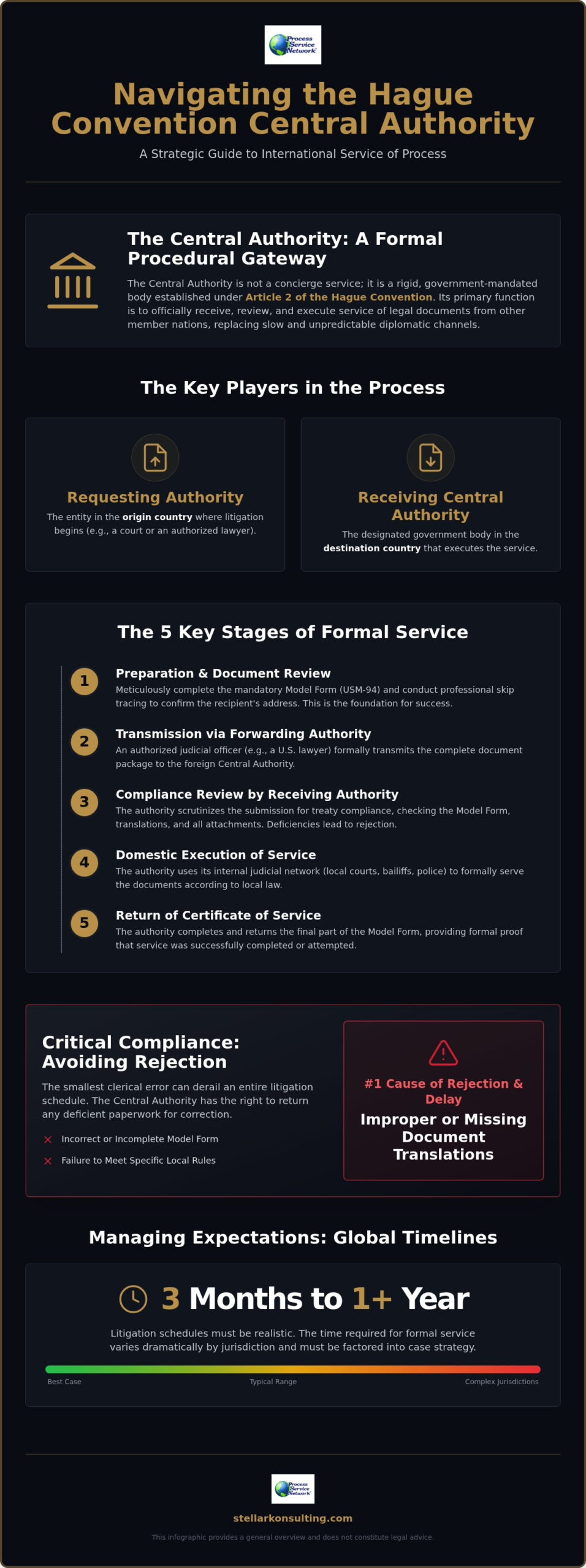
The Hague Convention establishes a streamlined path for international litigation, and at the heart of this system sits the Central Authority. Under Article 2 of the treaty, every contracting state must designate a specific entity to act as the primary hub for incoming service requests. This isn’t a private service provider; it’s a formal administrative arm of the state’s judiciary or ministry of justice. When you initiate a hague convention central authority service request, you’re engaging with a government-mandated body responsible for the receipt and execution of foreign legal documents.
In any standard cross-border case, we distinguish between two primary roles. The ‘Requesting Authority’ is the entity in the country where the litigation originated, often a court or a designated official. The ‘Receiving Central Authority’ is the counterpart in the destination country. This bilateral relationship ensures that documents don’t get lost in general diplomatic mail, but instead reach an office specifically trained to handle international judicial assistance.
The Legal Framework of Article 2
The creation of the Central Authority system was a deliberate move to modernize international law. Before this framework existed, lawyers relied on slow, unpredictable diplomatic channels or letters rogatory that could take years to resolve. This Hague Service Convention overview highlights how Article 2 mandates a centralized hub to eliminate these bottlenecks. By designating a single point of contact, member states provide a degree of certainty that was previously impossible. This centralized structure directly impacts the reliability of service, as it creates a standardized protocol that all member nations must follow, reducing the likelihood of a case being dismissed due to procedural errors at the international level.
Primary Duties and Jurisdictional Power
The Central Authority doesn’t just pass papers along; it performs a critical compliance review. Upon receiving a request, the authority determines if the documents meet the specific terms of the Convention. This includes checking for the proper use of the Model Form and ensuring that translation requirements are satisfied. If the paperwork is deficient, the authority has the right to return it for correction, which often causes significant delays for the unprepared litigant.
Beyond simple paperwork checks, these authorities hold significant jurisdictional power. They can object to a service request if they believe it infringes upon the state’s sovereignty or threatens national security. While such objections are rare in commercial litigation, the possibility underscores the authority’s role as a protector of domestic legal standards. The Central Authority serves as the essential gatekeeper of international judicial assistance, ensuring that every request for hague convention central authority service meets both treaty obligations and local legal requirements.
The Procedural Mechanism: How Formal Treaty Service Works
The transition from a domestic court filing to an international legal action requires more than just a change in mailing address. It involves a sophisticated transfer of judicial power facilitated by the Model Form. This document acts as the standardized vehicle for communication between the originating court and the foreign state. In the United States, the Department of Justice clarified in September 2025 that the law of the requesting state determines who is competent to forward these requests. For U.S. litigants, this means that lawyers are recognized as judicial officers authorized to complete and transmit the necessary paperwork.
Once the packet reaches the destination, the internal routing process begins. The receiving Central Authority doesn’t just hold the documents; they oversee their distribution through their domestic judicial hierarchy. This might involve sending the papers to a local court, a bailiff, or even a police department, depending on the country’s specific legal structure. This oversight ensures that the service of process adheres to the official text of the Hague Service Convention, protecting the integrity of the litigation from the outset.
Preparing the Model Form (USM-94)
Litigants must utilize the three-part Model Form, commonly known in the U.S. as the USM-94. This form consists of the Request for Service, the Certificate of Service, and the Summary of the Document to be Served. Rejections frequently occur because of minor clerical errors, such as failing to identify the correct “Applicant” or providing an incomplete address for the defendant. The Applicant is typically the attorney or the court official initiating the request, while the Forwarding Authority is the individual or office sending the documents. Ensuring these fields are accurate is the first step in a successful hague convention central authority service request.
Transmission from Requesting State to Receiving State
The journey of a legal packet is both physical and procedural. While digital transmission is becoming more common, many jurisdictions still require hard copies sent via international courier. The “gateway” check performed by the foreign Central Authority is the most critical phase of the journey. During this review, officials verify that the request complies with treaty requirements and local laws. If accepted, the authority proceeds with service using the methods outlined in Article 5 of the treaty. This often involves service by a particular method requested by the applicant, provided it’s not incompatible with the laws of the receiving state. Managing this hague convention central authority service requires a deep understanding of these technical requirements. For firms looking to minimize risk, utilizing professional formal Hague service of process ensures that every document is reviewed for compliance before it ever leaves your office.
Critical Compliance: Avoiding Central Authority Rejections
A rejection from a foreign Central Authority can stall a high-stakes case for six months or more. These entities don’t exist to correct your paperwork; they function as strict compliance filters. The primary cause of failure isn’t the substance of the lawsuit. It’s usually a failure to adhere to the technical declarations of the receiving state. When a hague convention central authority service request is returned, it’s often due to a lack of precision in document preparation or a misunderstanding of local treaty reservations. Compliance is mandatory.
Translation Mandates and Local Language Rules
Improper or missing translations remain the most frequent trigger for summary rejection. While some practitioners assume English is a universal standard for international business, Article 5 of the treaty explicitly permits receiving states to require that documents be translated into their official language. Even if a defendant is a fluent English speaker, the Central Authority may refuse to execute service if the local language requirements aren’t met. This is a non-negotiable hurdle in jurisdictions like China, Germany, or Vietnam, where the Convention enters into force on September 11, 2026. High-quality, certified legal document translation is essential. Technical errors in translated legal terminology can lead to the foreign authority deeming the request incompatible with their domestic law.
Proper Identification and Jurisdictional Nuances
Precision in identifying the defendant is paramount. Vague party names or outdated addresses lead to immediate failure. Foreign judicial officers tasked with physical delivery won’t conduct investigative work on your behalf. If the address is incorrect, the packet is simply returned. Different nations interpret the Model Form with varying degrees of rigidity. For instance:
- China: Requires extremely specific details regarding the defendant’s legal status and address, often rejecting requests that lack a local phone number.
- Germany: Maintains a decentralized system where the specific Central Authority depends on the state, requiring exact alignment with regional boundaries.
- Algeria: As a recent signatory (July 9, 2026), their administrative procedures are still stabilizing, making meticulous compliance even more critical for early filers.
Stellar Konsulting mitigates these risks through a rigorous document review process. We examine every hague convention central authority service packet for clerical consistency and adherence to the receiving state’s specific declarations before submission. This proactive approach prevents the common errors that typically result in months of lost time. We don’t just forward documents; we ensure they’re ready for acceptance.
Managing Expectations: Timelines, Costs, and the Certificate
Managing a litigation calendar requires a realistic appraisal of international procedures. While the Hague Conference on Private International Law suggests that most Central Authorities accomplish service within two months, the practical reality for many law firms is much longer. Depending on the jurisdiction, the hague convention central authority service path can take anywhere from six to twelve months to complete. This timeline is influenced by the administrative efficiency of the receiving state and the accuracy of the initial submission.
Costs are equally variable. Beyond the standard processing fees charged by some authorities, the volume of legal document translation is the primary driver of expense. A complex complaint with hundreds of pages of exhibits will naturally incur higher costs than a simple summons. Some jurisdictions also require additional fees for local bailiffs or police officers to effect physical delivery. While ‘informal’ service methods might seem faster or less expensive, they often fail to meet the strict requirements for a final judgment, leaving the case vulnerable to future challenges. Law firms evaluating qualified hague service of process providers should carefully assess each partner’s ability to manage these jurisdiction-specific cost variables alongside compliance requirements.
Variability Across Global Jurisdictions
Efficiency varies significantly between member states. Some Central Authorities maintain streamlined digital portals, while others rely on traditional paper-based systems that are prone to backlogs. Local factors such as national holidays, political shifts, or administrative reorganizations can abruptly change expected delivery dates. For example, as Vietnam joins the Convention on September 11, 2026, practitioners should anticipate an initial learning curve in their local administrative offices. Hague service is a marathon of compliance, not a sprint.
The Certificate of Service (Article 6)
The Article 6 Certificate is the definitive proof of service. When the Central Authority successfully delivers the documents, they return this official certificate to the requesting party. In U.S. courts, this document is considered the ‘gold standard’ for proving that a hague convention central authority service request was executed in accordance with international law. It’s the most effective tool for overcoming a defendant’s motion to dismiss based on improper service. If service cannot be completed, the authority returns a certificate of non-service detailing the efforts made. This record is vital for seeking alternative service methods from a judge. To navigate these variables effectively, law firms should partner with a provider that offers comprehensive formal Hague service of process, ensuring every requirement is met from the initial filing to the final certificate.
Strategic Management of Hague Convention Service
Professional oversight is essential for navigating the inherent bottlenecks of international service. A law firm’s primary focus should remain on the merits of the litigation, not the logistical minutiae of foreign administrative offices. By positioning a specialized service provider as the primary liaison between the firm and the foreign authority, you ensure that every communication is handled with diplomatic precision. Integrating expert skip tracing and meticulous legal document translation into the initial hague convention central authority service request creates a robust submission that is prepared for acceptance. This strategic approach transforms the Central Authority from a potential hurdle into a predictable procedural step. For organizations in the property sector, Dr. Jeffrey Scott Stanton offers specialized behavioral strategy for real estate organizations and sales teams to maintain peak performance during such complex transitions.
In a similar vein, the STO Foundation provides a comprehensive platform for companies to tokenize real-world assets and launch compliant investment offerings using blockchain technology, ensuring procedural integrity in digital finance.
The legal and financial consequences of improper service often don’t manifest until the enforcement phase of a judgment. If a foreign court or a domestic judge determines that service failed to comply with local laws or specific treaty declarations, the entire litigation effort may be invalidated. Professional vetting of documents ensures that every page of the packet aligns with the receiving state’s unique requirements. This level of scrutiny is vital for protecting high-stakes international litigation from summary dismissal. Partnering with a steady and authoritative partner like Stellar Konsulting provides the reliability needed to move forward with confidence. We focus on the procedural details so your team can focus on the case.
Why Professional Management Outperforms DIY Attempts
Managing international service in-house often exposes a firm to hidden complexities that can stall a case for months. Foreign judicial fees and accepted payment methods are rarely uniform across jurisdictions. For example, while the U.S. Central Authority’s contractor requires a $95.00 processing fee for certain requests, other nations may demand international money orders or specific bank transfers in local currency. Stellar Konsulting leverages over 30 years of experience to anticipate these hague convention central authority service requirements before they result in a rejection. We understand the specific administrative nuances that distinguish a successful filing from a clerical failure. Our deep-rooted network and procedural expertise allow us to navigate these global requirements efficiently and reliably.
Contact Stellar Konsulting to manage your Hague Service of Process and ensure your international legal documents are served without the risk of rejection.
Securing Procedural Integrity in Global Litigation
Navigating the Central Authority path requires more than administrative filing; it demands a deep understanding of diplomatic protocols and domestic legal reservations. Success hinges on meticulous document preparation and the precise execution of translation requirements to satisfy foreign judicial officers. By mastering the hague convention central authority service mechanism, you protect your case from the risk of dismissal and ensure your final judgment is enforceable across international borders.
Stellar Konsulting brings over 30 years of international legal support experience to every request. As specialists in formal Hague and Inter-American Convention service, we provide the comprehensive legal translation and skip tracing capabilities necessary to manage high-stakes litigation. Our team acts as your authoritative partner, handling the complex logistics of foreign administrative hubs with steady, business-like precision.
Secure Your International Service with Stellar Konsulting
We’re ready to help you navigate these global complexities and achieve reliable results for your firm.
Frequently Asked Questions
What is the primary role of a Hague Convention Central Authority?
The primary role of a Central Authority is to receive requests for service from other contracting states and execute them according to domestic law. This entity acts as the official governmental gateway for international judicial assistance. It reviews incoming documents for treaty compliance and then arranges for physical delivery to the defendant. By centralizing this process, the state ensures that foreign legal documents are handled with procedural consistency and legal validity.
How long does it typically take for a Central Authority to serve documents?
Timelines vary significantly by jurisdiction; however, most Central Authorities accomplish service within three to twelve months. While the Hague Conference suggests a two-month average, real-world factors like administrative backlogs and local judicial efficiency impact the speed. For example, requests to major jurisdictions like China or India often lean toward the longer end of that spectrum. It’s essential to account for these extended periods when establishing your domestic litigation schedule.
Can I bypass the Central Authority and serve documents via mail?
You may only serve documents via mail if the receiving state hasn’t filed an objection to Article 10(a) of the Convention. Many countries, including Germany and China, have specifically opted out of this provision, making mail service legally invalid in those jurisdictions. Bypassing the hague convention central authority service in a country with an Article 10 objection can lead to the immediate dismissal of your case or the inability to enforce a future judgment.
What happens if the Central Authority rejects my request for service?
If a Central Authority rejects your request, the documents are typically returned to the forwarding authority with a notice explaining the deficiency. Common reasons for rejection include improper translations, clerical errors on the Model Form, or insufficient fees. You must correct these issues and initiate a new submission, which resets the service timeline. Professional document review before filing is the most effective way to prevent these costly administrative delays and ensure acceptance.
Is a translation always required for Hague Convention service?
A translation is required whenever the receiving state makes a declaration under Article 5 of the treaty. Most non-English speaking signatories mandate that all legal documents be translated into their official language to ensure the defendant’s due process rights are protected. Even if a translation isn’t strictly required, providing one is a best practice. It minimizes the risk of the recipient refusing the documents or the Central Authority questioning the request’s validity.
What is the difference between a Forwarding Authority and a Central Authority?
The Forwarding Authority is the entity in the originating country responsible for sending the service request, while the Central Authority is the entity in the destination country that receives and executes it. In the United States, lawyers are considered judicial officers and act as the forwarding authority. The Central Authority in the receiving state serves as the administrative gatekeeper, ensuring the request meets both international treaty standards and their specific domestic legal requirements.
How much does it cost to use a Central Authority for service of process?
The cost of using a Central Authority varies by country because some states charge fixed fees while others provide the service without a government charge. For requests sent to the United States, the designated contractor charges a $95.00 fee for private litigants. You must also account for secondary expenses such as certified legal document translation and potential fees for local bailiffs. These costs are separate from the professional management fees charged by international service providers.
What is a USM-94 form and why is it necessary?
The USM-94 is the mandatory three-part Model Form required for every hague convention central authority service request. It includes the Request for Service, the Certificate of Service, and a Summary of the Document to be Served. This form provides the foreign authority with the essential information needed to identify the parties and execute the request. Any omission or technical error on this form is a frequent trigger for immediate rejection by the foreign state.