
A failed service of process due to an inaccurate address isn’t just a minor setback. It’s a strategic failure that can jeopardize the entire jurisdictional integrity of your international litigation and lead to a costly case dismissal. When you’re managing cross-border disputes, understanding international skip tracing costs is essential to ensuring your budget is spent on verified results rather than dead-end database hits. You’ve likely felt the frustration of wasted resources on cheap searches that fail to withstand judicial scrutiny or ignore strict foreign privacy laws like GDPR.
We recognize that your priority is securing a verified physical address that satisfies the due diligence requirements of the court. This guide provides a professional analysis of the investment required to locate defendants globally while maintaining strict compliance with international legal standards. We’ll examine the variables that influence pricing, such as the distinction between Hague Convention member states and countries requiring Letters Rogatory. By the end of this analysis, you’ll have a clear framework for executing cost-effective searches that provide a solid foundation for formal service of process.
Key Takeaways
- Professional skip tracing acts as a forensic foundation for global litigation, providing the verified data necessary for successful service of process.
- Various factors influence international skip tracing costs, including jurisdictional data privacy laws and the specific requirements of the Hague Service Convention.
- A verified physical address serves as essential proof of due diligence, reducing the risk of case dismissal or administrative delays in foreign courts.
- Relying on multi-source forensic verification rather than simple database hits ensures your results are accurate enough to withstand rigorous judicial scrutiny.
- Strategic skip tracing serves as the critical first step before initiating formal service of process via Letters Rogatory or international treaties.
The Fundamentals of Professional Skip Tracing Services in Global Litigation
Professional skip tracing is a forensic methodology used to locate individuals whose current whereabouts are unknown. In global litigation, it serves as the essential first step before legal documents can be served. Understanding The Fundamentals of Professional Skip Tracing is vital because the process involves more than just finding a name; it requires verifying a physical address to a standard that will satisfy a judge. While some firms view international skip tracing costs as a burden, they’re actually a strategic safeguard. They prevent the waste of much higher fees associated with failed service attempts or jurisdictional challenges.
The Legal Necessity of Locating Defendants Abroad
Establishing jurisdiction is impossible without accurate address verification. If a defendant isn’t properly located, the court cannot exercise its authority over them, which can lead to immediate case dismissal. This is particularly critical in cross-border probate and inheritance matters where beneficiaries may be scattered across different continents. Similarly, locating witnesses for international testimony or depositions requires a meticulous approach. Without a verified location, the momentum of litigation stalls, often leading to indefinite delays. Professional tracing ensures your case maintains its trajectory through the legal system without administrative friction.
Why Standard Database Searches Fail Internationally
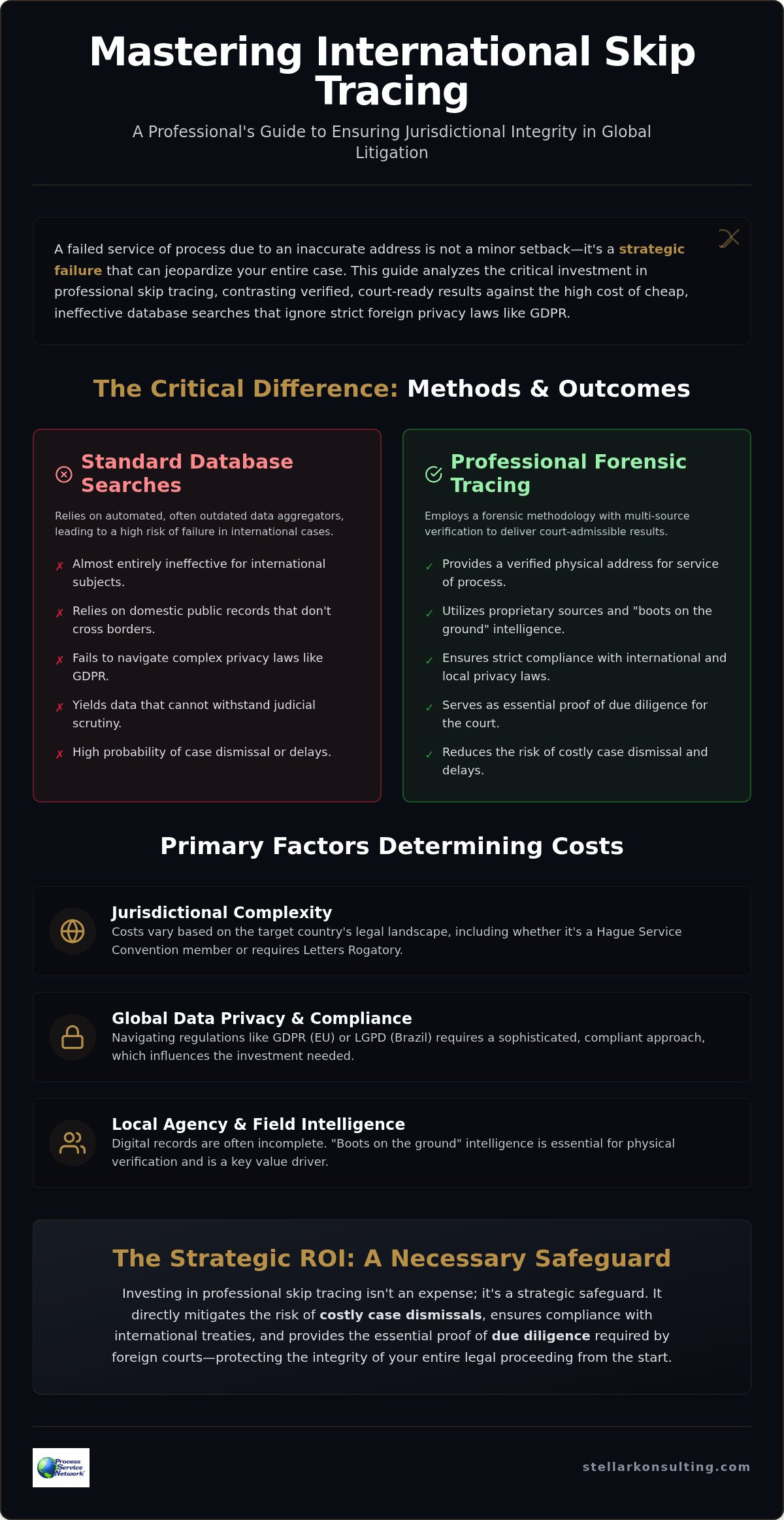
Domestic skip tracing tools are almost entirely ineffective for international subjects. Most US-based aggregators rely on credit headers and domestic public records that don’t extend beyond national borders. Many civil law jurisdictions lack centralized residency databases, making automated searches useless for legal purposes. Locating individuals in high-privacy regions like the EU requires an understanding of GDPR and local regulations that standard software simply doesn’t possess. Effective tracing requires proprietary sources and “boots on the ground” intelligence to confirm a subject’s presence. This level of forensic verification is what separates professional tracing from simple “one-click” searches that often yield outdated or inaccurate data.
Legal professionals should differentiate between “locating” and “investigating” for court-admissible purposes. Locating provides a verified address specifically for the service of process. Investigating involves a deeper dive into assets or background history. For global litigation, the primary goal is a verified physical address that withstands judicial scrutiny. Investing in professional services ensures that international skip tracing costs translate into actionable results that move your case forward with confidence. By prioritizing forensic accuracy over cheap database hits, you protect the integrity of your legal proceedings from the very beginning.
Primary Factors Determining International Skip Tracing Costs
International skip tracing costs aren’t uniform. They fluctuate based on the legal landscape of the target country. For example, locating a subject in a highly regulated EU member state requires a different investigative protocol than a search in Latin America. In the EU, investigators must navigate the General Data Protection Regulation (GDPR), which strictly governs how personal data is accessed and processed. These regulatory hurdles necessitate a more sophisticated, and often more expensive, approach to data retrieval. Legal professionals seeking to understand the full scope of international skip tracing techniques for global litigation will find that mastering these jurisdictional distinctions is essential to building a defensible case.
Navigating Global Data Privacy and Compliance
Privacy frameworks like the GDPR or Brazil’s LGPD require investigators to establish a “permissible purpose” before accessing data. This compliance layer adds to the overall project cost but is vital for protecting the admissibility of any subsequent service of process. Low-cost providers often bypass these ethical standards. They risk the entire legal action if a foreign court determines the data was obtained illegally. For those seeking deeper insights into these methodologies, this practitioner’s guide to tracing assets details the complexities of cross-border investigations and the importance of adhering to international standards.
The Value of Local Agency and Field Intelligence
Digital records are frequently incomplete or inaccessible in many jurisdictions. In these cases, physical verification by a field agent becomes necessary to confirm a subject’s residency. In Germany, for instance, an investigator might need to query the Meldeamt, which is the local residency registration office. This process requires specific linguistic expertise and an understanding of local administrative procedures. Local agency is the bedrock of successful international skip tracing.
Relying on regional investigative networks helps manage international skip tracing costs while ensuring accuracy. These networks provide “boots on the ground” intelligence that digital aggregators simply cannot replicate. Linguistic expertise is also essential for interpreting foreign property records, utility bills, or civil registries. Misinterpreting a single local document can lead to an incorrect address and a failed service attempt. If you require assistance with these complex requirements, we recommend reviewing our definitive guide to Hague Convention service to understand how localized tracing integrates with formal legal procedures.
The Strategic ROI: Skip Tracing for Hague and Letters Rogatory Compliance
Skip tracing in a global context is more than a simple location search. It’s a critical investment in the due diligence required by courts to maintain jurisdictional integrity. When a case moves across borders, the court must be satisfied that the plaintiff made an exhaustive effort to locate the defendant. Without a verified physical address, you risk “bad service,” which often leads to immediate case dismissal in foreign jurisdictions. Viewing international skip tracing costs as a strategic component of your litigation budget ensures that the subsequent service of process is legally defensible.
Establishing the Mandatory Physical Address
The Hague Service Convention applies only when the address of the person to be served is known. If a request is submitted with an inaccurate or “unknown” address, the Hague Convention Central Authority in the receiving state will likely reject the application. These administrative rejections cause significant delays, often stretching into months of lost time. Professional tracing streamlines this treaty-based process by providing a confirmed location before the formal paperwork is even filed. This proactive approach minimizes the risk of costly administrative friction and ensures that your legal documents reach the intended recipient through the correct channels.
Supporting Alternative Service Motions
In cases where a defendant is intentionally evasive, a professional skip tracing report serves as vital evidence for a Motion for Substituted Service. This is particularly relevant when navigating the high evidentiary bars required for service of process in Mexico or other jurisdictions with complex civil procedures. Even a “negative results” report has value. It provides the court with a documented trail of investigative steps, proving that you’ve met the due diligence standard required to seek alternative methods of service.
For countries that aren’t parties to the Hague Convention, a verified address is even more critical. The Letters Rogatory process is notoriously slow and expensive, often taking a year or more to complete. Initiating this diplomatic channel without a verified location is a high-risk gamble. By accounting for international skip tracing costs at the beginning of the case, you protect the long-term momentum of your litigation. You ensure that when you finally engage the formal power of the court, it’s directed toward a verified and actionable destination.
Benchmarking Costs: Professional Investigative Standards vs. Database Searches
Distinguishing between automated data scraping and forensic verification is essential for budgeting. While database aggregators offer speed, they often lack the accuracy required for legal service. Professional standards require the “Rule of Three,” where data is cross-referenced through at least three independent investigative channels. This ensures that international skip tracing costs are an investment in accuracy rather than a gamble on outdated records. Using low-cost, unverified data often results in “bad service.” This triggers a cycle of re-service fees and administrative delays. In some cases, courts may even issue sanctions if the lack of due diligence is deemed negligent.
Verification and Admissibility Standards
Professional investigators provide a layer of accountability by signing off on the location data. A verified address is the only acceptable output for international litigation. Models that promise “No Hit = No Fee” can be problematic. They often incentivize providers to supply the most recent “hit” regardless of its current validity, simply to trigger a billing event. For a report to be court-admissible, it must detail the specific investigative steps taken, the sources consulted, and the date of verification. This level of transparency is what allows a report to withstand the scrutiny of opposing counsel and the bench.
Transparency in Investigative Billing
Understanding the breakdown of costs is essential for law firms managing complex cases. There’s a significant difference between simple database access fees and the hourly rates required for manual forensic work. Prioritizing providers with professional liability insurance protects the firm from potential errors in the field. Additionally, maintaining ethical investigative methods upholds the “clean hands” doctrine, ensuring that the evidence remains admissible. If you require a detailed assessment of a complex case, contact the experts at Stellar Konsulting for forensic-grade location services.
A professional report acts as a shield against claims of insufficient due diligence. It documents the exhaustive effort made to locate a defendant, providing the evidentiary foundation for alternative service if the subject remains elusive. By benchmarking your providers against these investigative standards, you ensure that your budget is allocated toward results that move the litigation forward. High-quality tracing doesn’t just find people; it provides the legal certainty required to proceed with confidence in any jurisdiction.
Stellar Konsulting: Precision Global Tracing and Legal Support
Stellar Konsulting has served as a sophisticated guide for the legal industry since 1994. With over 30 years of experience, we provide the deep-rooted reliability required for high-stakes US-based litigation involving foreign parties. We position skip tracing not as a standalone task, but as the essential first step in a broader strategy for formal or informal service of process. This integrated approach ensures that every investigative action aligns with international treaties and local jurisdictional laws from the outset. Our firm acts as a global facilitator, handling the procedural complexities so your team can focus on the core merits of the case.
A Holistic Approach to International Litigation Support
Efficiency in global litigation is often hindered by the fragmentation of services. Using separate providers for skip tracing, legal document translation, and service of process creates unnecessary administrative friction. We offer a holistic model that streamlines these phases. Our firm’s ability to navigate high-privacy jurisdictions like the EU ensures that international skip tracing costs remain a productive investment. We maintain a quiet commitment to procedural results, ensuring that the data gathered remains admissible under both US and foreign regulations. This unified strategy protects the integrity of the case while navigating the nuances of diverse civil law systems.
Initiating Your International Search
Beginning a professional skip trace requires a foundation of accurate subject data. To ensure the highest probability of success, we typically require the subject’s full legal name, date of birth, and any known associates or historical addresses. It’s about more than just a name; it’s about building a profile that withstands judicial scrutiny. Once the investigation begins, the timeline is influenced by the specific administrative and digital infrastructure of the target nation. We provide a methodical, organized progression through the search, keeping your team informed of developments without the density of unnecessary jargon. This transparency allows law firms to accurately forecast their international skip tracing costs and litigation timelines.
We understand the precision required in legal process serving and reflect that meticulous nature in our investigative work. By leveraging our extensive professional network, we provide a level of geographic reach that standard databases cannot match. If your case involves complex cross-border requirements, you need a partner with the longevity and expertise to deliver verified results. Consult with Stellar Konsulting for International Legal Support to initiate your global search with confidence.
Securing Your Global Litigation Strategy
Effective cross-border litigation begins with a verified physical location. By prioritizing forensic accuracy over automated database hits, law firms protect their cases from administrative rejections and jurisdictional challenges. Managing international skip tracing costs effectively means investing in results that satisfy the high evidentiary standards required by the Hague Convention and Letters Rogatory process. This strategic foundation ensures that your service of process remains legally defensible in any jurisdiction.
Stellar Konsulting brings over 30 years of global legal support experience to your most complex cases. We specialize in navigating high-privacy environments and difficult jurisdictions where standard tools fail. Law firms trust our firm to provide the precision required for high-stakes litigation while ensuring strict compliance with both international treaties and local laws. Our methodical approach provides the clarity you need to move forward with confidence.
Secure Professional International Skip Tracing Services and ensure your case maintains its momentum across borders.
Frequently Asked Questions
How much does international skip tracing typically cost?
Costs vary significantly based on the target jurisdiction’s regulatory environment and the complexity of the subject’s digital footprint. Factors like the need for local field agents, document translation, and compliance with foreign privacy laws impact the total investment. While basic domestic searches are inexpensive, forensic international tracing requires cross-referencing multiple data sources. This professional verification ensures the resulting address is court-admissible for formal service of process under international treaties.
Is international skip tracing legal under the Hague Convention?
Skip tracing is a legal and often mandatory step before initiating formal service under the Hague Convention. The Convention specifically applies only when the address of the person to be served is known. Locating a defendant through professional tracing provides the necessary address to engage the Central Authority of a receiving state. This process ensures that the subsequent service remains compliant with the treaty’s requirements and local jurisdictional laws.
How long does it take to locate a defendant in another country?
The timeline for an international search typically ranges from a few business days to several weeks. Jurisdictions with centralized digital registries often yield faster results than regions requiring manual queries of civil records or physical verification by field agents. Factors such as the accuracy of the initial data provided and the responsiveness of local administrative offices also influence the duration. We prioritize methodical verification to ensure results are reliable for litigation.
What information is needed to start an international skip trace?
To initiate a forensic search, you should provide the subject’s full legal name, date of birth, and last known address. Additional details like the names of known associates or previous employment history can significantly enhance the efficiency of the investigation. Providing comprehensive data helps manage international skip tracing costs by reducing the time spent on broad searches. It’s about building a profile that withstands judicial scrutiny. Targeted data leads to faster, more accurate results.
Can skip tracing reports be used as evidence of due diligence in court?
A detailed skip tracing report serves as critical evidence that the plaintiff performed due diligence in attempting to locate a defendant. Courts require proof of an exhaustive search before they’ll consider motions for alternative or substituted service. A professional report documents the specific databases consulted, the field inquiries made, and the verified results obtained. This documentation is essential for satisfying the evidentiary burden required to move a case forward and avoid dismissal.
How do professional skip tracing services handle GDPR and privacy laws?
Professional services navigate privacy laws like the GDPR by establishing a permissible purpose for the search before accessing personal data. This involves ensuring that the investigative methods align with the legal requirements of the target country, such as the European Union or Brazil. Adhering to these ethical standards protects the admissibility of the location data in court. It prevents the legal action from being compromised by allegations of illegal data retrieval or privacy violations.
What happens if the subject is located in a country with no public records?
In jurisdictions with limited public records, we rely on a network of local field agents and proprietary intelligence sources. This boots on the ground approach allows for the physical verification of a subject’s residency through utility records, local interviews, or administrative inquiries. While these searches are more complex, they’re often the only way to secure a verified address in emerging markets or civil law countries where digital data aggregators lack comprehensive, reliable coverage.
Why is professional skip tracing more expensive than domestic searches?
Professional international searches involve forensic verification across multiple independent channels rather than simple database scraping. The investment reflects the costs of engaging local experts and navigating foreign privacy regulations. Domestic tools often rely on credit headers that don’t exist abroad. Professional services ensure the address is verified to a standard that withstands judicial scrutiny. This prevents the much higher costs of failed service attempts. International skip tracing costs represent a safeguard for your litigation’s integrity. For cases requiring locating witnesses for international testimony, the same forensic standards apply to ensure every verified address supports your broader litigation strategy. Law firms that invest in advanced international skip tracing techniques gain a decisive advantage by integrating multi-lingual OSINT with localized jurisdictional expertise to produce evidence that is both accurate and court-defensible.