
A single incorrect digit in a witness’s address can dismantle a multi-million dollar litigation strategy before it ever reaches a courtroom. You likely recognize that domestic skip tracing tools often hit a wall at the border. This leaves you to navigate a fragmented landscape of foreign privacy laws and complex international treaties on your own. The fear of violating GDPR or incurring the high costs of failed service attempts is a valid concern for any legal professional.
This guide provides the sophisticated protocols necessary for locating witnesses for international testimony, ensuring every step remains compliant with global standards. We’ll examine the integration of digital intelligence with formal service requirements to secure verified data that stands up to judicial scrutiny. You’ll learn how to transition from a dead-end lead to a verified current address, establishing a clear path for serving subpoenas or deposition notices across diverse jurisdictions. By mastering these cross-border methodologies, you can ensure that your evidence collection remains beyond reproach in any court of law.
Key Takeaways
- Identify why domestic skip tracing tools fail in cross-border litigation and how to access non-public global records effectively.
- Master the sophisticated protocols for locating witnesses for international testimony while maintaining strict adherence to jurisdictional privacy laws.
- Navigate the complexities of GDPR and international data fragmentation to ensure your search meets “due diligence” standards for US court requirements.
- Implement a step-by-step synthesis of digital intelligence and proprietary database analysis to establish a verified current address abroad.
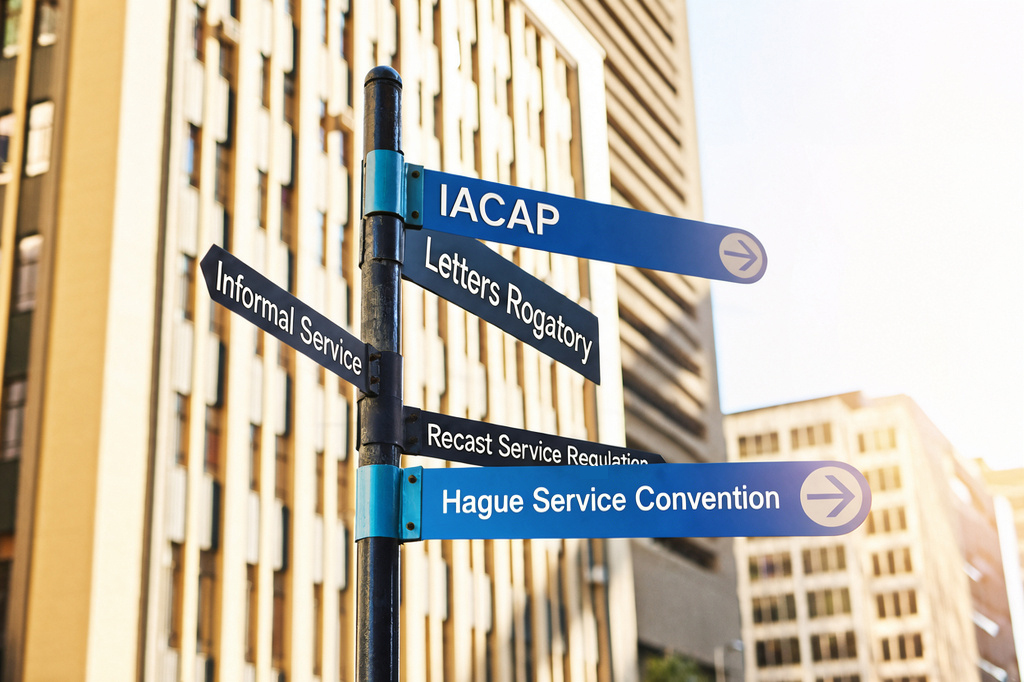
- Integrate successful location data with formal service methods, such as the Hague Convention or Letters Rogatory, to secure admissible evidence.
The Strategic Necessity of Locating Witnesses for International Litigation
Witness testimony remains a cornerstone of establishing the factual basis of any cross-border dispute. Within these complex frameworks, probative value refers to the degree of evidence that is relevant and sufficient to prove a specific fact or issue in a legal proceeding. Without the direct testimony of key individuals, a legal team’s ability to corroborate documents or demonstrate intent is severely compromised. This evidentiary gap can lead to unfavorable rulings or the inability to meet the burden of proof required in high-stakes litigation.
Standard domestic Skip Tracing Methodologies typically rely on U.S.-centric credit headers, utility records, and voter registrations. These tools inevitably fail the moment a target crosses an international border. Relying on stale or unverified location data introduces significant procedural risks, including the potential dismissal of a case if service is attempted at an incorrect address. Establishing a secure chain of custody from the initial point of discovery ensures that the information gathered remains admissible and untainted throughout the litigation lifecycle. Precise data isn’t just a convenience; it’s a prerequisite for judicial recognition.
Identifying Potential Witnesses through Discovery
Effective witness discovery begins with synthesizing fragmented data points from initial disclosures and internal documents. This process requires a meticulous construction of a witness profile to distinguish between cooperative parties and those who are intentionally elusive. Identifying these behavioral patterns early allows counsel to allocate resources more efficiently, prioritizing locating witnesses for international testimony who are most critical to the case’s outcome. A structured profile includes known associates, past employment history, and digital footprints that transcend national boundaries.
The Impact of Relocation on Litigation Timelines
When a witness relocates to a foreign jurisdiction, the procedural requirements shift immediately toward international service treaties. This transition often necessitates the use of Hague Convention protocols, which demand precise address verification before any formal request is submitted to a Central Authority. Counsel must account for how these requirements influence international skip tracing costs and overall litigation schedules. Managing client expectations is essential. The timeline for global witness discovery is governed by foreign judicial speeds and treaty compliance rather than domestic court rules. Success in locating witnesses for international testimony depends on early intervention and a methodical approach to jurisdictional sovereignty.
Advanced Skip Tracing Methodologies for Cross-Border Witness Discovery
Accessing non-public global records requires a strategy that goes beyond standard search engine queries or domestic credit headers. Effective discovery involves tapping into proprietary databases that aggregate international commercial registries, historical residency patterns, and cross-border credit data. These resources provide a starting point, but they’re often fragmented by national borders. Digital footprints serve as the primary foundation for modern skip tracing because they offer high-frequency, real-time indicators of a subject’s physical presence that traditional, static government records cannot match. Success relies on the ability to synthesize these disparate data points into a cohesive lead. Applying international skip tracing techniques designed for global litigation ensures that legal teams can navigate the 144 national data privacy laws currently in effect without compromising their legal standing.
Leveraging SOCMINT and Digital Forensics
Social Media Intelligence (SOCMINT) allows analysts to track digital movements by evaluating geotagged metadata, check-ins, and background imagery in public posts. We look for “lifestyle markers,” which are recurring locations such as specific gyms, professional clubs, or educational institutions that reveal a witness’s current geographic location. Automated data retrieval tools often struggle with the nuance of international platforms or language variations. Expert manual analysis is necessary to filter out intentional disinformation and confirm that the digital activity belongs to the target. This human-led approach ensures that the data used for locating witnesses for international testimony is both current and accurate.
Global Public and Private Record Synthesis
Navigating foreign voter registrations, property ownership records, and vehicle data is a complex task due to varying transparency standards. In many jurisdictions, especially within the European Union, strict privacy frameworks limit the availability of public data. Counsel must navigate these sovereignty issues by Overcoming Jurisdictional Barriers through established legal channels and local privacy exemptions. Utilizing international professional networks is a critical step in locating witnesses for international testimony, as it allows for the verification of employment status abroad without alerting the witness prematurely. This synthesis of public and private data creates a reliable profile for the next stage of the process.
Once a high-probability location is identified, field verification provides the necessary on-the-ground confirmation. Human-led verification ensures the address is capable of receiving service and that the witness is physically present at the location. This multimodal approach prevents the high costs and procedural delays associated with failed service attempts based on unverified data. Utilizing specialized skip tracing services allows legal teams to move from digital leads to physical verification with the precision required for international litigation. This methodical synthesis of data ensures that every finding is documented for court submission.
Overcoming Jurisdictional Barriers: Privacy Laws and Data Fragmentation
Entering foreign jurisdictions requires a shift in legal strategy. Unlike the relatively open data environment in the United States, international searches must contend with rigorous privacy frameworks. Failure to respect these boundaries doesn’t just result in a dead end; it can jeopardize the entire case’s admissibility. Legal teams must navigate these barriers with a clear understanding of both the foreign landscape and the expectations of the domestic court where the case is pending.
Navigating Foreign Data Privacy Regulations
The General Data Protection Regulation (GDPR) in the European Union significantly restricts how personal data is processed and shared across borders. When locating witnesses for international testimony, it’s essential to ensure that every piece of information is gathered through compliant channels. This involves balancing the legitimate interest of the litigation with the individual’s right to privacy. Utilizing Advanced Skip Tracing Methodologies that prioritize data-driven, ethical solutions is vital for maintaining the integrity of the evidence. Once a location is identified, contact must follow strict legal standards to avoid claims of harassment or witness tampering, which vary significantly by country.
The Pitfalls of Identity Fragmentation
Identity fragmentation often occurs when witnesses move across borders, leading to variations in name spellings, transliteration errors, or the use of localized aliases. For instance, a name translated from a non-Latin script can have multiple valid spellings, each appearing in different official records. Automated systems frequently miss these connections, resulting in “stale data” that points to a location the witness vacated years ago. Stale data is the primary reason international process service fails, leading to significant financial loss and procedural delays.
Human-led verification is the most effective way to mitigate these risks. By manually reviewing records and cross-referencing digital markers, specialists can confirm that the individual found is indeed the target witness. This level of scrutiny is vital for meeting the “due diligence” standards required by US courts when seeking alternative methods of service. Relying on unauthorized local investigators who lack legal support expertise is a dangerous gamble. These actors might use methods that violate local laws, potentially exposing the client to legal liability and rendering the gathered testimony unusable. Ethical standards must remain the priority throughout the search to ensure that locating witnesses for international testimony results in a successful and legally sound outcome.
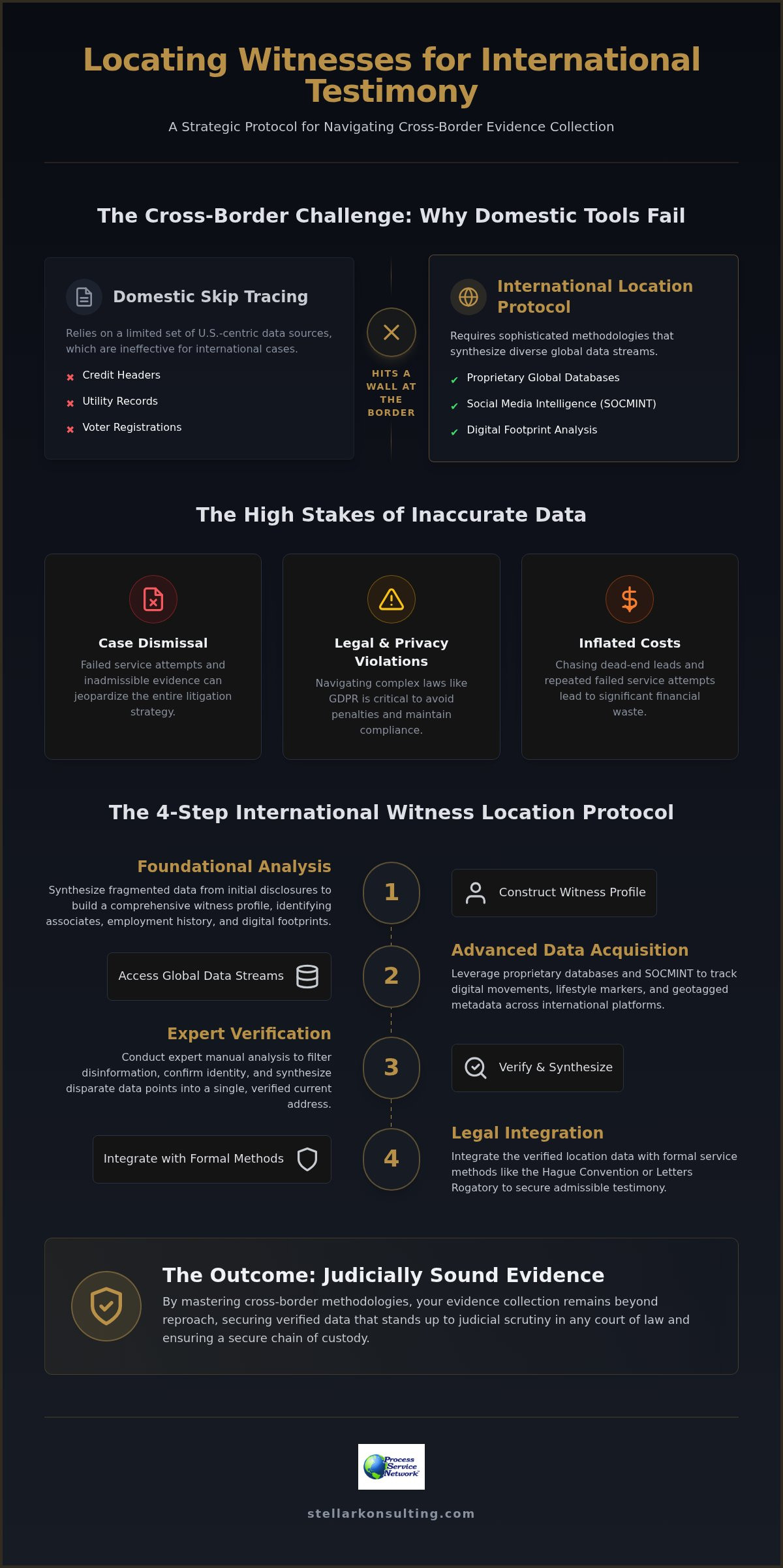
How to Execute an International Witness Search: A Step-by-Step Protocol
Executing a search for a witness abroad requires a methodical protocol that bridges the gap between raw data and legal admissibility. A structured approach ensures that the “due diligence” required by U.S. courts is fully documented and defensible. This protocol moves systematically from digital intelligence to physical confirmation, providing a reliable foundation for subsequent service. By following a logical progression, legal teams can avoid the procedural pitfalls that often lead to case delays or the exclusion of critical evidence.
Phase 1: Intelligence Gathering and Analysis
Success in locating witnesses for international testimony begins with the construction of a comprehensive dossier based on the target’s known domestic history. This profile synthesizes fragmented data, such as past employment, professional certifications, and known associates, to identify the most likely foreign jurisdictions. Analysts evaluate these leads against the procedural requirements of the destination country to determine the most effective path forward. For example, resource allocation is heavily influenced by hague convention service of process requirements, which may dictate specific timelines, mandatory translation services, or unique document formats that must be prepared in advance.
Phase 2: Operational Location and Verification
Once the target jurisdiction is identified, the search transitions to multi-jurisdictional database analysis and tactical field verification. This phase involves engaging local professional support to confirm the witness’s physical presence on the ground through discreet observation or registry checks. A verified address in international litigation is one confirmed by recent physical presence or a current official registry entry within the last 30 days, meeting the specific evidentiary standards required by a foreign Central Authority. This level of verification prevents the high costs associated with failed service attempts and ensures the search meets the “diligent effort” standard often required for alternative service motions. It’s the critical link between digital leads and physical service.
Transitioning to Formal Service and Testimony
With a verified address in hand, the case moves into formal treaty protocols to secure the witness’s participation. This transition is essential for obtaining testimony via deposition or subpoena that will be recognized by both the foreign and domestic courts. Whether the path involves the Hague Convention or Letters Rogatory, the underlying location data must be beyond reproach. To ensure your discovery efforts meet these rigorous standards, you can engage professional international skip tracing to verify witness locations before initiating formal service. This sequence ensures that the path from initial discovery to the witness stand remains legally sound and procedurally efficient, protecting the integrity of your litigation strategy across global borders.
Securing Admissible Testimony: Integrating Location with Process Service
Successfully identifying a witness’s physical location is a logistical victory, but it represents only the first half of the evidentiary challenge. Without a valid mechanism for service, the data gathered during the skip tracing phase cannot be leveraged in court. The objective of locating witnesses for international testimony is to bridge the gap between discovery and the witness stand, ensuring that the method of contact complies with both the forum court’s rules and the foreign jurisdiction’s sovereignty. Failure to integrate location data with a compliant service strategy often results in the exclusion of critical evidence.
Choosing the appropriate service method depends largely on the destination country’s treaty affiliations. For nations that are not signatories to the Hague Service Convention, counsel must often rely on letters rogatory legal services to request judicial assistance from foreign courts. This formal process is significantly more complex and time-consuming than treaty-based service. Additionally, professional translation plays a mandatory role in this transition. Most foreign Central Authorities will immediately reject service requests that are not accompanied by a certified translation in their official language. Stellar Konsulting facilitates this end-to-end process, ensuring that location data transitions seamlessly into formal service and admissible testimony.
Formal vs. Informal Service of Process
In certain regions, specific treaties provide streamlined alternatives to the Hague Convention. For witnesses located in Latin America, the Inter-American Service Convention offers a standardized framework for serving legal documents. While some jurisdictions may permit “informal” service through local agents, this approach carries substantial risks. Informal service often bypasses the official channels required to ensure the eventual admissibility of testimony in a U.S. court. If a witness later challenges the validity of service, the lack of a formal certificate from a Central Authority can lead to the testimony being struck from the record. Ensuring strict compliance with local laws at the outset prevents these costly future challenges.
Securing Testimony through International Judicial Assistance
When a witness is reluctant or a formal deposition is required, counsel must utilize mechanisms of international judicial assistance. Obtaining a Letter Rogatory is often the only path to compelling cooperation from a witness in a non-treaty jurisdiction. This process involves a formal request from a U.S. judge to a foreign judiciary, asking them to use their own power to summon the witness or oversee a deposition. Before initiating the search for a witness, counsel should review this final checklist:
- Confirm the target country’s current treaty status (Hague, Inter-American, or non-treaty).
- Identify if the jurisdiction allows for voluntary depositions or requires a court order.
- Ensure all documents are prepared for mandatory legal translation.
- Verify that the skip tracing data meets the “due diligence” standards for the specific foreign authority.
By integrating these procedural requirements with the search for locating witnesses for international testimony, legal teams protect the integrity of their discovery. This methodical approach ensures that once a witness is found, they can be legally brought into the litigation process without delay.
Strengthening Global Discovery Strategies
Successful litigation in an increasingly globalized legal environment depends on the precision of your discovery data. The process of locating witnesses for international testimony involves more than just finding a name in a database; it requires a methodical synthesis of digital intelligence and strict adherence to international service treaties. By integrating advanced skip tracing with professional translation and formal service protocols, you ensure that every finding transitions into admissible evidence that stands up to judicial scrutiny. The same methodical approach that underpins witness location is equally critical when pursuing international skip tracing for judgment enforcement, where locating an elusive debtor abroad is the essential first step in transforming a court-ordered judgment into tangible asset recovery.
Stellar Konsulting brings over 30 years of global legal support experience to your case. We specialize in maintaining strict compliance with the Hague Convention and Letters Rogatory, offering a comprehensive approach that integrates specialized skip tracing with professional translation. Our team understands the nuances of international privacy laws and the procedural complexities of foreign jurisdictions. Consult with our international skip tracing experts today to secure the verified data and testimony your case requires. We’re ready to help you navigate these complex requirements with confidence.
Frequently Asked Questions
Is it legal to skip trace a witness living in a foreign country?
It’s entirely legal provided the methods used comply with the foreign jurisdiction’s privacy laws and the forum court’s ethical standards. In the European Union, for example, skip tracing must adhere to GDPR requirements regarding the processing of personal data. Legal teams must ensure their location efforts don’t violate local sovereignty or involve unauthorized surveillance. Professional firms focus on legal support and treaty-compliant methods to maintain the integrity of the eventual testimony.
How long does it typically take to locate a witness for international testimony?
The timeline for locating witnesses for international testimony varies based on the complexity of the target’s digital footprint and the transparency of the foreign jurisdiction’s records. A standard search typically takes between two and six weeks. However, cases involving intentionally elusive individuals or countries with restrictive privacy laws may take longer. This phase must be completed before initiating formal treaty protocols, which add several months to the overall litigation schedule.
What happens if a witness is located but refuses to cooperate with the US court?
If a witness refuses to cooperate voluntarily, counsel must use formal judicial assistance to compel their participation. This often involves the Hague Evidence Convention or the letters rogatory process. A US court issues a request to the foreign judiciary, which then uses its local power to summon the witness for a deposition or testimony. This process ensures that the witness’s participation is obtained through a legally binding mechanism recognized by both countries.
Do I need to translate my legal documents if the witness is located in a non-English speaking country?
Translation is almost always a mandatory requirement for formal service through Central Authorities. Most signatories to the Hague Service Convention require that all documents be translated into their official language before they’ll facilitate service. Failing to provide a certified translation typically results in the immediate rejection of the request. Stellar Konsulting provides professional translation as part of an integrated approach to ensure compliance with these international treaty requirements.
Can I serve a witness by email once they have been located abroad?
Service by email is generally only permissible if the foreign jurisdiction allows it and the US court specifically authorizes it under Federal Rule 4(f)(3). Many countries that are party to the Hague Service Convention have formally objected to alternative methods of service, including mail or electronic means. Attempting email service without explicit judicial approval and treaty compliance can lead to the testimony being ruled inadmissible during later stages of the litigation.
What is the difference between skip tracing for a defendant versus a witness?
Skip tracing for a defendant focuses on establishing a verified address for the service of a summons to establish jurisdiction. For witnesses, the goal is often more complex, as the location data must support a subpoena or a request for a deposition. While both require high-quality data, locating witnesses for international testimony often demands a higher level of behavioral analysis to predict where they might be found for a scheduled appearance or testimony.
How does the Hague Evidence Convention differ from the Hague Service Convention?
The Hague Service Convention governs the delivery of legal documents to a party abroad to ensure they’ve received notice of a proceeding. In contrast, the Hague Evidence Convention provides the framework for taking evidence, such as witness testimony or document production, in a foreign country. While the Service Convention starts the legal process, the Evidence Convention is the primary tool for securing admissible testimony for use in a US trial or deposition.
What are the most common reasons an international witness search fails?
Most international searches fail due to reliance on stale data or a lack of understanding of foreign record-keeping systems. Identity fragmentation, such as name transliteration errors or the use of localized aliases, often leads domestic tools to incorrect conclusions. Additionally, failing to account for strict privacy laws like GDPR can result in data that is legally unusable. Success requires a multimodal approach that combines international skip tracing techniques with human-led field verification on the ground.