
The geographic distance between your local court and a foreign defendant is rarely the primary factor in a litigation delay; instead, administrative precision dictates the calendar. Legal practitioners frequently encounter the question of how long does hague service take only after a Central Authority has already rejected their initial filing due to a minor clerical error. It’s a common frustration to face the opaque walls of international bureaucracy while a Rule 4(m) deadline looms and court backlogs abroad remain unpredictable.
Stellar Konsulting understands that reliability is the cornerstone of international litigation. This comprehensive 2026 guide provides the definitive timeline estimates and the procedural strategies needed to secure your case against administrative dismissal. We’ll examine specific benchmarks, ranging from the efficient three-month window in Germany to the more complex 18-month cycles often seen in China. You’ll learn how to minimize rejection risks through precise translation and skip tracing, ensuring you can present the court with undeniable evidence of due diligence and maintain the momentum of your legal proceedings.
Key Takeaways
- Understand the standard 90 to 180-day window for most signatory nations and gain clarity on how long does hague service take when accounting for international exemptions from domestic time limits.
- Identify the primary causes of administrative bottlenecks and learn how professional translation prevents the “Request for Correction” delays that can double your timeline.
- Differentiate between the relative efficiency of Western European jurisdictions and the complex, multi-month administrative landscapes found in countries like China and India.
- Explore alternative methods to expedite the process, such as utilizing Article 10(a) for registered mail or leveraging direct service through competent persons where permitted.
- Master the documentation required to establish “Good Cause” for extensions under Rule 4(m) by providing the court with verifiable evidence of due diligence.
The Realistic Timeline for Hague Convention Service of Process
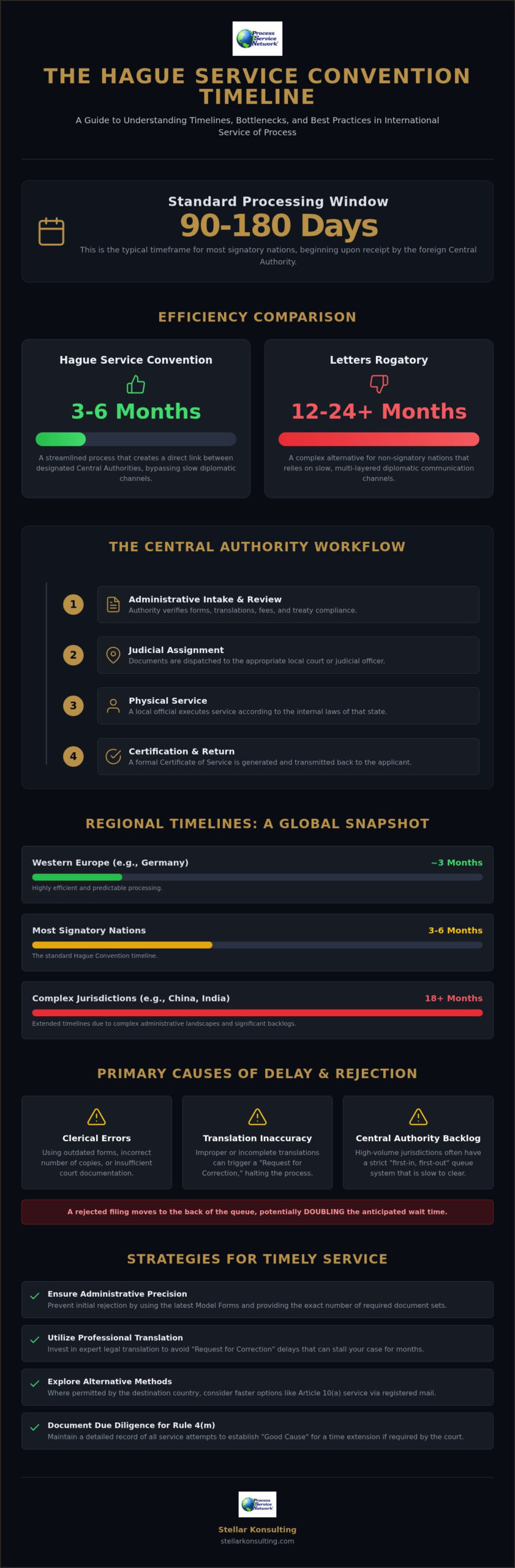
Establishing a baseline for international litigation requires a shift in perspective regarding procedural speed. For most signatory nations, the Hague Service Convention establishes a standard processing window of 90 to 180 days. While domestic attorneys are accustomed to tight deadlines, international service is generally exempt from the standard 90-day limit found in Rule 4(m) of the Federal Rules of Civil Procedure. This exemption acknowledges the inherent complexities of cross-border bureaucracy. When calculating how long does hague service take, you must recognize that the procedural clock typically begins upon the Central Authority’s physical receipt of the request, not the date it was mailed from your office.
The 3-to-6 Month Standard: Why the Wait?
The timeline is largely dictated by the internal workflow of the foreign Central Authority. Once they receive a request, it undergoes a formal review for treaty compliance and translation accuracy. If approved, the documents are forwarded to a local court or judicial officer in the target jurisdiction. This internal logistics chain involves multiple handoffs that can be impacted by local administrative backlogs. The typical workflow includes:
- Administrative Intake: The Central Authority verifies the payment of fees and the presence of required summary forms.
- Judicial Assignment: Documents are dispatched to the appropriate local judicial district or police department.
- Physical Service: A local official executes service according to the internal laws of that state.
- Certification: The authority generates a formal Certificate of Service and transmits it back to the applicant.
International courier logistics and local holidays often add several weeks to this sequence. The final step, receiving the signed Certificate of Service, is often the most time-consuming as it must travel back through the same bureaucratic channels that initiated the request.
Hague vs. Letters Rogatory Speed Comparison
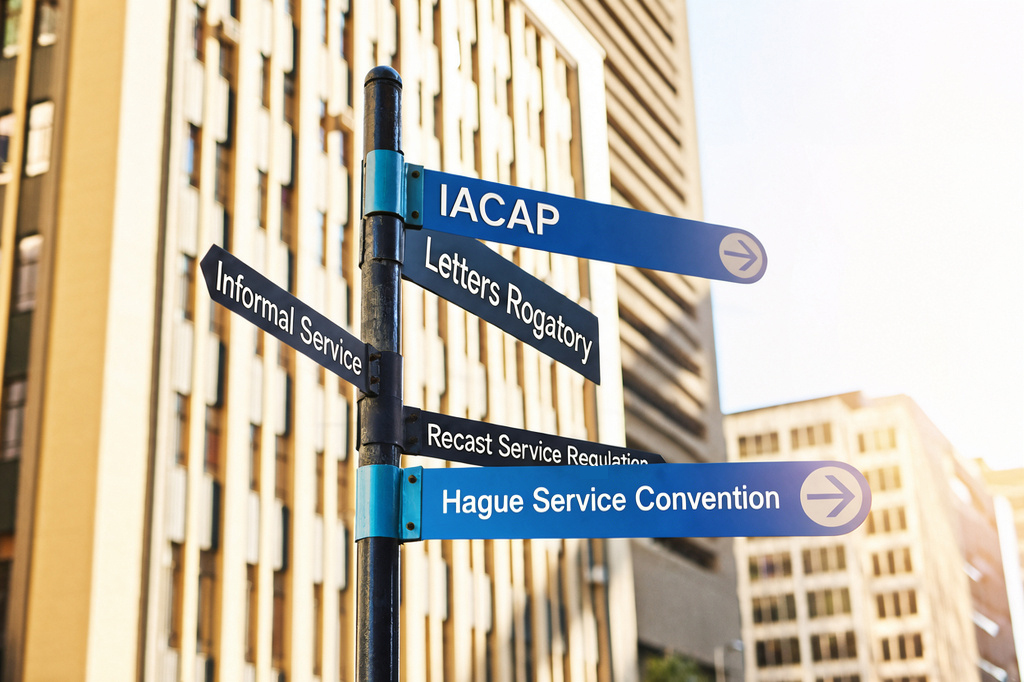
It’s helpful to contrast this with the Letters Rogatory process, which serves as a last resort for service in non-signatory countries. While the Hague process is streamlined, Letters Rogatory can easily span 12 to 24 months. This is because Letters Rogatory rely on diplomatic channels. A request must move from a domestic court to the Department of State, then to a foreign embassy, and finally through the foreign country’s Ministry of Foreign Affairs before reaching their judicial system. The Hague Convention was specifically designed to bypass these diplomatic layers. Understanding how long does hague service take compared to these diplomatic methods highlights the efficiency of the treaty system, which creates a direct link between Central Authorities to reduce administrative friction. For a comprehensive overview of the formal procedures involved, our definitive guide to Hague Convention service of process covers the full compliance framework across all 84 contracting parties.
Critical Factors That Influence International Service Timelines
How long does hague service take depends heavily on the administrative gatekeeper of the receiving nation: the Central Authority. This entity serves as the primary bottleneck in the international service chain. While the treaty provides a framework, the actual speed of execution is dictated by the Central Authority’s current backlog and the meticulousness of their review process. The HCCH Practical Handbook on the Service Convention outlines the specific operational standards for these authorities, yet local interpretation of “sufficient documentation” varies significantly between signatories.
The Central Authority Review Process
Upon receipt of a request, foreign officials perform a rigorous vetting process to ensure the documents comply with both the treaty and local internal law. This intake phase is where many requests fail. Common reasons for immediate rejection include using outdated versions of the mandatory Model Form, failing to include the correct number of duplicate sets, or providing insufficient evidence of the initiating court’s authority. In high-volume jurisdictions, these offices operate on a strict “first-in, first-out” queue system. If a request is rejected for a clerical error, the applicant is often forced to refile, effectively moving to the back of the line and doubling the anticipated wait time. Administrative calendars and local judicial holidays in 2026 also play a role; many European and Asian authorities experience significant slowdowns during seasonal observances, which can add four to six weeks of unexpected delay.
The Translation Factor: A Hidden Delay
Translation quality is perhaps the most overlooked variable in the service timeline. A recurring cause for timeline resets is the submission of “summary” translations rather than full, certified translations of all judicial documents. Many Central Authorities, particularly those in civil law jurisdictions, will not accept a request if any portion of the summons or complaint remains in English. Poorly executed or machine-generated translations often lead to “Requests for Correction.” These notices typically take two to three months to reach the applicant, at which point the entire process must restart. Precise legal translation ensures that the foreign official understands the nature of the claim immediately, preventing contested service and unnecessary administrative friction.
Beyond documentation, the accuracy of the defendant’s location data is vital. In high-volume jurisdictions, a single error in the recipient’s address can result in a “non-found” return after several months of waiting. Utilizing professional skip tracing services before filing ensures the address is current and valid. This proactive step prevents the most common cause of “non-found” returns, ensuring the timeline starts correctly with a verifiable destination.
Regional Variance: Turnaround Times by Jurisdiction
Geographic distance is a poor predictor of service speed. Instead, the political and judicial maturity of the destination state determines the calendar. When evaluating how long does hague service take, you must account for the specific regional variances that define the international legal landscape in 2026. While some nations have digitized their intake, others maintain legacy systems that require extensive local coordination.
High-Efficiency Jurisdictions (2-4 Months)
The United Kingdom and Canada consistently provide the fastest returns for North American litigants. This speed is largely due to the absence of translation requirements and a shared legal heritage. In Northern Europe, nations like Germany typically process requests within three months, including the time required for international shipment. These jurisdictions benefit from highly organized Central Authorities and reliable local judicial infrastructure. For those initiating requests from the United States, the U.S. Department of Justice Guidance on Service Requests provides essential procedural context for navigating these efficient channels. It’s often possible to receive a completed certificate from these nations before a domestic court even schedules a preliminary hearing.
Complex Jurisdictions (6-12+ Months)
The administrative landscape in the People’s Republic of China presents significant hurdles. Current estimates for service in China range from 4 to 18 months. While the Chinese Ministry of Justice now prefers online portal submissions, the process still involves a $95 filing fee and a multi-layered review that can stall for half a year or more. Similarly, service in Mexico often requires significant local court involvement, extending the timeline well beyond the standard Hague window. In these jurisdictions, the Central Authority acts as a high-level distributor, but the actual execution relies on local judicial officers who may prioritize domestic matters. Political shifts or administrative restructuring can also cause these offices to pause operations without notice.
Latin American service often follows a distinct path. Many nations in this region utilize the Inter-American Service Convention alongside or instead of the Hague treaty. These requests frequently involve a more decentralized approach, requiring a deeper understanding of local civil codes to avoid administrative rejection. Success in these regions depends on identifying the specific local court with jurisdiction over the defendant, as the Central Authority may only provide a partial facilitation of the request. Verifying the current operational status of these authorities is a necessary step before finalizing your litigation schedule.
Strategies to Expedite the Hague Service Process
In legal matters involving specific international corridors, such as business and investment disputes between the United States and Israel, specialized firms like the Israel Cross Border Law Firm provide the regional expertise necessary to navigate both procedural requirements and local judicial nuances.
While the Central Authority is the default mechanism for international litigation, it’s often the slowest route. Shifting the answer to how long does hague service take from months to weeks requires a strategic selection of service methods. By utilizing specific provisions within the treaty, legal professionals can bypass the primary administrative bottlenecks that typically cause delays.
Leveraging Article 10 Alternatives
Article 10 of the Convention provides alternative channels that can significantly accelerate the process. In jurisdictions that don’t object to these provisions, such as the United Kingdom, the Netherlands, and Canada, service by international registered mail under Article 10(a) is often permissible. This method bypasses the Central Authority’s internal queue entirely, which can save three to five months of administrative wait time. Similarly, Article 10(b) and (c) allow for direct service through judicial officers or other competent persons in the destination state.
Practitioners must exercise extreme caution when selecting these alternatives. Many high-volume jurisdictions, including Germany, China, and Mexico, have filed formal objections to Article 10. Attempting service through these channels in an objecting nation is more than just a delay; it renders the service void and can lead to the dismissal of the case. Always verify the current declarations of the destination state to ensure the chosen method is legally recognized. Understanding the country-specific compliance requirements for each of the 84 contracting parties is essential; our complete guide to Hague Convention service of process details the mandatory translation requirements and formal procedures that govern each jurisdiction.
Pre-Filing Due Diligence: Skip Tracing
Predictability in your timeline depends on the accuracy of the defendant’s location. A “non-found” return after four months of waiting is a catastrophic failure that restarts the entire process. International skip tracing serves as a critical pre-filing step to confirm the recipient’s current physical address. This proactive due diligence ensures that the documents reach a valid destination on the first attempt, preventing the timeline resets that occur when a Central Authority cannot locate the party. It’s the most effective way to protect your litigation schedule from the unpredictability of elusive defendants.
Technical precision in the mandatory Model Forms is equally non-negotiable. Even a minor clerical error, such as a mismatched name or an incomplete summary form, provides a foreign official with grounds for immediate rejection. Ensuring every field is completed with absolute accuracy reduces the risk of the “Request for Correction” notices that are the leading cause of timeline doubling. If you’re ready to secure your case against these common pitfalls, consider our Formal Hague Service of Process to ensure your documents meet every technical requirement from the start.
Managing Court Expectations and Compliance Deadlines
Rule 4(m) of the Federal Rules of Civil Procedure typically mandates that a defendant be served within 90 days of the complaint being filed. However, the rule explicitly provides an “international exception” for service in a foreign country. This exception isn’t a blank check for indefinite delays. Judges expect to see consistent evidence of due diligence. If a case remains stagnant for months without a status update, you risk a dismissal for lack of prosecution. To secure a timeline extension, you must be prepared to present the court with “Good Cause,” which typically includes:
- Proof of Transmission: Verifiable receipts from the Central Authority or international courier.
- Translation Certifications: Evidence that all documents were professionally translated to meet treaty requirements.
- Interim Status Reports: Documentation of correspondence with the foreign authority regarding the status of the request.
- Compliance Records: Proof that all local fees and Model Forms were submitted correctly on the first attempt.
Providing this level of detail transforms a vague delay into a documented administrative process, reassuring the court that the litigation is proceeding with the necessary precision.
The Role of Professional Process Serving Firms
Maintaining momentum in global litigation requires constant oversight. At Stellar Konsulting, we move beyond simple document transmission by actively monitoring the progress of every request through the foreign Central Authority’s internal queue. This level of management is essential because many authorities don’t proactively provide status updates unless prompted through the correct diplomatic or administrative channels. We act as a single point of professional contact, bridging the gap between your local court’s expectations and the reality of foreign bureaucracy.
The culmination of the process is the return of a formal Certificate of Service. Unlike a domestic Affidavit of Service, which is signed by a private individual, the Hague Certificate is an official government document. It’s the gold standard for proving service in a foreign state. We ensure that this final return is technically compliant and ready for immediate filing, preventing the last-minute clerical rejections that can occur when a return doesn’t meet the specific requirements of the forum court. By managing the complexities of how long does hague service take, we allow legal teams to focus on the merits of their case rather than the mechanics of the calendar.
Securing Your International Litigation Schedule
Meticulous preparation is the only reliable defense against the unpredictable nature of foreign judicial bureaucracies. While the question of how long does hague service take is ultimately influenced by regional backlogs, your timeline is primarily protected by the technical accuracy of your initial filing. Eliminating clerical errors in Model Forms and ensuring certified translation quality prevents the administrative rejections that often double a case’s duration. As we’ve explored, the efficiency of jurisdictions like Germany or the UK contrasts sharply with the administrative landscapes of China or Mexico, making regional expertise indispensable.
Proactive strategies, such as conducting pre-filing skip tracing to confirm defendant locations and utilizing Article 10 alternatives where permitted, provide a clear path to expedited results. Stellar Konsulting brings over 30 years of international expertise and a global network of specialists to every engagement. Our integrated approach combines professional legal translation with specialized skip tracing to ensure your service is executed correctly on the first attempt. Consult with Stellar Konsulting for a precise international timeline assessment to maintain the momentum of your cross-border legal proceedings. With the right partner, the complexities of international service become a manageable part of your litigation strategy.
Frequently Asked Questions
Does the 90-day rule for service apply to international defendants?
Rule 4(m) of the Federal Rules of Civil Procedure contains a specific exemption for service in a foreign country. While domestic defendants must be served within 90 days, this limit doesn’t strictly apply to international parties. You must still demonstrate continuous due diligence to avoid a lack of prosecution dismissal. Judges frequently request status reports to verify that you’re actively pursuing the Central Authority process rather than letting the case languish.
Can I speed up Hague service by paying an expedite fee to the Central Authority?
Most foreign Central Authorities don’t offer an official expedite service for a fee. Their internal queues are strictly administrative and follow a first-in, first-out protocol. While some private contractors for the U.S. Central Authority offer expedited attempts for foreign applicants, this isn’t a standard feature in most signatory nations. Speeding up the process usually involves ensuring your documentation is flawless on the first attempt to avoid time-consuming requests for correction.
What happens if the Central Authority does not return the certificate within six months?
If six months have passed since you initiated the request, you may be eligible to move the court for alternative service under Rule 4(f)(3). Article 15 of the Convention also provides a mechanism for a judge to enter a default judgment if a certificate hasn’t been received after six months of diligent effort. You’ll need to provide the court with a verifiable transmission receipt to prove the timeline started correctly.
Is service by email allowed under the Hague Convention to save time?
The Hague Convention doesn’t explicitly authorize service by email. This method is typically only available via a court order under Rule 4(f)(3) as a secondary measure when formal treaty efforts are delayed or unsuccessful. Some courts permit it if the destination country hasn’t filed a specific objection to Article 10, but it shouldn’t be your primary strategy without prior judicial approval and a thorough compliance review of local laws.
Why does service in China take significantly longer than in the UK?
The difference in timelines is largely due to administrative complexity and translation requirements. Service in China involves a multi-layered review by the Ministry of Justice and local courts, often taking 6 to 18 months. The UK doesn’t require translation for English documents and utilizes a more streamlined judicial officer system. Understanding how long does hague service take in these high-volume regions helps in setting realistic expectations for your litigation calendar.
What is the fastest way to serve process in a Hague Convention country?
Utilizing Article 10 alternatives is the fastest route in countries that don’t object to service by mail or judicial officer. In nations like the Netherlands or Canada, this can reduce the wait by several months compared to the formal Central Authority channel. If Article 10 is prohibited, the fastest way to ensure success is through absolute technical precision in your Model Forms to prevent any administrative rejections or timeline resets.
Do I need to translate my documents if the defendant speaks English?
Translation requirements are dictated by the laws of the receiving state rather than the language skills of the defendant. Even if a recipient is fluent in English, most Central Authorities in civil law jurisdictions won’t execute service without a certified translation in their official language. Failing to provide these documents is a primary reason why people ask how long does hague service take, as rejections for translation errors often add months to the process.
Will my case be dismissed if Hague service takes longer than a year?
A case won’t be dismissed automatically for exceeding a year if you can prove you’ve been diligent. Courts recognize that international service is subject to foreign backlogs beyond your control. You must provide regular status reports and evidence that the delay lies with the foreign Central Authority rather than your own inaction. Maintaining a clear record of every communication and follow-up is vital to protecting your standing before the judge.