
A single technical error in the service of process can render years of complex litigation entirely void before the merits of the case are even heard. Legal professionals understand that the stakes of international litigation are high, yet the procedural requirements often feel like an unpredictable moving target. When you’re tasked with serving a foreign corporation, the distinction between a valid delivery and a fatal procedural mistake often rests on a handful of specific treaty articles and jurisdictional nuances.
This guide provides the authoritative roadmap you need to master these complexities while ensuring strict compliance with international treaties and domestic statutes. We’ll examine the specific triggers for the Hague Service Convention, which now includes 130 contracting parties, and the lengthy timelines associated with Letters Rogatory. You’ll also learn how professional skip tracing and legal translation function as essential safeguards against service rejection. By following this methodical approach, you can navigate cross-border requirements with the precision that sophisticated global litigation demands.
Key Takeaways
- Distinguish between domestic out-of-state entities and international corporations to determine if service on a registered agent is legally sufficient.
- Learn the essential procedural steps for serving a foreign corporation while maintaining strict compliance with the Hague Service Convention.
- Identify the risks associated with informal service methods to avoid technical errors that could lead to a case dismissal.
- Understand the necessity of professional legal document translation and skip tracing when locating corporate officers in non-English speaking jurisdictions.
- Navigate the logistical differences between formal Central Authority requests and the traditional diplomatic channels of Letters Rogatory.
Understanding the Legal Definition of a Foreign Corporation
A common point of confusion in U.S. litigation is the term “foreign corporation.” In many state statutes, this refers simply to a company incorporated in a different U.S. state. However, when serving a foreign corporation in a global context, we’re often dealing with “alien” corporations incorporated in another country. In international litigation, a foreign corporation is a legal entity organized under the laws of a nation other than the forum state, requiring specific procedural adherence to both local statutes and international treaties.
Determining the corporation’s registration status is your first critical step. If an international company is authorized to do business in your forum state, it likely maintains a registered agent of record. This simplifies the service of process significantly. If they’re unauthorized and have no physical presence, you must pivot to international protocols. Jurisdictional reach depends on “minimum contacts,” but the method of delivery is governed by where the entity is physically located. Failure to distinguish between these categories at the outset often leads to service being quashed later in the proceedings.
Domestic Foreign Corporations: Out-of-State Entities
When a company is incorporated in Delaware but operates in another state, it’s considered a domestic foreign corporation. Attorneys can usually identify the registered agent of record through state-maintained business entity databases. For example, a foreign corporation registering to do business in Texas must pay a $750 filing fee and designate an agent for service. To navigate these corporate registration and compliance requirements, Massingill Attorneys & Counselors at Law offers specialized business law support for entities operating in the state. If the agent can’t be located after reasonable diligence, many states allow for substitute service via the Secretary of State. This involves filing an affidavit and paying a statutory fee to ensure the court maintains jurisdiction over the out-of-state entity.
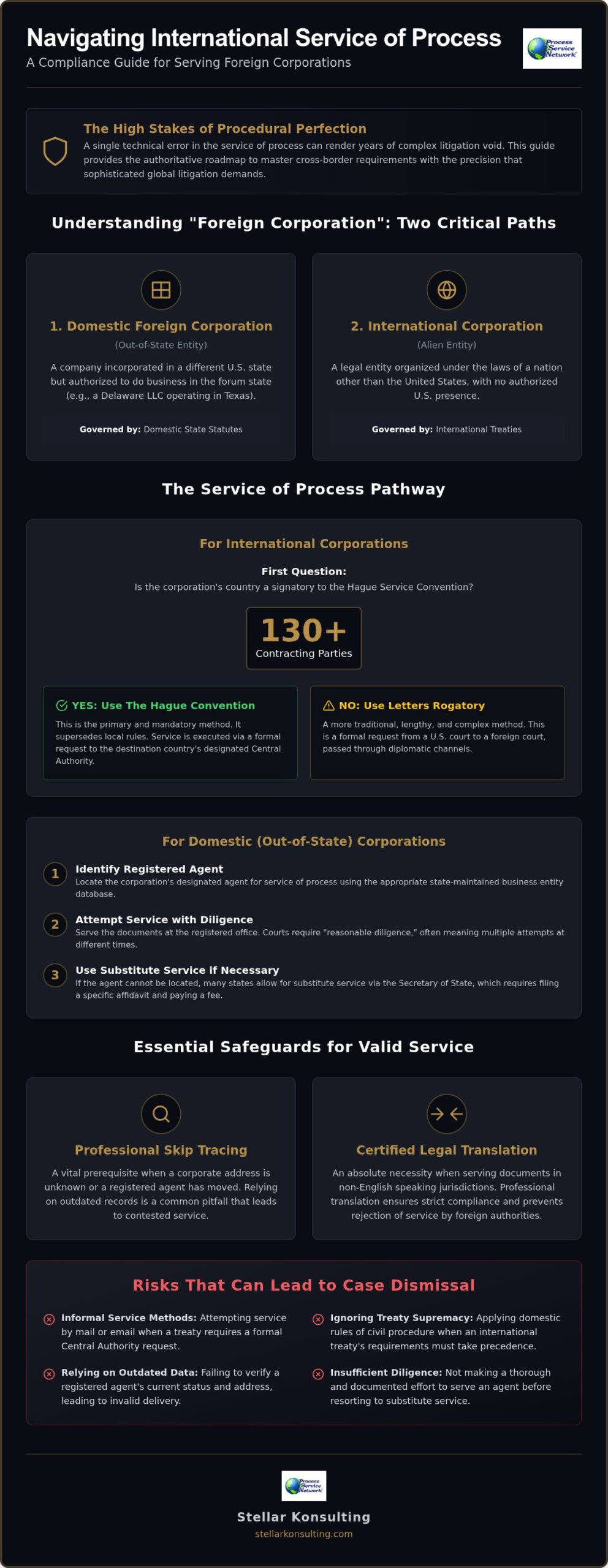
For companies located entirely outside U.S. borders, state statutes often yield to international treaties. The Due Process Clause of the U.S. Constitution requires that the method of serving a foreign corporation is reasonably calculated to provide actual notice. This is why identifying the exact corporate headquarters abroad is vital. Once the location is confirmed, you must determine if the target nation is a signatory to the Hague Service Convention. With 130 contracting parties currently recognized, treaty requirements will almost always supersede local rules of civil procedure. If the corporation has no known address, specialized skip tracing becomes a prerequisite for valid service.
Serving Corporations Authorized to Do Business Domestically
When an international entity registers to conduct business within a U.S. jurisdiction, the procedural burden of serving a foreign corporation shifts from international treaty compliance to domestic statutory adherence. This registration requires the corporation to appoint a registered agent, creating a reliable point of contact for legal notifications. However, simply having an address on file doesn’t guarantee a valid service. You must follow a precise sequence to ensure the court recognizes the delivery as legally binding.
The process begins by verifying the current agent of record through the appropriate state database. Once identified, service is attempted at the registered office. Courts demand “reasonable diligence,” which usually means multiple attempts at different times and a thorough investigation if the office appears vacant. A detailed scholarly review of Service of Process on Foreign Corporations emphasizes that while registration simplifies the path to jurisdiction, any deviation from state-specific service rules can result in a dismissal. The return of service must be exhaustive. It often requires a photographic copy of the designation instrument to confirm the agent’s authority at the time of delivery.
Locating and Verifying the Registered Agent
It’s common for corporate records to lag behind reality. Registered agents may move, resign, or dissolve without the corporation updating its filings. Relying on outdated state data is a frequent pitfall that leads to contested service. Utilizing specialized location services is often necessary to verify that an agent is still active and physically present at the listed address. Legally, serving a designated natural person within the agent’s office is typically sufficient, provided they’re authorized to accept documents. If the office is a commercial mail drop or a virtual space, the service’s validity may be challenged under local rules.
Alternative Service when Agents are Unavailable
If the registered agent cannot be found after diligent efforts, most states provide a fallback mechanism. This usually involves substitute service on the Secretary of State or the Clerk of the Commission. You must adhere to strict statutory timelines, often requiring a specific waiting period after the initial failed attempt. Once the state official is served, the burden typically falls on the plaintiff to ensure the summons and complaint are also sent to the corporate headquarters via certified mail. This dual-notification process ensures compliance with the Due Process Clause while serving a foreign corporation that has failed to maintain its domestic presence. To avoid these issues, many international firms maintain their local standing by using professional HR outsourcing services Savannah Georgia to manage their regional administrative and compliance needs.
When a corporation has no domestic presence or registered agent, the process of serving a foreign corporation must move into the international arena. This transition requires a shift from local rules of civil procedure to the rigid frameworks of international treaties and diplomatic protocols. The choice between these methods is rarely optional; it’s dictated by whether the target nation is a signatory to specific conventions. As of 2026, there are 130 contracting parties to the Hague Service Convention, making it the most common pathway for cross-border litigation.
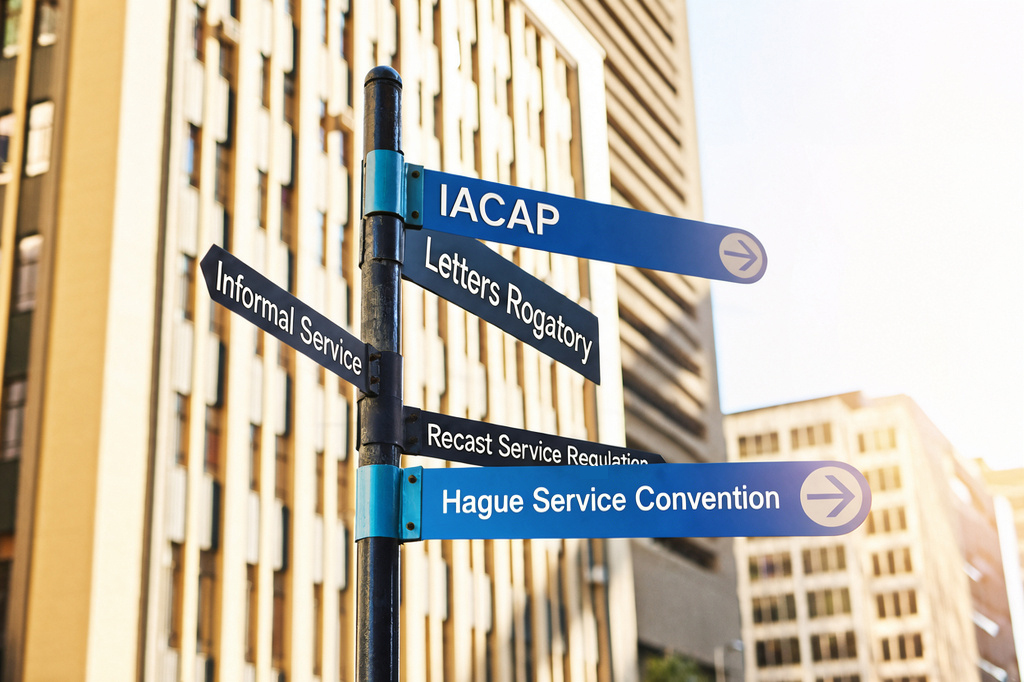
While some jurisdictions may occasionally permit alternative service via email or social media, these methods often fail to meet the “due process” standards required for the eventual enforcement of a judgment. Relying on Article 10 “informal” methods, such as service by mail, is particularly hazardous in countries that have filed formal objections to those specific provisions. In such cases, the only path to a valid, enforceable result is through the formal Central Authority of the destination country. For litigation involving Latin American entities, the Inter-American Service Convention provides a similar, though distinct, treaty-based framework that must be followed with equal precision.
Hague Convention Service: The Gold Standard
The Formal Hague Service of Process remains the most reliable method for ensuring a U.S. court retains jurisdiction. This mechanism involves sending a formal request to the Central Authority of the foreign state, which then executes service according to its internal laws. While this process typically takes between three and six months, it culminates in an official Certificate of Service. This document is virtually immune to challenges regarding procedural validity. Without this certificate, you risk a case dismissal if the defendant corporation claims they were never properly notified under the treaty’s mandatory terms.
Letters Rogatory: Service in Non-Hague Jurisdictions
In nations that aren’t parties to the Hague Convention, serving a foreign corporation requires the traditional, more arduous method of Letters Rogatory. This involves a formal request from a U.S. court to a foreign court, transmitted through diplomatic channels. It’s a methodical, court-to-court request for judicial assistance that demands strict adherence to the recipient nation’s sovereignty. You should expect significant delays, as this process commonly takes a year or more to complete. Additionally, every document must meet exacting translation standards, as any linguistic error can lead to a total rejection by the foreign judiciary. Because of these complexities, Letters Rogatory is considered the method of last resort, used only when no treaty-based alternative exists.
Overcoming Logistics: Skip Tracing and Translation Requirements
Validating a treaty-compliant method is insufficient if the target entity’s location is outdated or the documents are linguistically flawed. When serving a foreign corporation, logistical precision is the difference between a successful service and a costly, time-consuming rejection by a foreign Central Authority. The procedural complexity of international litigation doesn’t end with choosing the right convention; it requires a meticulous approach to identifying the correct recipient and ensuring they receive the documents in a language they’re legally entitled to use.
Many practitioners underestimate the rigor of foreign civil law systems. In these jurisdictions, the definition of a corporate “control person” often differs significantly from U.S. standards. Identifying the specific individual authorized to accept service is a prerequisite for a valid delivery. If the documents are served to a person without the proper legal standing under the destination country’s laws, the service can be quashed, even if the delivery was physically successful. This is why verifying the corporate structure before initiating service is a mandatory step in our methodical process.
Locating Corporate Officers Globally
Finding an offshore address requires sophisticated investigative techniques that go beyond simple public record searches. Utilizing professional skip tracing services is essential to verify the current physical presence of a corporation before initiating expensive treaty service. Corporate restructuring, mergers, or sudden relocations can render a service attempt void if the documents are delivered to a defunct office or an unauthorized representative. We focus on verifying the current place of business to ensure that the 3-to-6-month timeline of the Hague Convention isn’t wasted on an incorrect address. This preliminary verification acts as a safeguard, protecting the litigation timeline from unnecessary delays caused by bad data.
Certified Legal Translation for International Use
In many jurisdictions, a full translation of every legal document, including all exhibits and attachments, is a non-negotiable requirement. Automated translations are strictly grounds for service rejection in almost all foreign jurisdictions because they lack the necessary precision for legal terminology. A certified translator must provide a formal affidavit of accuracy to accompany the translated Summons and Complaint. This ensures the documents meet both the international treaty requirements and the local court standards of the destination country. Even a minor linguistic error in a technical exhibit can lead to a summary dismissal of the service request by a Central Authority. Managing these high-stakes linguistic requirements requires a partner who understands the nuance of legal jargon across diverse languages. You can partner with Stellar Konsulting for comprehensive translation and service management to ensure your documents withstand judicial scrutiny in any jurisdiction.
Securing Valid Service with Stellar Konsulting
Stellar Konsulting operates as a specialized facilitator in the international legal arena. We manage the entire lifecycle of serving a foreign corporation, from the initial verification of corporate status to the final delivery of the Certificate of Service. Our team possesses deep technical knowledge of both the Hague Service Convention and the Inter-American Service Convention. This dual expertise is critical for law firms handling litigation involving entities in Europe, Asia, and Latin America. By centralizing these tasks, we eliminate the logistical gaps that frequently lead to a defense of improper service.
A unified litigation support strategy is the most effective way to secure a case against procedural challenges. We integrate professional skip tracing and legal document translation directly into the service process. This ensures that every document is delivered to a verified address and translated to meet the specific linguistic requirements of the destination country. This comprehensive approach addresses the pain points discussed earlier, such as the confusion between domestic and international treaty requirements. We focus on the precision required to withstand judicial scrutiny in both the forum state and the foreign jurisdiction.
Expertise in Complex Cross-Border Litigation
Navigating foreign Central Authority backlogs requires persistence and established relationships within the international legal community. Stellar Konsulting leverages over 30 years of experience to manage these delays effectively. We provide the meticulous documentation and affidavits necessary for U.S. courts to prove that valid service has occurred. This level of procedural adherence is essential for reducing the risk of a case dismissal due to technical errors. Our methodology prioritizes transparency and directness, ensuring that counsel remains informed throughout the months required for formal treaty service.
Next Steps for Your International Case
Initiating the process for international summons and complaint service requires organized documentation. Counsel should prepare a complete set of documents, including any necessary exhibits, for our team to review. We’ll then determine the most efficient pathway based on the target corporation’s location and registration status. This organized approach mirrors the precision we apply to every task. You can take the first step toward securing valid cross-border service today. Consult with Stellar Konsulting for Global Process Serving to ensure your litigation proceeds without procedural interruption.
Securing Global Jurisdictional Authority
Successfully serving a foreign corporation requires more than just physical delivery; it demands a dual-track strategy that respects both domestic statutes and international treaties. The distinction between a registered out-of-state entity and an alien corporation dictates whether you follow state-level rules or the rigid frameworks of the Hague Convention. Ensuring your documents are properly translated and that corporate officers are accurately located via skip tracing isn’t just a best practice. It’s a procedural necessity to avoid the improper service defense that can derail your case before it truly begins.
Stellar Konsulting brings over 30 years of specialized international legal support to every engagement. Our comprehensive Hague Convention and Letters Rogatory expertise, paired with a global network for skip tracing and legal translation, ensures your litigation remains on track. Don’t let technical errors jeopardize your client’s interests. Ensure Your International Service is Valid—Contact Stellar Konsulting Today. With the right procedural partner, you can navigate these complex cross-border requirements with total confidence and professional precision.
Frequently Asked Questions
Can I serve a foreign corporation by certified mail?
Generally no, unless the target country has not objected to Article 10(a) of the Hague Convention. Even then, U.S. courts may require proof that the method is valid under the laws of the receiving nation. Relying on mail often leads to unenforceable judgments or a case being quashed by the court. It’s safer to use formal Central Authority channels to ensure the service is legally recognized internationally.
What happens if a foreign corporation does not have a registered agent?
If an entity is authorized to do business but lacks an agent, you may use substitute service on the Secretary of State. However, for serving a foreign corporation with no domestic presence, you must use international treaty methods like the Hague Convention. This involves identifying the corporate headquarters abroad through skip tracing before submitting a formal request to the foreign nation’s Central Authority for execution.
How long does it typically take to serve a corporation under the Hague Convention?
The process generally takes between three and six months to complete. This timeline depends heavily on the efficiency of the receiving country’s Central Authority and whether the documents were properly translated and formatted. While this is significantly faster than the year-long wait often associated with Letters Rogatory, it still requires advanced planning to meet U.S. court deadlines for the return of service and jurisdictional proof.
Is service by email valid for a foreign corporation?
Service by email is only valid if specifically authorized by a U.S. court order under Federal Rule of Civil Procedure 4(f)(3). Courts usually only grant this when traditional treaty methods are proven to be impossible or unsuccessful. Additionally, the method must not be prohibited by an international agreement. Without a court order, electronic delivery is almost never considered valid service on a foreign entity in most jurisdictions.
What is the difference between formal and informal service of process?
Formal service involves the Central Authority of a foreign state executing the request according to its domestic laws. This results in a Certificate of Service that is highly resistant to legal challenges. Informal service refers to methods like delivery by mail or private process servers under Article 10 of the Hague Convention. While informal methods are faster, they’re only valid if the destination country has not filed a formal objection.
Do I need to translate my legal documents when serving a foreign corporation?
Yes, most foreign jurisdictions and Central Authorities require a full translation of all legal documents into their official language. This includes the summons, complaint, and all attached exhibits. Failure to provide a certified translation is a primary cause for the immediate rejection of a service request. Professional translation ensures that the technical legal terminology remains accurate, preventing a defense of improper notice by the defendant corporation.
What is a Letter Rogatory and when is it used for corporate service?
A Letter Rogatory is a formal court-to-court request for judicial assistance transmitted through diplomatic channels. It’s the required method for serving a foreign corporation in countries that aren’t parties to the Hague Convention. Because it relies on the voluntary cooperation of a foreign judiciary, it’s the slowest and most complex method available. It often takes a year or more to execute and requires strict adherence to foreign procedural and linguistic norms.
Can a US court dismiss my case if service on a foreign entity is delayed?
While Federal Rule of Civil Procedure 4(m) generally exempts international service from the 90-day time limit, courts can still dismiss a case for failure to prosecute. You must demonstrate reasonable diligence by showing that you’ve actively pursued service through valid treaty channels. Documenting your efforts with a Central Authority or demonstrating the use of skip tracing to locate a defendant is essential to avoid a dismissal for lack of progress.