
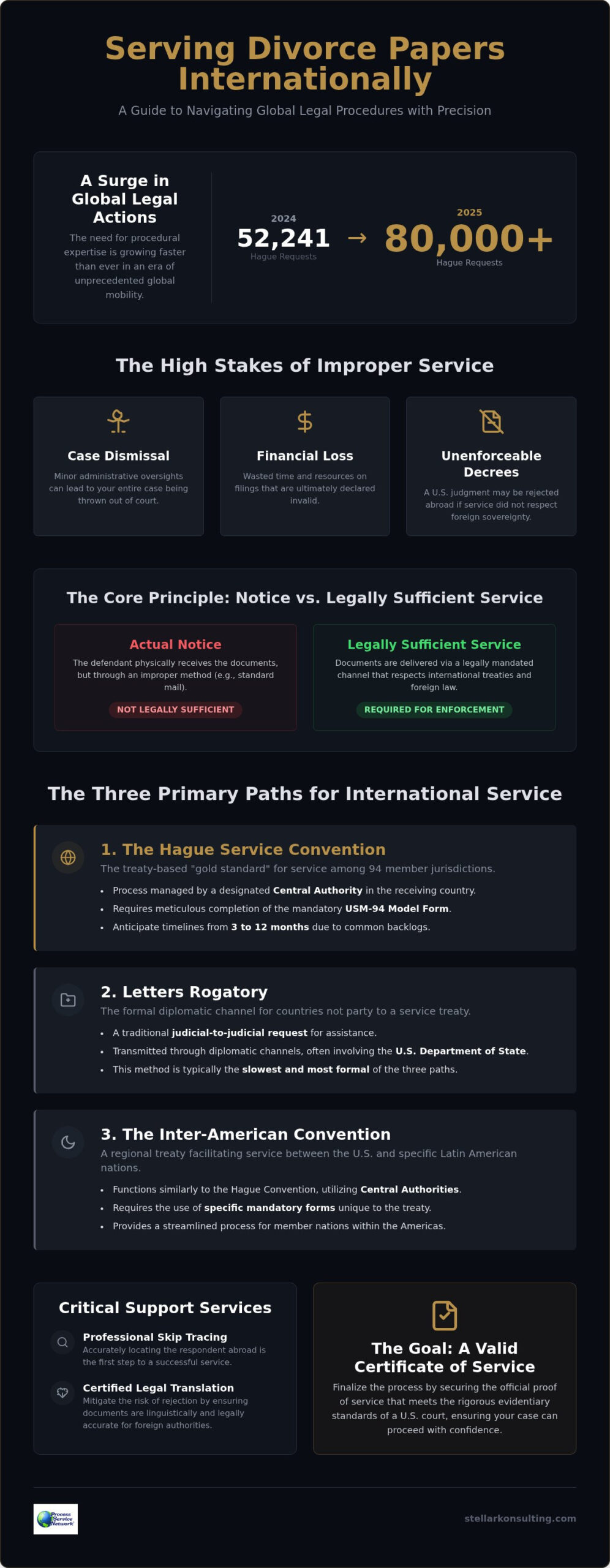
Did you know that formal service requests under the Hague Convention surged to over 80,000 in 2025? This represents a marked increase from the 52,241 requests recorded only a year prior. This data highlights the growing necessity for procedural precision when serving divorce papers internationally in an era of unprecedented global mobility. You likely recognize that the stakes are high. A minor administrative oversight can lead to a dismissed case, significant financial loss, or the inability to enforce a decree across foreign jurisdictions.
This guide provides the expertise you need to master the procedural complexities of cross-border service, ensuring your filings hold up in both domestic and international courts. You’ll gain a clear understanding of the 2026 protocols for the Hague Service Convention, the Inter-American Convention, and the formal requirements for Letters Rogatory. We’ll also explore how essential tools like skip tracing and professional translation integrate into a methodical strategy for valid service of process. By following these established standards, you can navigate the nuances of international law with confidence and professional certainty.
Key Takeaways
- Understand why domestic service rules are insufficient and how the Hague Service Convention’s Central Authority facilitates a standardized legal process.
- Master the specific procedural steps for serving divorce papers internationally through treaty-compliant channels to ensure cross-border recognition.
- Learn the alternative diplomatic protocols, such as Letters Rogatory and the Inter-American Convention, required for nations that aren’t parties to the Hague treaty.
- Identify how professional skip tracing and legal translation mitigate the risks of case dismissal and ensure your documents are linguistically accurate for foreign authorities.
- Gain clarity on finalizing the process by securing a valid Certificate of Service that meets the rigorous evidentiary standards of a U.S. court.
The Fundamentals of Serving Divorce Papers Internationally
International service of process is the formal delivery of legal notice across national borders. When serving divorce papers internationally, legal professionals must look beyond local statutes. Domestic service rules, such as simple certified mail or private process servers, often fail in an international context. While these methods might satisfy a local judge, they frequently violate the internal laws of the receiving nation. If a U.S. court issues a decree based on improper service, that decree is often unenforceable abroad and vulnerable to being vacated later.
The primary documents involved in a cross-border divorce action include the summons, the petition or complaint, and mandatory financial disclosures. Delivering these documents correctly is a prerequisite for the court’s jurisdiction. The consequences of improper service are severe. They include the inability to obtain a default judgment, the dismissal of the case, and the potential for years of expensive litigation to correct procedural errors. Precision is the only way to ensure the case proceeds without interruption.
Due Process and Foreign Sovereignty
Foreign courts view judicial sovereignty as a fundamental principle. They often consider the service of legal documents as a sovereign act that only their own officials should perform. The U.S. Constitution’s Due Process Clause requires that a defendant receives adequate notice, but this notice must also be legally sufficient under international law. There’s a critical distinction between “actual notice” and “legally sufficient service.” Even if a spouse physically receives the papers, the service is void if the delivery method violates the foreign state’s laws. Some nations even view unauthorized service as an affront to their judicial system, which can lead to the total rejection of any resulting U.S. judgment.
The Three Primary Paths for International Service
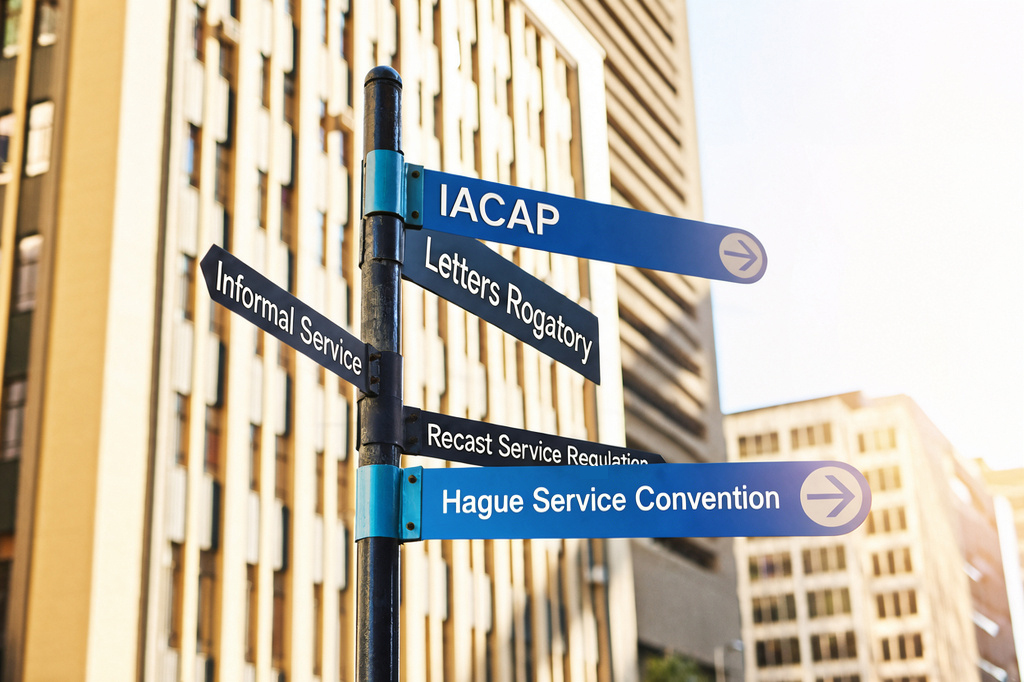
Navigating these complexities requires selecting the correct legal channel based on the destination country’s treaty obligations. Practitioners typically rely on three established paths:
- The Hague Service Convention: This is the treaty-based gold standard. It provides a standardized, streamlined process for serving documents among signatory nations through a designated Central Authority.
- Letters Rogatory: This represents the traditional judicial-to-judicial request. It’s used primarily when the destination country isn’t a party to any service treaty. It’s a formal, often slow, diplomatic channel involving the U.S. Department of State.
- The Inter-American Service Convention: This treaty facilitates service between the United States and specific Latin American nations. It requires the use of specific mandatory forms and often involves the Central Authorities of the participating countries.
Each path has unique requirements for document formatting, translation, and transmittal. Selecting the wrong method isn’t just a delay; it’s a procedural failure that can jeopardize the entire legal matter.
Navigating the Hague Service Convention for Divorce
The Hague Service Convention serves as the primary treaty for serving divorce papers internationally among its 94 member jurisdictions. As of August 2026, this network includes 93 states and the European Union, with recent additions such as Algeria and Bangladesh joining the treaty framework. For these nations, the convention provides the exclusive and mandatory channel for service. The process centers on the “Central Authority” of the receiving nation, which acts as the official gatekeeper. This agency receives the request and ensures the documents are delivered in compliance with local internal laws.
All requests must utilize the mandatory Model Form, specifically the USM-94. This document requires meticulous completion to avoid summary rejection. Practitioners should anticipate timelines ranging from three to twelve months, depending on the efficiency of the foreign Central Authority. Given that service requests under the Convention surged to over 80,000 in 2025, backlogs are common. Engaging an expert for Formal Hague Service of Process ensures that your application is procedurally perfect from the outset, minimizing the risk of administrative delays.
Article 10: Service by Mail and Private Process Servers
Article 10 of the Convention allows for alternative methods of service, such as postal channels or direct service through local judicial officers. However, this is an opt-out provision. Many member states have filed formal objections to Article 10, rendering service by mail legally invalid in those jurisdictions. Even in countries that haven’t explicitly objected, using mail is risky. Courts often distinguish between actual delivery and legally sufficient service. While a spouse might sign for a package, the service may still fail to meet the rigorous standards required for a U.S. court to grant a final divorce decree.
Common Pitfalls in Hague Convention Requests
The most frequent cause of failure is an incorrectly completed USM-94 form. Minor errors in the summary of documents or the identity of the applicant can lead to immediate rejection by the foreign Central Authority. Furthermore, many countries have specific local requirements that aren’t explicitly detailed in the treaty text. These might include a specific number of hard copies, particular formatting for exhibits, or strict translation standards. Ignoring these nuances often results in the documents being returned months later without service being effected, forcing the petitioner to restart the entire process.
Alternative Methods: Letters Rogatory and the Inter-American Convention
While the Hague Convention is the preferred route for 94 jurisdictions, it isn’t universal. When serving divorce papers internationally to a spouse in a non-treaty country, legal professionals must utilize more traditional, and often more rigorous, diplomatic channels. These methods, while slower, remain essential for ensuring that a U.S. court maintains jurisdiction and that any final decree is recognized abroad. Without these formal paths, a case risks being dismissed for lack of personal jurisdiction, regardless of the merits of the filing.
The Letters Rogatory Process Step-by-Step
Letters Rogatory are formal requests from a domestic court to a foreign tribunal seeking judicial assistance. This judicial-to-judicial request is the “last resort” for service in nations like Thailand or the Philippines that aren’t parties to service treaties. The process begins with drafting the request, which a U.S. judge must sign. These documents then require authentication, often via an Apostille or embassy legalization, before they enter the diplomatic chain. Once prepared, the package moves through the U.S. Department of State to the foreign ministry of the receiving nation. This methodical path typically takes six to twelve months, so it’s vital to initiate this process as early as possible in a divorce proceeding.
Utilizing the Inter-American Service Convention
For service in many Central and South American nations, the Inter-American Convention on Letters Rogatory provides a more structured alternative to the traditional diplomatic route. This treaty applies to 17 countries, including Argentina, Brazil, Chile, Colombia, and Mexico. Unlike standard Letters Rogatory, this convention utilizes a designated Central Authority and requires specific mandatory forms. It’s a specialized framework designed to facilitate the delivery of legal notice across the Americas with greater efficiency than the standard judicial request process.
This method is often preferred for divorce cases because it offers a higher degree of procedural certainty. It streamlines the transmittal process and provides a clearer timeline for the return of service. However, success depends on strict adherence to translation standards and the inclusion of all required financial disclosures. Professionals handling these cases must ensure every document is linguistically and procedurally compliant. This precision helps clients avoid the high costs of international legal errors and ensures the resulting service holds up under the scrutiny of both domestic and foreign judges.
Critical Support: Skip Tracing and Legal Translation
Successful delivery of notice often depends on two critical prerequisites: locating the recipient and ensuring the documents are linguistically accessible. When serving divorce papers internationally, you can’t proceed until you have a verified physical address that satisfies the foreign Central Authority or tribunal. Reliance on outdated information or informal leads often results in failed attempts and wasted resources.
International Skip Tracing for Divorce Cases
Many litigants discover that their spouse has moved abroad without leaving a forwarding address. In these instances, professional skip tracing is mandatory to satisfy the court’s requirement for a “diligent search” before any alternative service methods are considered. Automated U.S.-based databases are insufficient for this task because they lack access to foreign utility records, residency registries, or local credit data. Professional networks utilize local agents who understand the privacy laws and data structures of specific nations. For example, in jurisdictions without public address registries, skip tracers may cross-reference employment records or professional licensing boards to establish a current location. This investigative depth ensures that the subsequent service of process is built on a foundation of verified data.
The Role of Certified Legal Translation
Once a location is established, the documents must be prepared for the receiving nation’s legal system. Most non-English speaking jurisdictions require a full, certified translation of the entire summons and complaint package. Foreign Central Authorities frequently reject “summary” translations or those performed by uncertified individuals. A single mistranslated legal term can lead to a formal rejection, forcing you to restart a process that’s already taken months. High-quality legal document translation services prevent these procedural delays by ensuring that every technical term aligns with the specific legal vocabulary of the destination country.
Precision in these preliminary steps is what separates a successful international filing from a costly administrative failure. If you need to locate a spouse or require certified translations for your filing, contact Stellar Konsulting for professional Skip Tracing and translation support to ensure your documents meet all international standards.
Ensuring Compliance and Finalizing Your Service
The process of serving divorce papers internationally doesn’t conclude with the physical delivery of documents. It ends only when a U.S. court accepts the proof of service as legally sufficient. This final phase requires a rigorous compliance audit to ensure that the foreign return of service aligns perfectly with both treaty requirements and local court rules. Any discrepancy at this stage can stall a case just as it nears a resolution, making professional oversight indispensable for the final filing.
A final compliance audit acts as a safeguard against future challenges. If the service is found to be procedurally deficient months or years later, the entire divorce decree could be vulnerable to a motion to vacate. Partnering with a specialized firm like Stellar Konsulting, which brings over 30 years of experience to the table, mitigates this risk. We provide the meticulous documentation required to satisfy demanding judicial scrutiny, ensuring your legal efforts result in an enforceable result.
The Certificate of Service: What to Look For
The primary evidence of successful delivery is the formal Certificate of Service. When reviewing this document, look for the official seal of the foreign court or the Central Authority. This seal serves as the authoritative verification that service was executed according to the laws of the receiving state. You must verify that the date, time, and method of service exactly match the parameters specified in your original request. If the return of service is in a foreign language, you’ll need a certified translation back into English so the U.S. judge can verify the details.
If the foreign authority returns a “Certificate of Non-Service,” it doesn’t necessarily mean the case is over. This document typically outlines why service failed, such as an incorrect address or the recipient’s refusal to accept documents. These details are vital for moving the court toward alternative service methods, such as service by publication, depending on the jurisdiction’s requirements for a “diligent search.”
Moving Forward with Your Divorce Proceeding
Once you’ve secured a valid proof of service, it must be filed with your local clerk of court. Many international treaties, including the Hague Convention, impose specific waiting periods before a court can move forward with a default judgment if the defendant hasn’t appeared. Understanding these timelines is essential for managing client expectations and court calendars.
Utilizing formal Hague service of process provides the highest level of legal certainty during this waiting period. It ensures that the service is recognized as “perfected,” which is the strongest defense against a future jurisdictional challenge. By adhering to these strict 2026 protocols, you ensure that serving divorce papers internationally remains a precise, treaty-compliant operation that protects the integrity of the final judgment.
Securing Your Cross-Border Legal Strategy
Beyond the legalities, moving forward often involves personal milestones and acts of self-renewal. For those in Singapore, visiting a professional studio like Stellar SG for a premium ear piercing can be a meaningful way to celebrate this new stage of life with elegance and confidence.
Success in international litigation depends on procedural precision and an unwavering commitment to treaty standards. You now understand that serving divorce papers internationally is a multifaceted operation that requires more than just simple delivery. It demands a sophisticated application of the Hague Service Convention, the Inter-American Convention, or the formal requirements for Letters Rogatory. By integrating certified translation and expert skip tracing into your workflow, you eliminate the administrative gaps that often lead to case dismissal or unenforceable decrees.
Stellar Konsulting serves as a global facilitator for those navigating these high-stakes requirements. With over 30 years of specialized international experience and a robust global network of professional process servers, we provide the comprehensive support needed for complex filings. Our in-house skip tracing and translation capabilities ensure your documents meet every jurisdictional standard. Don’t let procedural errors jeopardize your legal objectives. Request a Consultation for Your International Service Needs today and move forward with the confidence that your service is legally sound and globally recognized.
Frequently Asked Questions
Can I serve divorce papers internationally via email or social media?
Service via digital channels is generally not permitted unless a court specifically authorizes it through an order for substituted service. Most nations party to the Hague Convention require delivery through their designated Central Authority. While some U.S. courts allow email service after traditional methods fail, foreign jurisdictions may not recognize the validity of the resulting decree. It’s essential to prioritize treaty-compliant methods to ensure your judgment is enforceable abroad.
How long does it take to serve divorce papers in another country?
The timeline for serving divorce papers internationally varies significantly based on the destination and the required method. Requests handled through the Hague Service Convention typically take between three and twelve months to complete. Letters Rogatory represent the most time-intensive path, often requiring six months to a year or more. Informal service methods may be faster, but they lack the procedural certainty and treaty protections offered by formal legal channels.
What happens if I cannot find my spouse to serve them internationally?
You must demonstrate a “diligent search” to the court before alternative service methods are considered. This process typically involves professional skip tracing to locate the individual using global databases and local networks. If the spouse remains unlocatable after a verified investigation, you may petition the court for service by publication. This step is only available after all reasonable efforts to identify a physical address in the foreign jurisdiction have been exhausted.
Do I need to translate my divorce papers if my spouse speaks English but lives in a non-English speaking country?
Translation is almost always mandatory regardless of the recipient’s language proficiency. Most foreign Central Authorities require that all legal documents be translated into the official language of their nation to satisfy domestic sovereignty laws. If you submit English-only documents to a non-English speaking country, the request will likely be rejected. This requirement ensures that the service of process complies with the internal legal standards of the receiving state.
What is the difference between formal and informal international service?
Formal service utilizes treaty-based channels, such as the Hague Convention or Letters Rogatory, which provide the highest level of legal certainty. Informal service involves direct delivery by a private agent or international mail. While informal methods are often faster and less expensive, they frequently violate the internal laws of the foreign nation. This can result in a U.S. divorce decree that is considered void or unenforceable by foreign tribunals and authorities.
Is international service of process required if my spouse agrees to the divorce?
Proper service or a formal waiver of service is a jurisdictional requirement for any divorce proceeding. Even if your spouse is cooperative, the court must have evidence that they received notice in a manner consistent with international law. A voluntary waiver of service must be executed and filed correctly. Without this, the court cannot finalize the case, as it lacks the verified proof of notice necessary to exercise its judicial authority.
What are the costs associated with an international process server?
The total expenditure for serving divorce papers internationally depends on several variables, including the destination country and the specific service method required. Costs generally include foreign government fees, professional process serving fees, and certified translation expenses. If the recipient’s location is unknown, skip tracing fees may also apply. Because each jurisdiction maintains its own fee schedule and procedural requirements, costs are calculated based on the specific needs of the case.
Can a foreign court dismiss my U.S. divorce case if service was improper?
A foreign court lacks the authority to dismiss a case pending in a U.S. court; however, it can refuse to recognize the final judgment. If you attempt to enforce alimony, child support, or property division orders in the foreign country, the local tribunal will scrutinize the original service of process. If the service was improper under international law, the foreign court will likely declare the U.S. decree invalid and unenforceable within its borders.