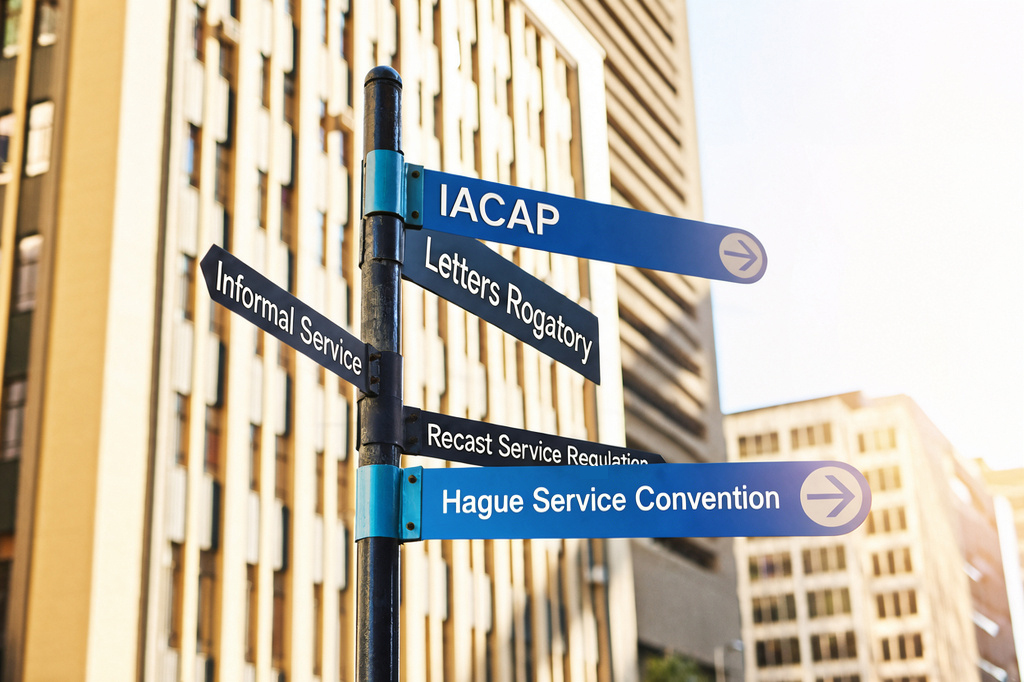

What if the success of your high-stakes US litigation hinged entirely on a single procedural stamp from the UK Central Authority? Many legal professionals find that serving legal documents in uk from us is a source of persistent anxiety, especially when the risk of a case dismissal looms over a minor technical error. It’s a valid concern because the intersection of US Federal Rule 4 and UK treaty reservations creates a high-stakes environment where precision isn’t just preferred; it’s mandatory.
This guide provides a methodical framework to help you master these international complexities and ensure your service is recognized by both jurisdictions. We’ll examine the current 2026 landscape, including the nuances of Article 10 postal service and the updated King’s Bench Division requirements. You’ll gain the clarity needed to choose between formal Hague channels and informal methods, allowing you to move forward with the confidence that your US proceedings remain enforceable across the Atlantic.
Key Takeaways
- Learn the precise procedural requirements for serving legal documents in uk from us to ensure your proceedings meet both US Federal Rule 4 and UK treaty standards.
- Navigate the formal requirements of the Hague Service Convention, including the specific role of the Senior Master of the Royal Courts of Justice as the UK Central Authority.
- Identify when to utilize alternative channels under Article 10, taking advantage of the United Kingdom’s permissive stance on personal service by local agents.
- Implement sophisticated skip tracing strategies that maintain strict compliance with the UK GDPR and the Data Protection Act 2018 when locating elusive defendants.
- Secure a formal certificate of service that provides definitive proof for US courts, protecting your litigation from jurisdictional challenges or future dismissal.
Navigating the Legal Framework: US Jurisdiction in the United Kingdom
Establishing personal jurisdiction over a defendant located in the United Kingdom requires a precise adherence to international law. While domestic US litigation often allows for flexible service methods, serving legal documents in uk from us involves the sovereignty of a foreign nation. If a US court finds it lacks personal jurisdiction because service was handled improperly, the entire case risks immediate dismissal. Many practitioners mistakenly believe that following their local state-level service rules is sufficient. However, international treaties take precedence over state rules, making domestic methods insufficient for cross-border matters.
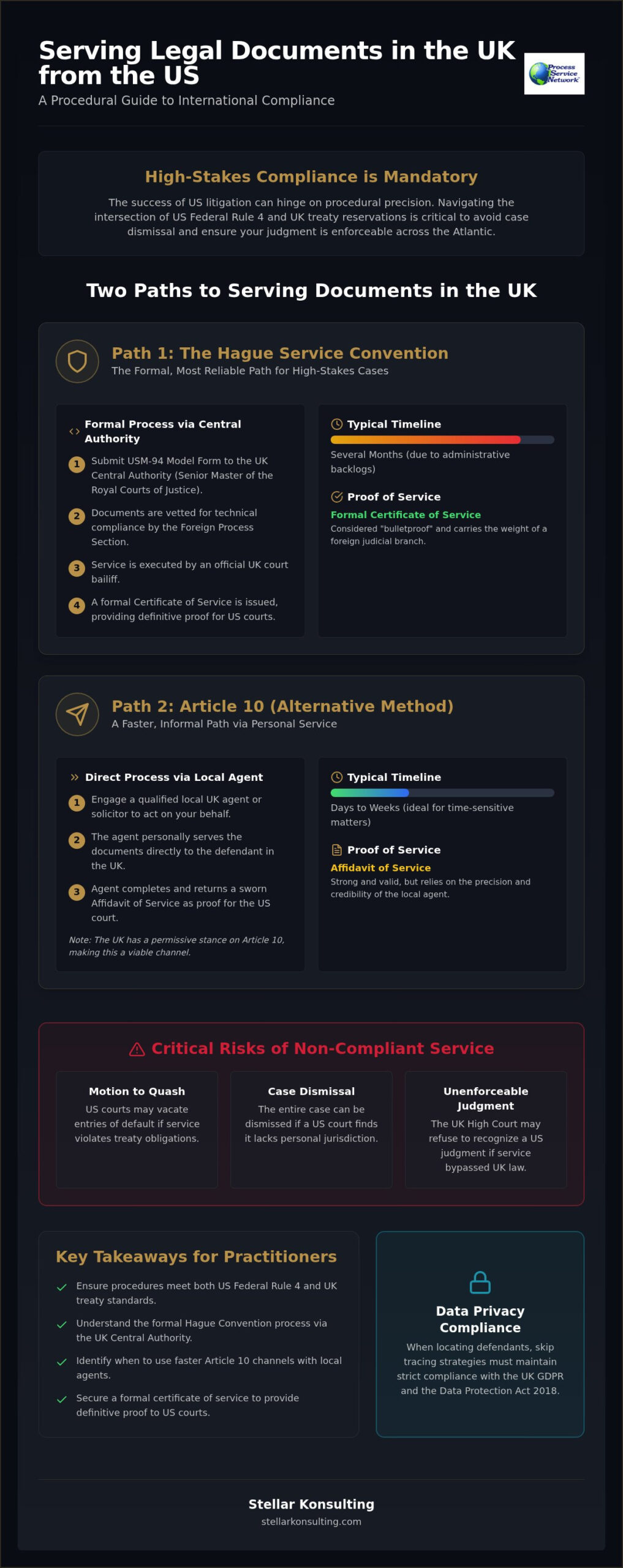
Improper delivery can have catastrophic effects on a litigation strategy. It isn’t just about whether the defendant received the papers. It’s about whether the court recognizes that receipt as a valid legal act. The primary framework governing these interactions is the Hague Service Convention, which provides the standardized channel for judicial documents to move between the United States and the United Kingdom. This treaty ensures that defendants receive adequate notice and that the method of delivery respects the legal traditions of the host country.
Why Federal Rule 4 Matters for UK Service
Federal Rule of Civil Procedure 4(f) dictates how process must be served in a foreign country. It mandates that service follow internationally agreed means. US courts are increasingly strict about this requirement. They often rule that service is invalid if it violates the laws of the destination country. This creates a critical gap between service that is merely “legal” under a US court order and service that is “enforceable” if you need to collect on a judgment or freeze assets in the UK. Practitioners must ensure their methods align with Rule 4(f)(1) to avoid jurisdictional challenges later in the case.
The Risks of Non-Compliant International Service
The most immediate threat of improper service is a Motion to Quash. If a defendant proves they weren’t served in accordance with treaty obligations, the US court may vacate entries of default. The long-term risk involves the enforcement of your final judgment. Since the UK is not a party to the Lugano Convention for US judgments, enforcement relies on common law recognition. If the High Court in London determines that the initial service bypassed UK procedural protections, they’ll likely refuse to enforce the US order. Comity is the doctrine where US and UK courts recognize each other’s judicial acts out of mutual respect for sovereignty and international legal standards.
The Hague Service Convention: The Formal Path to Compliance
Formal compliance begins with the Hague Convention. It’s the primary treaty for serving legal documents in uk from us, providing a structured mechanism that bypasses the need for inconsistent diplomatic channels. This framework is overseen by the Hague Conference on Private International Law. For US litigants, this formal path is the most reliable route to ensure that service withstands future jurisdictional challenges in high-stakes cases.
The process relies on the USM-94 Model Form. In England and Wales, the designated Central Authority is the Senior Master of the Royal Courts of Justice. As of 2026, the Foreign Process Section operates under the updated King’s Bench Division Guide, which includes a strict checklist for applicants. While the UK is generally efficient, current processing times can span several months due to administrative backlogs. Practitioners should account for the £150 fee if diplomatic channels are used, though standard Hague requests follow a distinct administrative path through the High Court. Understanding the full scope of hague service of process requirements before submission is essential to avoiding the administrative rejections that contribute to these delays.
The Central Authority Process in the UK
Once the Senior Master receives your request, the documents are vetted for technical compliance. If they’re approved, the Foreign Process Section typically forwards them to the local County Court nearest the defendant’s address for service by a court bailiff. This official involvement culminates in a formal Certificate of Service. This document is essentially bulletproof in US courts, as it carries the weight of a foreign sovereign’s judicial branch. For those requiring precision in these filings, utilizing Formal Hague Service of Process ensures that every technicality of the USM-94 is addressed before submission.
Documentation and Translation Requirements
While the UK accepts documents in English, specific jurisdictional nuances exist that can cause delays. In Wales, the Welsh Language Act may occasionally necessitate translations if the defendant is a public body or if specific local rules apply. It’s also vital to distinguish between jurisdictions; Scotland and Northern Ireland maintain their own Central Authorities with distinct administrative preferences. Common errors that lead to immediate rejection include:
- Failure to provide two complete sets of all documents, one for service and one for the court’s records.
- Incomplete USM-94 forms, particularly regarding the summary of the document to be served.
- Incorrectly identifying the competent authority in the US.
Ensuring these details are correct from the outset prevents costly delays in the 2026 litigation cycle.
Alternative Methods: Article 10 and Personal Service
Article 10 of the Hague Convention provides several alternative channels for transmission, provided the destination state doesn’t object. The United Kingdom’s position is notably permissive in this regard. Unlike many civil law jurisdictions in Europe, the UK doesn’t object to Article 10(b) or 10(c), which permit service through judicial officers, officials, or other competent persons. This flexibility is a significant advantage when serving legal documents in uk from us, as it allows for informal service through a private agent rather than relying solely on the Central Authority’s administrative timeline. Reviewing the complete Hague service of process requirements and compliance checklist can help practitioners confirm which alternative channels are available for each member state before proceeding.
Legal practitioners must distinguish between the internal jurisdictions within the UK. While the treaty applies nationally, the method of execution should align with local procedural rules. In England and Wales, service is governed by Part 6 of the Civil Procedure Rules (CPR). In Scotland, the process follows distinct Scots law requirements. Using a private server is often the most efficient way to meet these local standards while maintaining the speed required for time-sensitive litigation. It bridges the gap between US procedural needs and UK legal reality.
Service by Private Process Server in the UK
Hiring a UK-based agent to hand-deliver US papers is entirely legal and often preferred for its speed. It bypasses the administrative queue of the Foreign Process Section. To ensure this service is recognized in the US, the agent must provide a comprehensive Affidavit of Service. This document must detail the date, time, and specific location of delivery, often accompanied by a physical description of the recipient to satisfy US Due Process requirements. This method is particularly effective for family law matters or urgent injunctions where time is of the essence.
Service by Registered Mail: Risks and Rewards
Article 10(a) permits the service of judicial documents by postal channels. While both the US and the UK permit this, it’s often a high-risk strategy. Some US states have specific statutes or case law that forbid or strictly limit mail service for international defendants. If your state law doesn’t explicitly authorize it, the service may be deemed invalid regardless of the Hague Convention’s stance. Additionally, UK courts are historically hesitant to enforce a US judgment if the defendant claims they never received the papers. We generally recommend using mail as a secondary method of providing notice rather than the primary means of establishing jurisdiction.
Execution Strategy: Overcoming Locational and Procedural Hurdles
Successful litigation depends on more than just treaty compliance; it requires the physical location of the defendant. When serving legal documents in uk from us, practitioners must navigate the strict privacy environment created by the UK GDPR and the Data Protection Act 2018. Unlike the US, where public records are often expansive, the UK treats personal data as a fundamental right. Locating a defendant requires a methodical approach that respects these boundaries while gathering the evidence necessary to satisfy a US court. Failing to adhere to these privacy standards can jeopardize the admissibility of the service evidence later in the proceedings.
Managing the litigation timeline is equally critical. US courts typically monitor the progress of international service under Federal Rule 4. While the standard 90-day limit for domestic service often has an exception for foreign defendants, judges still demand a showing of diligent effort. If the process stalls without documentation, you may face “Good Cause” hearings to justify the delay. Precise record-keeping of every attempt, including interactions with the UK Central Authority or private agents, is the only way to avoid the risk of a case being dismissed for lack of prosecution.
International Skip Tracing for Elusive Defendants
Skip tracing in the UK is the foundation for any eventual motion for substituted service in a US court. It’s not merely a digital search; it’s a documented investigation. To satisfy the “due diligence” requirement, you must prove that you’ve exhausted all reasonable means to find the recipient. This involves utilizing professional databases, electoral roll checks, and local field agents to verify residency. You must also distinguish between residential service and “place of business” service. In the UK, serving a corporate officer at a registered office follows different procedural paths than serving an individual at their home, and the US court will expect you to justify why a specific location was chosen.
Letters Rogatory: The Path of Last Resort
In many cases, the search for a defendant begins domestically; for instance, a corporate private investigator NYC from a firm like International Investigative Group can be utilized to uncover digital evidence or local leads before the investigation expands internationally to satisfy US court requirements.
When the Hague Convention doesn’t apply or if the defendant’s address is truly unknown despite exhaustive efforts, Letters Rogatory become the necessary alternative. This process involves a formal judicial request from the US court to the UK High Court. It moves through the “Diplomatic Channel,” passing from the US State Department to the UK Foreign, Commonwealth & Development Office. This method is notoriously slow, often exceeding a 12-month timeline. It also carries specific costs, such as the £150 fee for diplomatic service via the FCDO. Because of this duration, it’s strictly reserved for cases where treaty-based service is impossible.
For cases involving elusive defendants or complex jurisdictional hurdles, our specialized Skip Tracing services provide the verified data needed to satisfy both UK privacy laws and US court requirements.
Securing Global Compliance with Stellar Konsulting
Transatlantic litigation requires more than just delivery; it requires a strategic alignment of two distinct legal systems. Stellar Konsulting serves as the essential bridge for those serving legal documents in uk from us, ensuring that every procedural step satisfies both US Federal Rules and UK local mandates. By acting as a single point of contact, we eliminate the fragmentation often found in international service. Communication gaps between US counsel and foreign agents can lead to critical errors that jeopardize the entire case, and our professional oversight ensures your litigation remains on a firm jurisdictional footing.
Expert Handling of Hague and Informal Requests
Our approach is rooted in over 30 years of international experience. We don’t just forward papers; we conduct a methodical document review to ensure that Hague Convention forms or informal requests are technically perfect before they ever reach a UK official. Every USM-94 form and summary of the document to be served undergoes a rigorous internal audit to prevent the administrative rejections that currently affect the UK Central Authority’s backlog. Our expertise in serving legal documents in uk from us allows us to provide real-time tracking and reporting, which is vital for managing sensitive legal deadlines in a high-stakes environment—a setting where many firms also rely on Esquire Talent Consultants to ensure they have the right specialized legal talent in place.
The complexities of international litigation often extend beyond the act of service itself. We provide integrated solutions, including specialized Skip Tracing for elusive defendants and Legal Document Translation when jurisdictional requirements demand it. Our team consults with you to determine the most effective method, whether it be Formal Hague Service of Process or Informal Service of Process, based on your specific case goals and the need for future judgment enforcement. When you delegate these tasks to an experienced partner, you protect your litigation from the procedural pitfalls that often derail cross-border cases. We ensure every Affidavit of Service is formatted for immediate US court acceptance. If you’re ready to secure your proceedings, Contact Stellar Konsulting for a consultation on your UK service needs.
Ensuring Procedural Integrity in Transatlantic Litigation
Success in cross-border disputes requires a precise balance between US procedural demands and the sovereign legal standards of the United Kingdom. The path to enforceable judgments depends on choosing the correct channel, whether that involves the formal Central Authority process or utilizing the UK’s permissive stance on Article 10. Failing to document diligent effort through professional skip tracing can lead to jurisdictional challenges that derail your strategy before it begins. Serving legal documents in uk from us is a complex undertaking, but it doesn’t have to be a source of litigation risk.
With over 30 years of global process serving expertise, we provide the methodical oversight needed to navigate these technical requirements. Our specialized knowledge of Hague Convention Article 10 reservations and our comprehensive skip tracing and translation capabilities ensure your service remains bulletproof in any US court. By partnering with a seasoned facilitator, you can focus on the merits of your case while we handle the procedural complexities. Secure Your International Litigation with Stellar Konsulting and move forward with the confidence that your global legal requirements are in expert hands.
Frequently Asked Questions
Is it legal to serve US legal papers personally in the UK?
Yes, personal service is legal. The UK doesn’t object to service by “competent persons” under Article 10 of the Hague Convention. This method allows a private agent to hand-deliver papers directly to the defendant. It’s one of the most efficient ways of serving legal documents in uk from us. You’ll need a detailed affidavit of service that meets the specific evidentiary standards of your US jurisdiction to ensure the court accepts the proof.
How long does the formal Hague Service process take in the UK?
The formal process usually spans three to six months. Current backlogs at the Foreign Process Section in 2026 can influence these timelines. After the Senior Master of the Royal Courts of Justice approves your USM-94, the papers are sent to a local court for delivery by a bailiff. If your litigation has tight deadlines, consider using a private server to bypass these administrative queues while remaining treaty-compliant.
Do I need to translate my US legal documents into English for UK service?
Translation is generally unnecessary because English is the official language across the UK jurisdictions. You don’t need to translate documents for service in England, Scotland, or Northern Ireland. In specific cases involving public bodies in Wales, Welsh translations might be requested, but this is rare for standard commercial litigation. Always submit two identical sets of your English documents to satisfy the Central Authority’s procedural requirements for record-keeping.
Can I serve a defendant in the UK via email or social media?
Service via email or social media is only an option as a last resort. You must first demonstrate that traditional methods, like personal delivery or Hague channels, were unsuccessful. A US court must issue a specific order for substituted service before these digital methods are considered valid. UK courts show increasing flexibility for digital service in urgent matters, but you’ll need documented proof of your diligent efforts to find the defendant.
What happens if the defendant in the UK refuses to accept the papers?
A defendant’s refusal to accept papers doesn’t stop the legal process. If the individual is identified and the documents are left in their presence, service is usually deemed successful. Process servers in the UK are trained to perform “drop-service” in these instances. The resulting Certificate of Service or affidavit will explicitly state the defendant’s refusal, which US courts recognize as valid notice under the due process clause.
Does the UK object to Article 10 of the Hague Service Convention?
The United Kingdom maintains no objections to Article 10 of the Hague Service Convention. This makes serving legal documents in uk from us more flexible than in many other European nations. You’re permitted to use postal channels or private agents for direct delivery. While postal service is an option, personal service by a professional agent is the preferred strategy for high-stakes litigation to ensure the proof of service is indisputable.
How much does it cost to serve legal documents in the UK from the US?
Total costs depend on the complexity of the task and the defendant’s location. If you utilize the diplomatic channel through the Foreign, Commonwealth & Development Office, there is a verified fee of £150. Private process serving costs vary depending on the number of attempts required and the urgency of the matter. You should also account for disbursements such as skip tracing if the recipient’s address isn’t immediately verified by your records.
What is the role of the UK Central Authority in process serving?
The Central Authority serves as the official regulatory body for international service requests. For England and Wales, this role is filled by the Senior Master of the Royal Courts of Justice. They review incoming USM-94 requests to ensure they meet treaty standards before authorizing service by local bailiffs. Their primary value is providing the formal Certificate of Service, which is the most authoritative proof of delivery recognized by US courts.