
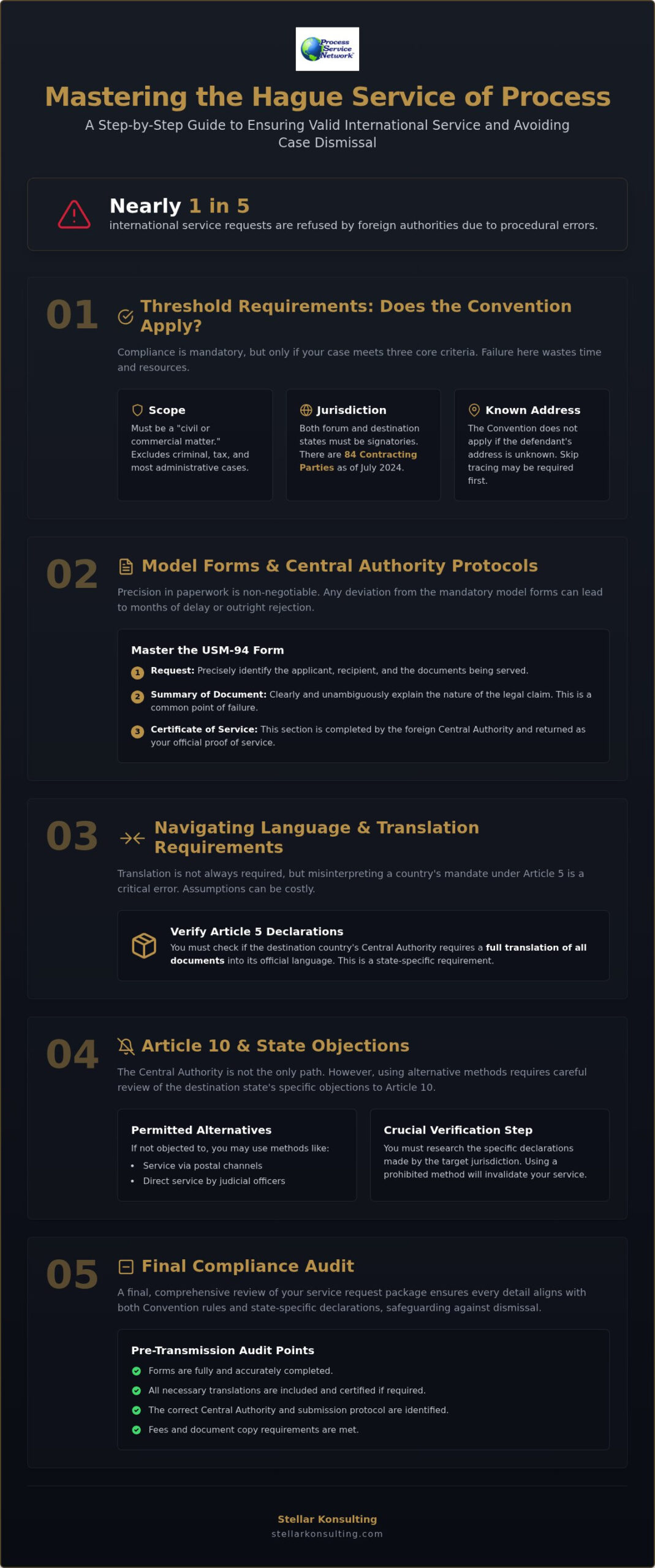
Nearly one in five international service requests is refused by foreign authorities on grounds of sovereignty or security, often because the petitioner failed to satisfy precise procedural standards. In cross-border litigation, a single administrative oversight can lead to a devastating case dismissal or a judgment that’s unenforceable abroad. You’re likely aware that meeting the hague service of process requirements isn’t a mere formality; it’s a mandatory jurisdictional hurdle that requires exactitude and deep knowledge of international law.
We understand the frustration of navigating varying translation mandates and the silence of foreign Central Authorities during long waiting periods. This article provides the clarity you need to move forward with confidence. You’ll gain a master checklist for document preparation, an understanding of which nations allow alternative service methods, and the steps required to secure court-admissible proof of service. From verifying the latest 2026 member state declarations to managing electronic service trends, this guide ensures your international legal documents are served validly and remain beyond challenge.
Key Takeaways
- Determine if your legal matter falls within the “civil or commercial” scope of Article 1 and confirm the current signatory status of the destination state.
- Master the technical preparation of the USM-94 and mandatory three-part model forms to satisfy specific hague service of process requirements.
- Identify whether the destination country’s Central Authority requires a full translation of all documents into its official language under Article 5.
- Understand the specific objections to Article 10 to determine if alternative methods, such as postal channels or judicial officers, are legally valid in your target jurisdiction.
- Execute a final procedural audit of your service request to ensure compliance with state-specific declarations and avoid the risk of case dismissal.
Threshold Requirements: Does the Hague Service Convention Apply?
Before diving into the technicalities of hague service of process requirements, you must confirm the Convention’s applicability to your specific case. The U.S. Supreme Court has established that compliance is mandatory whenever the treaty’s terms apply. However, its scope is strictly limited by the nature of the litigation and the geographic location of the parties involved. If the case doesn’t meet these preliminary criteria, attempting Hague service is a waste of time and resources. Especially in the realm of international commerce and trade, where firms like Customs and Trade Logistics facilitate complex cross-border transactions, identifying the correct legal framework for service is the first step toward a successful resolution.
Identifying Civil and Commercial Matters
Article 1 states the Convention applies in all cases where there’s occasion to transmit a judicial or extrajudicial document for service abroad in “civil or commercial matters.” While this sounds straightforward, it excludes criminal proceedings and most administrative law cases. The characterization of a claim by the forum court is the primary factor in determining eligibility. For example, tax matters are generally excluded because they’re considered public law rather than private civil disputes. Family law cases, particularly those involving child support or custody, usually fall within the scope, provided they aren’t strictly administrative in the destination country. For a broader Hague Service Convention overview, legal professionals often review historical case law to see how specific jurisdictions categorize “civil” versus “public” duties. You must also verify that both the forum and destination states are HCCH members. As of July 2024, there are 84 Contracting Parties to the Convention, representing a 24% increase in signatories over the last decade.
The Known Address Requirement and Skip Tracing
A critical but often overlooked limitation is the “known address” requirement. Article 1 explicitly states the Convention shall not apply where the address of the person to be served is not known. If you don’t have a specific physical location for a defendant, you can’t initiate a formal Hague request through a Central Authority. This creates a procedural deadlock that can stall a case indefinitely if not handled correctly at the outset.
We’ve spent over 30 years refining the process of establishing these threshold facts. When a defendant’s location is uncertain, Stellar Konsulting utilizes specialized skip tracing to locate the individual before proceeding. This step is a prerequisite for meeting hague service of process requirements in any of the 84 current HCCH member states. If an address remains undiscoverable after exhaustive efforts, we help you document that “due diligence” for the court. This documentation is essential if you need to petition for an alternative method of service, such as service by publication or through the Inter-American Service Convention, depending on the jurisdiction. Establishing a valid address first ensures the subsequent service remains valid and beyond challenge.
The Formal Requirements: Model Forms and Central Authority Protocols
Adhering to the technical hague service of process requirements is the next critical step after establishing jurisdiction. The Convention functions through a Central Authority system, which requires a specific set of standardized documents to be transmitted between nations. You must follow the full text of the Hague Service Convention guidelines to ensure your request isn’t returned for technical deficiencies. While the process is designed to streamline international cooperation, any deviation from the mandatory model forms can lead to months of delay.
Completing the Model Form (USM-94)
The USM-94 is the standard request form used by U.S. litigants under the Hague Convention. This three-part model form includes the formal Request, the Certificate of Service, and the Summary of the Document to be Served. You must ensure the identity and address of the applicant are precise. The “Summary of the Document” must provide a clear explanation of the legal matter so the recipient and the foreign authority understand the nature of the claim. Ambiguity in the summary is a frequent cause for rejection. The Certificate portion is equally vital, as it’s the document the foreign Central Authority completes and returns to serve as your official proof of service.
Central Authority Submission Procedures
Each signatory state designates its own Central Authority to handle incoming requests. Submission protocols aren’t universal. You’ll need to verify state-specific fee requirements and accepted payment methods, such as bank drafts or wire transfers. For example, requests for service on private individuals or companies in the United States require a $95.00 fee, processed through the U.S. Central Authority’s contractor. In contrast, many other nations don’t charge a fee for standard service but may bill for expenses incurred by using a specific method.
Timelines for processing are a common point of frustration. The July 2024 HCCH Special Commission recommended that Central Authorities execute requests as soon as practicable, ideally within 90 calendar days. Despite this guidance, some jurisdictions remain backlogged. Direct communication with the destination’s Central Authority is usually the most efficient path, bypassing the delays inherent in diplomatic channels. Understanding how to strategically navigate this diplomatic gateway is critical; our detailed breakdown of hague convention central authority service procedures and submission requirements provides the precision needed to avoid costly rejections. Our specialists at Stellar Konsulting manage these intricate hague service of process requirements daily, ensuring every model form is technically perfect before it leaves your desk.
Navigating Language and Translation Requirements
Meeting the technical hague service of process requirements involves more than just completing the correct forms. Under Article 5 of the Convention, the Central Authority of the destination country has the power to require that the documents be translated into its official language. This isn’t a mere suggestion; it’s a gatekeeping mechanism that determines whether your request will be executed or returned. While some nations may accept English documents if the recipient is known to understand them, most Central Authorities enforce strict translation mandates to protect the due process rights of their citizens.
Official Language Declarations
Each signatory state makes specific declarations regarding language. You must consult the HCCH country profiles to determine the exact requirements for your target jurisdiction. Some countries, like Germany or France, maintain mandatory translation requirements for all incoming judicial documents. Others may require bilingual versions where both the original English and the local language are presented side-by-side. It’s a common mistake to translate only the summons and complaint while leaving the USM-94 model form or the “Summary of the Document” in English. To satisfy hague service of process requirements, every page intended for the recipient must typically be translated to avoid a formal refusal of service.
The Quality of Legal Translation
The precision of legal terminology is non-negotiable in international litigation. Relying on machine translation or general-purpose translators is a significant liability. If the translated summons uses incorrect legal phrasing, the foreign court may find the service invalid, even if the Central Authority initially accepted the request. Consistency is vital. The terminology used in the translated complaint must match the terminology in the translated summons and the summary form.
Incomplete or inaccurate translations often lead to months of administrative delays. In a 2022 questionnaire on the operation of the Convention, 19% of service requests were reported as refused for various reasons, including technical non-compliance. We’ve spent over 30 years integrating professional Legal Document Translation with our serving protocols. Stellar Konsulting ensures that every translation meets the specific linguistic standards of the destination Central Authority. By handling both the translation and the formal service in-house, we eliminate the communication gaps that often lead to procedural errors and case dismissals.
Alternative Methods: Article 10 and State Objections
While the Central Authority pathway is the primary channel for international judicial assistance, Article 10 of the Convention provides alternative methods for litigants seeking greater efficiency. These alternatives are only available if the destination state hasn’t formally objected to them. Understanding the nuances of Article 10 is essential for satisfying hague service of process requirements when time is of the essence or when the Central Authority process proves too cumbersome. These methods allow you to bypass the administrative backlog of government agencies, provided you adhere to the specific declarations of the target nation.
The most debated provision is Article 10(a), which permits the transmission of judicial documents through postal channels. For decades, a circuit split existed in the United States over whether the word “send” in the treaty actually authorized “service.” The Supreme Court resolved this in the Water Splash decision, confirming that service by mail is permissible under the Convention, provided the destination state doesn’t object. However, you must verify the specific declarations of the target country. Major jurisdictions such as China, Germany, Argentina, and the Republic of Korea have formally objected to Article 10(a), rendering service by mail legally invalid in those territories.
Service by International Mail
If you choose to utilize Article 10(a) in a non-objecting state, you must adhere to strict evidentiary standards. Most U.S. courts require “Registered Mail with Return Receipt” to provide a verifiable proof of delivery that’s court-admissible. Even when a treaty allows it, many U.S. judges remain skeptical of service by mail due to the risk of delivery failure or the lack of a signed receipt from the actual defendant. In July 2024, the HCCH Special Commission clarified that Article 10(a) also includes electronic transmission, such as email, if permitted by the laws of both the originating and destination countries. This trend toward digitalization is accelerating, but it requires careful legal vetting before implementation.
Service via Private Process Servers Abroad
Articles 10(b) and 10(c) allow for service through judicial officers, officials, or other “competent persons” in the destination state. This method is frequently used in common law jurisdictions like the United Kingdom or Canada, where private process servers are recognized as competent persons. For U.S. litigants specifically, serving legal documents in the UK from the US involves navigating the updated King’s Bench Division requirements and Article 10 postal service nuances that distinguish British practice from other common law nations. Bypassing the Central Authority in these countries can significantly reduce timelines, often resulting in service within days rather than months. You must ensure the individual performing the service is authorized under the local laws of the destination state to maintain compliance with hague service of process requirements.
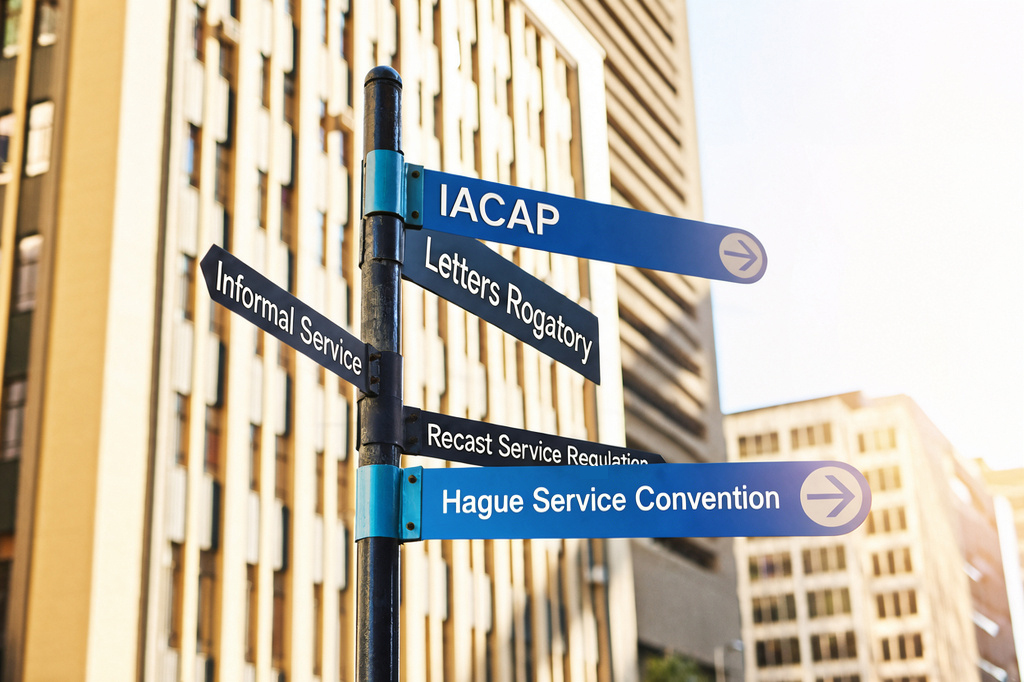
In complex jurisdictions where formal service is notoriously slow, we often recommend utilizing Informal Service of Process as a strategic supplement. This ensures the defendant receives actual notice immediately while the formal Hague request proceeds through the official Central Authority. If you need to determine the most effective method for your specific jurisdiction, contact Stellar Konsulting to evaluate your options under the current 2026 state declarations.
Final Compliance Checklist: Avoiding Dismissal for Improper Service
The final phase of any international litigation strategy involves a rigorous audit of hague service of process requirements before documents leave your office. International service isn’t self-executing. It requires a high level of technical precision to survive a motion to dismiss in U.S. courts. To prevent administrative oversights, families and legal advisors often utilize IronClad Family to organize and protect the critical documents and digital assets required for these procedures. A single error, such as failing to translate a minor exhibit, can result in months of wasted effort and significant legal exposure.
Before initiating the formal request, perform a comprehensive review of these critical components:
- Signatory Verification: Confirm the destination state’s current status among the 84 HCCH member states and verify their specific declarations for 2026.
- USM-94 Technical Audit: Ensure the names, addresses, and summary of documents are perfectly aligned with the underlying summons and complaint.
- Translation Certification: Verify that a professional legal service has certified the translations, ensuring they meet the standards of Article 5.
- Exhibit Inclusion: Confirm that every attachment referenced in the primary documents is included in the service packet and translated where mandatory.
The ‘Due Process’ Audit
U.S. courts prioritize whether the chosen method provided actual and timely notice to the defendant. Even if a Central Authority returns a completed certificate, the service remains vulnerable if the underlying procedure didn’t comply with the destination state’s internal laws. You must ensure the final proof of service is in a format that your forum court will recognize as admissible. This often requires a specific type of affidavit or a formal Certificate of Service from the foreign judicial officer. Addressing these potential challenges during the preparation phase prevents the defendant from successfully arguing improper service later in the litigation.
Leveraging Professional Facilitation
With over 30 years of experience, Stellar Konsulting provides the deep-rooted reliability required for high-stakes cross-border litigation. We manage the entire lifecycle of international service, starting with skip tracing to establish a valid address and concluding with the delivery of court-admissible proof. Our in-house legal translation capabilities ensure that your documents satisfy the strict hague service of process requirements of even the most complex jurisdictions. Don’t leave your case’s jurisdictional foundation to chance. Ensure your international service is bulletproof with Stellar Konsulting.
Securing Your International Jurisdictional Foundation
Mastering the intricate hague service of process requirements is essential for any legal professional involved in cross-border litigation. Success depends on identifying the correct order of operations, from verifying the “known address” prerequisite through skip tracing to ensuring every document meets the current 2026 translation mandates. As global legal landscapes shift and member state declarations evolve, relying on outdated or static information is a risk your case shouldn’t afford. A single technical error in the USM-94 or an insufficient translation can result in a devastating case dismissal.
Stellar Konsulting brings over 30 years of specialized international experience to every request we handle. Our comprehensive approach integrates expert skip tracing and certified legal translation, backed by a deep understanding of HCCH state declarations. We handle the procedural complexities of the Hague Service Convention so you can focus on the core merits of your litigation. You deserve a partner that ensures your service is valid, enforceable, and beyond challenge in any jurisdiction. Streamline your international process serving with Stellar Konsulting and move forward with global confidence.
Frequently Asked Questions
How long does Hague Service of Process typically take?
Recent guidance from the HCCH encourages Central Authorities to execute requests within 90 calendar days. However, actual timelines vary significantly by jurisdiction. Some countries process requests within a few months, while backlogged authorities may take a year or longer. Efficiency depends on the technical accuracy of your submission and the specific administrative capacity of the destination state’s Central Authority. We recommend starting the process as early as possible.
Can I serve a foreign defendant via email under the Hague Convention?
Service by email is permissible under Article 10(a) provided that both the originating and destination countries allow this method. The July 2024 HCCH Special Commission clarified that postal channels include electronic transmission. You must verify that the target nation hasn’t filed an objection. The method must also comply with local laws. This ensures the service remains valid and court-admissible in your forum court.
What happens if a country objects to Article 10 of the Hague Convention?
If a country objects to Article 10, you can’t use alternative methods like international mail or private process servers. In these jurisdictions, you must utilize the formal Central Authority channel. Attempting service through an objected method renders the process legally invalid. This often leads to the dismissal of your case. It’s a failure to meet hague service of process requirements that can’t be easily fixed.
Is translation always required for Hague Service of Process?
Translation requirements depend on the specific declarations of the destination country under Article 5. While some nations accept English documents, most Central Authorities mandate that all judicial papers be translated into their official language. It’s standard practice to translate the summons, complaint, and the “Summary of the Document.” This prevents the foreign authority from refusing the request on technical grounds and ensures the defendant receives proper notice.
What is the difference between a Central Authority and a Receiving Authority?
A Central Authority is the primary government entity designated by a member state to manage incoming service requests. A Receiving Authority is a broader term describing any competent authority or official authorized to execute service within that jurisdiction. While the Central Authority acts as the main hub, they often delegate the physical delivery of documents to local Receiving Authorities, such as police departments, bailiffs, or specific judicial officers.
Does the Hague Convention apply if I don’t have the defendant’s address?
The Convention explicitly doesn’t apply where the address of the person to be served is not known. Article 1 requires a physical location to initiate the formal process. If the address is missing, the treaty’s mandatory protocols are bypassed. In these scenarios, litigants often utilize skip tracing to establish a valid address. This is a necessary first step to satisfy the formal hague service of process requirements.
How much does it cost to serve process through the Hague Convention?
Central Authority services are generally free under Article 12 of the Convention. However, countries may charge for specific service methods or administrative costs. Some jurisdictions require a set fee for requests involving private individuals or corporations. You’ll also need to budget for professional translation and skip tracing. These are essential for compliance. Because every nation maintains its own fee structure, verify current requirements before submitting your request.
What is a USM-94 form and where do I file it?
The USM-94 is the mandatory three-part model form used by U.S. litigants to request service abroad. It includes the formal request, a summary of the documents, and a certificate of service. You don’t file this form with the U.S. court. Instead, you transmit it directly to the Central Authority of the destination country, whose role and submission requirements vary significantly by jurisdiction. Include the translated legal documents and any required administrative fees with your submission to avoid delays.