

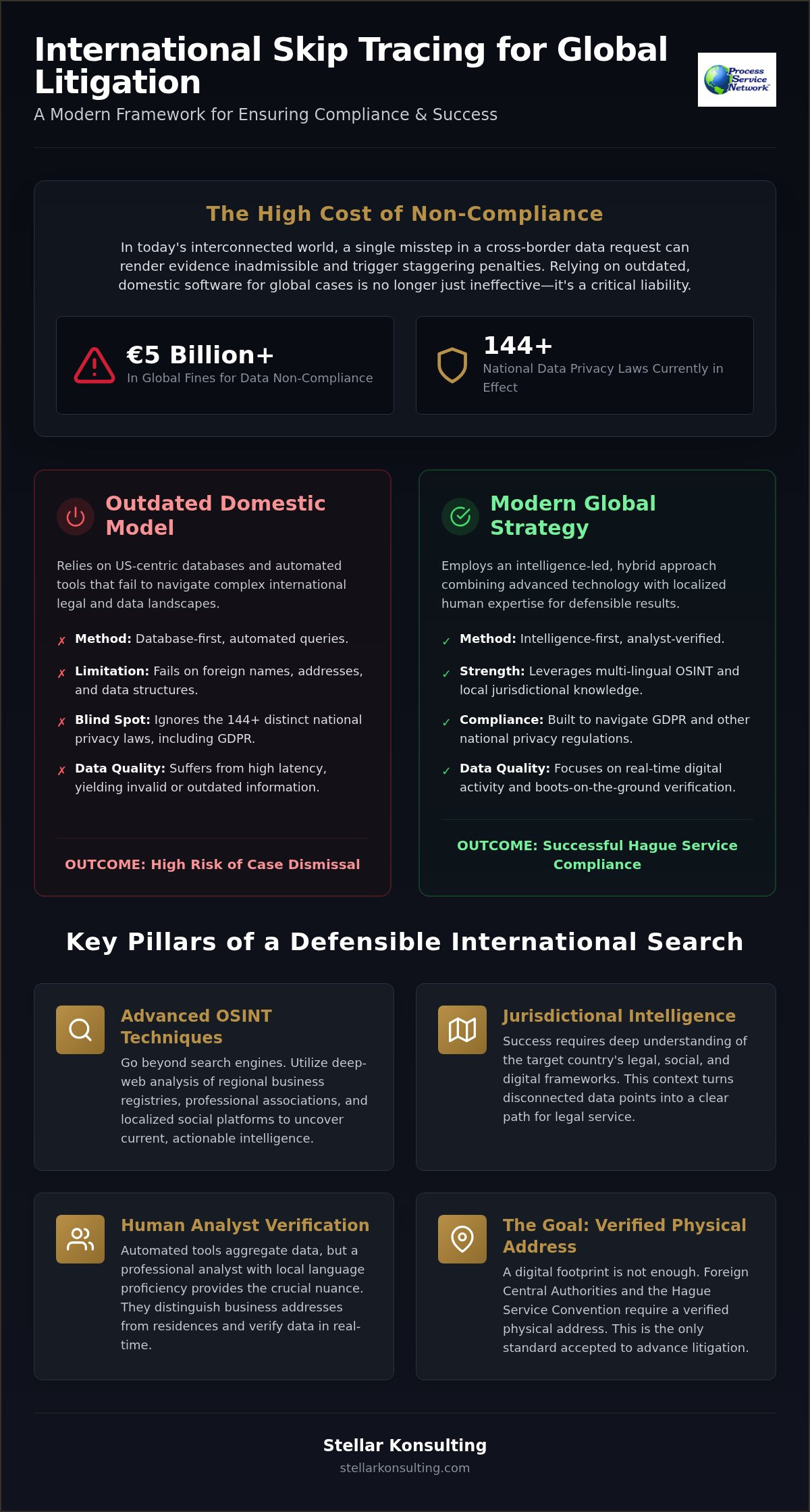
A single non-compliant data request in a foreign jurisdiction can result in evidence being ruled inadmissible and trigger fines that now exceed five billion euros globally. For legal professionals, relying on domestic software for global litigation isn’t just ineffective; it’s a liability. You understand that a dead-end lead from a US-based credit header doesn’t just stall a case. It risks a dismissal under the Hague Service Convention if you can’t verify a physical address for service. This guide provides the advanced international skip tracing techniques required to navigate the 144 national data privacy laws currently in effect, ensuring your subject is located without compromising your legal standing.
You’ll learn to integrate multi-lingual OSINT with localized jurisdictional expertise to secure evidence that is both accurate and defensible. We’ll examine the shift toward boots-on-the-ground verification in regions where digital records are limited or heavily regulated. This article outlines a methodical approach to identifying defendants and witnesses across borders, providing the verified data necessary for successful court filings and Hague Service compliance in 2026. By moving beyond simple database searches, you can secure the verified physical addresses required to advance your international litigation with confidence.
Key Takeaways
- Shift from a domestic database-first model to an intelligence-led strategy to overcome the inherent limitations of US-based software.
- Master advanced international skip tracing techniques that leverage localized OSINT and social platforms to find subjects in restrictive jurisdictions.
- Identify the specific procedural requirements of GDPR and foreign privacy laws to maintain strict legal compliance during cross-border investigations.
- Connect precise subject location directly to the successful completion of formal Hague Service of Process and Letters Rogatory.
- Recognize why a verified physical address is the only standard accepted by foreign Central Authorities to ensure your litigation proceeds.
The Evolution of International Skip Tracing: Beyond Traditional Databases
Traditional skip tracing often relies on centralized data repositories. In the United States, investigators typically query credit headers, utility records, and public filings to locate a subject. However, effective international skip tracing techniques require a multi-layered investigative process that transcends these domestic silos. The global model is intelligence-first rather than database-first. This shift is mandatory because the centralized credit-reporting infrastructure found in North America doesn’t exist in most of the world. In jurisdictions governed by strict privacy mandates like GDPR and the 144 national data privacy laws now in effect, the availability of public personal data is severely restricted.
For 2026, the professional standard is jurisdictional intelligence. This concept moves beyond simple name-matching; it requires a deep understanding of the specific legal, social, and digital frameworks within a target country. It isn’t enough to find a digital footprint. You must verify a physical address that satisfies the requirements of the Hague Service Convention. Without this localized context, an investigation remains a collection of disconnected data points rather than a path to successful service. Relying on outdated methods often leads to case dismissals when a foreign Central Authority rejects an unverified address.
The Limitations of Domestic Investigative Software
Standard US-centric algorithms struggle with foreign naming conventions and address structures. For instance, the use of patronymics in Eastern Europe or double surnames in Latin America frequently causes domestic software to generate false positives. These tools often fail to parse addresses that don’t follow the Street, City, State, Zip format. Data latency is also a significant hurdle in emerging markets. In many developing nations, official government records may lag by several years. Relying on automated software in these regions often yields addresses that are no longer valid, leading to costly delays in litigation.
The Shift Toward Hybrid Intelligence Models
The most effective international skip tracing techniques now combine automated data scraping with rigorous analyst verification. While digital tools can aggregate massive datasets, they cannot replace the nuance provided by a professional with local language proficiency. An analyst can distinguish between a subject’s business registration and their actual residence, a distinction software often misses. Real-time digital activity is frequently more reliable than historical filings in 2026. By tracking current professional engagements and localized social media activity, investigators can establish a subject’s location with a high degree of certainty. This hybrid model leverages over 30 years of jurisdictional experience to ensure that the results are not only accurate but legally defensible in a global court.
Advanced OSINT Techniques for Global Subject Location
Open Source Intelligence (OSINT) has evolved from a secondary research method into the primary engine of modern cross-border investigations. Effective international skip tracing techniques in 2026 depend on an investigator’s ability to pivot between fragmented digital ecosystems. This process isn’t limited to standard search engines; it requires deep-web analysis of regional business registries and professional associations. In jurisdictions across Europe and Asia, these registries often provide current director details or professional licensure addresses that are more reliable than historical government filings. Accessing these records requires specialized knowledge of local administrative structures and data access rights.
Once a potential address is identified, satellite imagery and street-level mapping tools act as the final verification step before physical service is attempted. This step confirms that a location is a habitable residence rather than a commercial mail drop or an abandoned property. This level of due diligence is essential for court filings, as it demonstrates that the investigator has exhausted all reasonable means to verify the subject’s residency. For complex cases involving evasive defendants, employing professional skip tracing services ensures that the intelligence gathered is accurate enough to withstand judicial scrutiny.
Multi-Lingual Social Media and Forum Analysis
Searching for an evasive subject requires looking beyond the platforms dominant in the West. Platforms like WeChat, VK, and XING are essential for locating subjects in China, Russia, and Central Europe. Utilizing specialized OSINT tools for skip tracing allows investigators to search non-Latin character sets, such as Cyrillic or Hanzi, which are often invisible to English-language queries. By analyzing family and professional network proximity, an investigator can triangulate a subject’s location even when the individual maintains a minimal digital footprint. Local community boards and niche interest groups often contain the digital breadcrumbs necessary to confirm current residency.
Metadata and Digital Footprint Tracking
Modern international skip tracing techniques also involve “lifestyle tracing.” This focuses on monitoring recurring digital transactions or professional memberships that signal a physical presence in a specific city. This includes everything from analyzing domain registration details for self-employed subjects to extracting location data from publicly available digital assets shared on professional forums. While many subjects attempt to mask their location, the cumulative weight of their digital business footprint often reveals their true whereabouts. Analysts look for patterns in digital activity that coincide with local business hours, providing a refined geographic area for field verification.
Navigating Global Privacy Regulations and Compliance Hurdles
A common concern in global litigation is whether locating a subject in highly regulated zones like Europe or Asia is legally permissible. The answer depends entirely on the framework of your investigation. In 2026, 144 countries have enacted national data privacy laws, making compliance a central pillar of effective international skip tracing techniques. Central to this is the concept of “permissible purpose.” In a legal context, this means the investigation is conducted to facilitate the service of process or to protect a legitimate legal interest. Without this justification, any data gathered may be classified as “toxic data,” which can lead to evidence being struck from the record or trigger severe regulatory penalties.
The risks are not theoretical. Cumulative fines under the General Data Protection Regulation (GDPR) exceeded 5.5 billion euros by the end of 2025. While private firms don’t have the same jurisdictional reach as the U.S. Marshals Service International Operations, they must operate with similar procedural rigor to ensure that the information obtained is admissible in court. Navigating these hurdles requires a nuanced understanding of local statutes, such as India’s Digital Personal Data Protection Act, which is currently undergoing phased enforcement through 2027. Relying on non-compliant methods doesn’t just stall a case; it can expose a law firm to significant international liability.
GDPR and the European Investigative Landscape
Under GDPR, investigators must identify a lawful basis for processing personal data as outlined in Article 6. In most litigation scenarios, this is achieved by documenting a “legitimate interest” that outweighs the subject’s privacy rights. This requires a careful distinction between public OSINT and intrusive private data collection. Professional analysts focus on gathering data that is already in the public domain or accessible through legal registries. Documenting this “legitimate interest” is vital for protecting the law firm from liability if the subject later challenges the investigation. By following these protocols, you ensure the investigation remains compliant with foreign standards while securing the data needed for court filings.
Ethical Boundaries and Court Admissibility
Maintaining a clear chain of custody is essential when presenting located information to a court. If an address was obtained through “grey-market” data sources, such as leaked databases or unauthorized hacks, it can jeopardize the entire lawsuit. Judges are increasingly scrutinizing the origins of skip tracing data to ensure it wasn’t obtained through harassment or illegal means. Professional international skip tracing techniques prioritize ethically sourced data to ensure that when a physical address is provided, it’s not only accurate but also fully admissible for Hague Service compliance. This methodical approach prevents the “toxic data” trap that often leads to case dismissals in multi-jurisdictional litigation.
The Intersection of Skip Tracing and International Process Service
Successfully locating a subject is only the first step in a complex global legal chain. The ultimate utility of international skip tracing techniques lies in their ability to facilitate a valid Hague Convention service of process. Many practitioners mistakenly believe that a “likely” residential address is sufficient for a Central Authority. In reality, most foreign jurisdictions require absolute certainty. If a Central Authority attempts service at an address that proves incorrect, the request is returned unexecuted, often after months of waiting. This results in significant delays and additional costs, as the entire formal request must be refiled from the beginning.
Precision is equally critical when utilizing letters rogatory legal services. In countries that are not signatories to the Hague Convention, the judicial assistance process is even more rigid. A verified physical location is the foundational requirement for any court-to-court request. Beyond formal service, professional tracing provides the necessary evidence of “due diligence” required by US courts for motions for substituted service. By documenting every investigative step, from digital footprint analysis to field verification, you create a defensible record of a diligent search. For cases requiring immediate action, you should secure a professional skip trace to ensure your filings meet these strict international standards.
Verifying Addresses for Central Authority Compliance
Address requirements vary significantly between civil law and common law countries. While common law jurisdictions may accept service at a place of business, many civil law nations strictly require service at the subject’s registered domicile. Our international skip tracing techniques involve using local investigative agents to perform “physical knocks” and residency verifications. This on-the-ground intelligence confirms the subject’s presence before you submit formal documents to a foreign government. A detailed skip tracing report then serves as the primary evidence of a diligent search, which is essential if the subject proves evasive and you must seek alternative methods of service from the presiding judge.
Locating Witnesses for International Testimony
The scope of an investigation often extends beyond the defendant. Locating witnesses for international testimony presents unique challenges, particularly when dealing with former employees or corporate officers who have moved across multiple jurisdictions. Strategic tracing in these instances involves analyzing third-party records, such as professional license renewals or property transfers, to corroborate witness locations. Finding these key individuals is vital for discovery and trial preparation. Establishing a verified location for a witness allows for the timely issuance of subpoenas or the coordination of remote testimony, ensuring that critical evidence is not lost due to jurisdictional hurdles.
Strategic Implementation: Partnering for Global Investigative Success
Effective litigation in 2026 requires more than just access to raw data; it demands the strategic application of that data within a sophisticated global legal framework. While digital tools have advanced significantly, automated software remains a tool rather than a comprehensive solution for complex cross-border cases. Relying solely on algorithms often leads to procedural failures when those tools encounter localized data gaps or restrictive privacy laws. Integrating professional international skip tracing techniques into your initial litigation strategy ensures that you aren’t just finding a subject, but securing an address that will withstand the scrutiny of a foreign Central Authority.
Choosing a partner with over 30 years of jurisdictional experience provides a level of reliability that automated platforms cannot replicate. This longevity translates into a deep-rooted network of local agents and a thorough understanding of the Hague Convention and Inter-American Service Convention requirements. By identifying the subject’s location before the formal service process begins, you significantly reduce the risk of case dismissal. This proactive approach transforms skip tracing from a reactive recovery effort into a foundational element of successful international service of process. For practitioners also pursuing debt recovery, understanding international skip tracing for judgment enforcement is equally critical to transforming a court-ordered judgment into tangible asset recovery when a debtor has relocated across borders.
Why Automated Software Cannot Replace Human Intelligence
The “nuance gap” is the primary reason software often fails in international investigations. Algorithms frequently miss cultural clues, such as localized naming conventions or the distinction between a legal domicile and a secondary business address. For example, a “verified” match in a US-based database may pull from historical records that are years out of date in emerging markets. We’ve encountered numerous instances where software-verified data was proven incorrect by a simple local inquiry or a physical residency check. Professional analysts verify data through established local networks, ensuring the intelligence is current and the physical location is habitable before any legal documents are dispatched.
Optimizing Your International Litigation Strategy
Viewing international skip tracing costs as a strategic investment rather than a mere expense is essential for budget management. Domestic attempts often result in “dead-end leads” that waste time and resources. In contrast, professional tracing provides the verified physical address needed for Hague compliance on the first attempt. This efficiency reduces the overall “time-to-service,” preventing the costly cycle of refiling unexecuted requests. Integrating these international skip tracing techniques at the earliest stages of your case allows for a more streamlined transition to formal service. For authoritative global support and results grounded in decades of expertise, consult with the specialists at Stellar Konsulting to advance your cross-border litigation with confidence.
Advancing Your Global Litigation Strategy
Navigating the complexities of cross-border litigation requires a shift from automated database searches to a multi-layered, intelligence-driven approach. By mastering advanced international skip tracing techniques, your firm can bypass the limitations of domestic software and secure the verified physical addresses necessary for Hague Convention compliance. This methodical process ensures that every investigative step respects global privacy regulations like GDPR, protecting your case from the risks of inadmissible evidence or regulatory penalties.
A successful outcome depends on the fusion of localized OSINT and jurisdictional legal expertise. With over 30 years of specialized international legal support experience, Stellar Konsulting provides the procedural rigor and global network of partners required to locate even the most evasive subjects. We maintain comprehensive compliance with the Hague Convention and local privacy laws; it’s the only way to ensure your litigation remains on solid ground from discovery through service.
Secure your international litigation with expert skip tracing from Stellar Konsulting and move forward with the confidence that your case is supported by seasoned global facilitators.
Frequently Asked Questions
How does international skip tracing differ from domestic skip tracing?
International investigations cannot rely on the centralized credit header data or Social Security databases common in the United States. Domestic tools often fail to parse foreign address formats or naming conventions. Effective global tracing requires jurisdictional intelligence and multi-lingual OSINT to navigate fragmented records. We focus on localized registries and digital footprints that vary significantly between common law and civil law jurisdictions.
Is it legal to use OSINT to find a defendant in a GDPR-protected country?
Yes, it’s legal provided the investigator establishes a “permissible purpose” under Article 6 of the GDPR. This usually involves documenting a “legitimate interest” related to a legal claim. It’s vital to distinguish between public OSINT and intrusive data collection. Non-compliance can be costly, as cumulative GDPR fines exceeded 5.5 billion euros by the end of 2025.
What information do I need to provide to start an international skip trace?
You should provide the subject’s full legal name, including any regional variations, and their last known address. Additional details like date of birth, professional affiliations, and known social media handles are highly beneficial. The more localized context you provide, the more efficiently our analysts can apply international skip tracing techniques to verify a current physical residency for service.
Can skip tracing help if a defendant is actively evading service of process?
Professional skip tracing is specifically designed to overcome evasion by identifying “lifestyle footprints.” This involves monitoring current professional engagements or recurring digital transactions that reveal a physical presence. A comprehensive tracing report also serves as the “due diligence” evidence required by US courts. This documentation is essential when moving for substituted service after a diligent search has been performed.
How long does a typical international skip tracing investigation take?
Most international investigations are completed within a timeframe of two to four weeks. These timelines depend on the data accessibility of the target jurisdiction and the subject’s level of evasion. High-regulation zones or countries with limited digital infrastructure may require more time. This allows local agents to perform the necessary field verification to ensure an address meets Hague Convention standards.
What happens if a subject is located in a country that does not recognize the Hague Convention?
We facilitate the Letters Rogatory process or use the Inter-American Service Convention for countries outside the Hague network. Locating the subject remains the mandatory first step in these jurisdictions. Once we verify a physical address, we manage the court-to-court request through diplomatic channels. This ensures the service is recognized as valid by both the foreign government and the US court.
How do you verify a foreign address without alerting the subject?
Verification is performed using discrete international skip tracing techniques that prioritize subject anonymity. We analyze secondary data sources such as professional license renewals, business registries, and property transfers. In many cases, local agents conduct passive site visits to confirm residency without making direct contact. This ensures the subject remains unaware of the investigation until the formal service of process is executed.
Are the results of an international skip trace admissible in US courts?
The results are admissible if the investigation follows a compliant and documented methodology. A professional report detailing the investigative steps and sources consulted is vital for court filings. This evidence establishes the “due diligence” required for Hague Service or motions for alternative service. Admissibility depends on maintaining a clear chain of custody and avoiding “toxic data” from unauthorized or grey-market sources.