
A flawlessly drafted litigation strategy remains vulnerable if the initial delivery of process fails to meet the rigid standards of a foreign central authority. You likely understand the frustration of navigating the Hague Service Convention only to face unpredictable timelines or the looming threat of service being quashed due to minor treaty non-compliance. When managing an international summons and complaint service, the margin for error is nonexistent, as a single procedural misstep can delay a case by months or even years.
It’s understandable to feel concerned about locating defendants in distant jurisdictions or ensuring that translations meet specific legal requirements. This guide provides a professional framework to master the complexities of cross-border legal delivery, ensuring you obtain a valid certificate of service that withstands judicial scrutiny. We’ll examine the procedural requirements for Hague and non-Hague jurisdictions, the role of letters rogatory, and how integrated skip tracing and translation services create a seamless path toward litigation readiness. By the end of this article, you’ll have a clear roadmap for planning timelines and managing the end-to-end delivery of critical legal documents.
Key Takeaways
- Identify the legal requirements of FRCP Rule 4(f) to ensure cross-border delivery meets federal standards.
- Determine whether formal treaty-based service or informal delivery is the appropriate method for your target jurisdiction.
- Establish a valid international summons and complaint service by following a structured procedural template that prioritizes treaty compliance.
- Ensure all legal documents meet the specific translation and certification requirements necessary for foreign judicial recognition.
- Mitigate the risks of litigation delays by understanding the operational timelines and requirements of foreign central authorities.
The Legal Framework for International Summons and Complaint Service
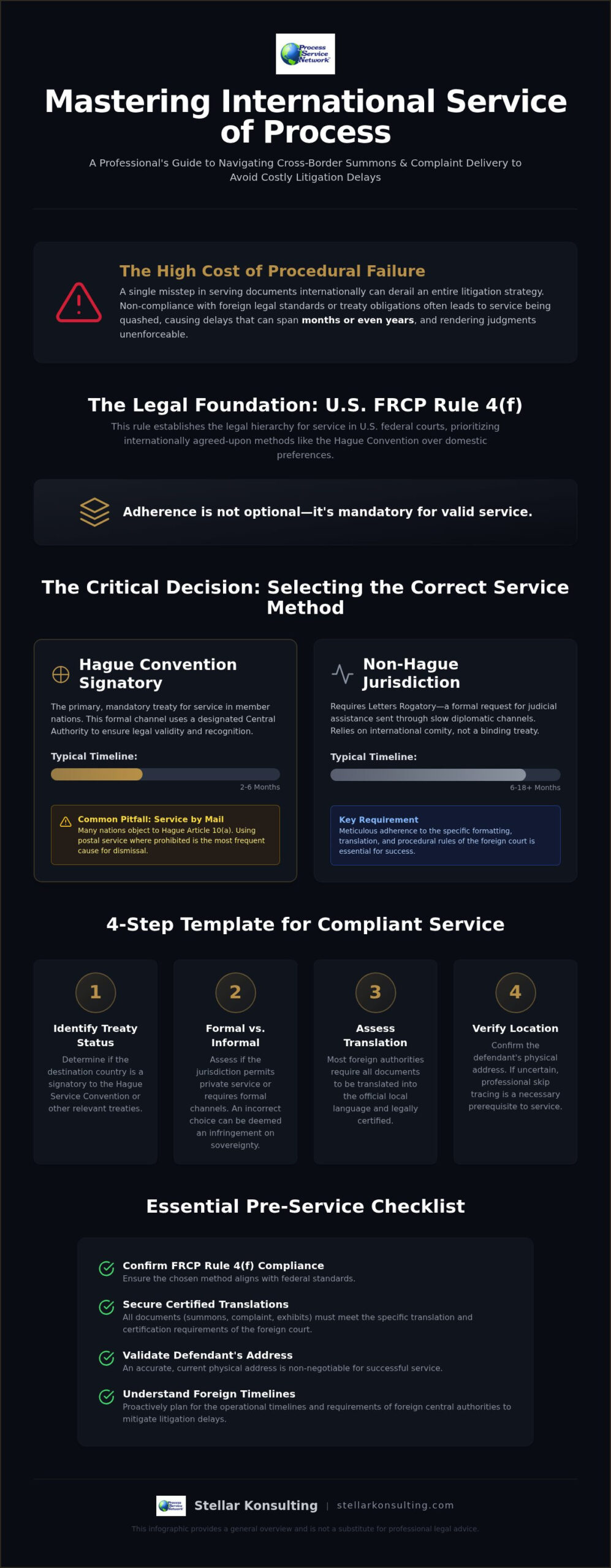
International summons and complaint service refers to the formal procedure of delivering legal notice to a defendant located outside the jurisdiction where the litigation is initiated. In U.S. federal courts, this process is governed primarily by the Federal Rules of Civil Procedure (FRCP) Rule 4(f). This rule provides a structured hierarchy for service, requiring litigants to utilize internationally agreed means reasonably calculated to give notice, such as those authorized by the Hague Service Convention. Failure to adhere to these specific protocols often results in a total failure of service, rendering any subsequent judgment unenforceable in the foreign forum.
The legal hierarchy places international treaties above local procedural preferences. While a plaintiff might prefer the convenience of service by mail, this method remains the most frequent cause for the dismissal of service. Many sovereign nations have entered specific reservations against Article 10(a) of the Hague Convention, which relates to postal channels. If a destination country has objected to this article, service by mail is legally invalid, regardless of its acceptance in domestic U.S. courts. Professional international summons and complaint service ensures that the selected method aligns with both the forum court’s rules and the recipient nation’s treaty obligations.
The Supremacy of the Hague Service Convention
The Hague Service Convention is the primary multilateral treaty governing the transmission of judicial and extrajudicial documents between signatory nations. Its application is mandatory whenever a document must be transmitted for service abroad to a recipient in a member state. Central to this framework is the Central Authority, a designated governmental body in the destination country responsible for receiving requests and executing service according to local law. Utilizing this formal channel ensures that the resulting certificate of service is recognized by both the originating court and the foreign judiciary.
Non-Hague Jurisdictions and Letters Rogatory
When a defendant resides in a country that is not a party to the Hague Convention, litigants must often rely on the more traditional and rigorous process of judicial assistance. This involves the use of letters rogatory legal services to facilitate communication between the domestic court and the foreign tribunal. This method requires a formal request for judicial assistance, which travels through diplomatic channels, often involving the Department of State and the foreign ministry of the destination state. Because this process relies on international comity rather than a binding treaty, timelines are significantly longer, frequently extending from six months to over a year. Successful execution requires meticulous attention to the specific formatting and translation requirements of the receiving court.
A Procedural Template for Selecting the Correct Service Method
Selecting the appropriate method for an international summons and complaint service requires a methodical assessment of the destination’s legal landscape. It’s not merely a matter of logistical convenience but a critical decision that determines whether a resulting judgment will be enforceable. Counsel should follow a structured template to mitigate the risk of procedural challenges.
- Step 1: Identify Treaty Status. The first priority is to determine if the destination jurisdiction is a signatory to the Hague Service Convention or another multilateral agreement. This status dictates the mandatory channels for service.
- Step 2: Formal vs. Informal Service. You must evaluate whether the country permits “informal” service via a private process server or requires “formal” service through its Central Authority. Some nations consider private service an infringement on their sovereignty, which can lead to criminal penalties for the server or dismissal of the case.
- Step 3: Assess Translation Requirements. Most jurisdictions require that the summons, complaint, and all supporting exhibits be translated into the official local language. These translations must typically be certified and treaty-compliant to be accepted by foreign authorities.
- Step 4: Verify the Defendant’s Location. Service cannot proceed without a confirmed physical address. If the defendant’s current location is uncertain, initiating a professional skip tracing search is a necessary prerequisite to ensure the validity of the service attempt.
Engaging a specialized firm for Formal Hague Service of Process ensures these initial steps are handled with the precision required for complex litigation.
The Inter-American Service Convention Path
Litigation involving defendants in Latin America often follows the inter-american service convention process. This treaty utilizes a specific set of forms, primarily the Annex A (Request) and Annex B (Certificate of Service). Unlike the Hague Convention, this process often requires additional layers of authentication, such as the use of an apostille or consular legalization, depending on the specific country’s requirements. Success in these jurisdictions relies heavily on regional expertise and a deep understanding of local bureaucratic expectations.
Service via Diplomatic Channels
In rare instances where no treaty exists or where a country has suspended its treaty obligations, litigants must use the service of process via diplomatic channels workflow. This is a “last resort” method where documents are transmitted from the domestic court to the Department of State, then to the U.S. Embassy in the destination country, and finally to the foreign ministry. This process is inherently slow and requires patience, as it depends on diplomatic comity rather than codified treaty timelines.
Formal vs. Informal Service: A Strategic Comparison
Executing a valid international summons and complaint service requires a strategic choice between formal and informal channels. Formal service involves utilizing the official mechanisms established by international treaties, such as the Hague Service Convention or the Inter-American Service Convention. This method relies on the Central Authority of the destination country to execute service according to its local laws. While this provides the highest level of legal certainty, it often involves longer wait times and rigid procedural requirements. The resulting certificate of service is a sovereign document that is nearly impossible to challenge in either the originating or the receiving court.
Informal service, by contrast, bypasses the Central Authority in favor of using local agents or private process servers. When selecting a method for international summons and complaint service, the decision usually hinges on whether you intend to enforce the judgment in the defendant’s home country. If the defendant has significant assets in the U.S., informal service may be a viable tactical choice to move the litigation forward quickly. However, if the ultimate goal is the international recognition and enforcement of a judgment, informal methods may be viewed as a violation of the foreign state’s sovereignty, rendering the judgment unenforceable abroad.
When to Choose Informal International Service
The primary tactical advantage of informal international service of process is speed. In jurisdictions that do not strictly prohibit private service, such as the United Kingdom or Canada, an agent can often complete delivery in a matter of days. This is particularly useful in preliminary injunctions or cases where time is of the essence. Despite the speed, attorneys must remain cautious. Some civil law jurisdictions consider the act of serving process to be a judicial function reserved exclusively for the state. In these regions, using a private server can lead to the service being quashed or even result in legal complications for the server involved.
The Risks of “Article 10” Service by Mail
Relying on Article 10 of the Hague Convention to serve process via postal channels is a common gamble that frequently leads to dismissal. While Article 10(a) mentions the “freedom to send judicial documents, by postal channels, directly to persons abroad,” many signatories have filed formal objections to this specific provision. Countries such as Germany, China, and Switzerland have explicitly stated that they do not recognize service by mail as a valid method of delivery. If an attorney serves a defendant in an objecting country via mail, the service is void ab initio. Stellar Konsulting verifies the current status of Article 10 objections for every jurisdiction to prevent the risk of service being quashed during litigation.
The Essential Pre-Service Checklist for Legal Professionals
Transitioning from strategic selection to operational execution requires a rigorous logistical audit. Even a perfectly chosen treaty path will fail if the underlying documentation is flawed. Preparing an international summons and complaint service requires ensuring that every document is “service-ready” for a foreign judiciary. This includes verifying that the summons is currently valid, properly sealed by the clerk, and that all exhibits are complete. Foreign central authorities are notoriously meticulous; they’ll often reject a request for a single missing page or an unauthenticated signature.
Coordination with local agents or process servers must occur in real-time. This ensures that any local developments, such as a defendant attempting to evade service, are addressed immediately. For high-stakes litigation, managing these moving parts requires a partner who integrates skip tracing and translation into the service workflow. You can streamline this process by utilizing the expert process serving solutions offered by Stellar Konsulting.
Certified Legal Document Translation Requirements
Standard commercial translation is insufficient for international judicial assistance. Most Hague Convention members require that documents be translated into their official language, even if the defendant speaks English. These translations must be certified and, in many cases, treaty-compliant to meet the standards of the receiving Central Authority. An error in translating a specific legal term can lead to a challenge of the service’s validity or a refusal by the foreign court to execute the request. Precision in translation is as critical as the service itself to ensure the resulting certificate of service survives judicial scrutiny.
International Skip Tracing and Defendant Location
A common cause of protracted delays is the “bad address” scenario. Before initiating a formal request, it’s essential to verify the defendant’s current physical location through professional skip tracing. This is especially true in jurisdictions where the Central Authority won’t conduct an investigation if the provided address is incorrect. If the defendant remains elusive after exhaustive efforts, skip tracing results provide the necessary due diligence required to petition a U.S. court for alternative service or service by publication. Ensuring the defendant’s location is verified at the outset protects the litigation timeline from unnecessary resets.
Optimizing Global Litigation with Stellar Konsulting
Managing an international summons and complaint service requires more than a simple understanding of treaty text; it demands a sophisticated logistical framework capable of adapting to diverse judicial environments. Stellar Konsulting provides end-to-end management of this complex workflow, ensuring that every procedural requirement is met before documents leave the country. With over 30 years of experience in international process serving, our firm acts as a global facilitator for legal teams navigating high-stakes litigation. We integrate certified legal document translation and professional skip tracing into a single, seamless support system that prioritizes legal validity and procedural transparency.
Proactive communication remains a cornerstone of our service model. Legal teams require clear timelines and real-time status tracking to plan their litigation strategies effectively. By centralizing the management of translation, delivery, and reporting, we eliminate the fragmentation that often leads to delays when using multiple vendors. This methodical approach ensures that your international summons and complaint service proceeds without the friction typically associated with cross-border legal delivery.
Why Specialized Expertise Prevents Procedural Dismissal
The financial and strategic costs of a failed service attempt far outweigh the investment in professional process serving. A service that’s quashed due to a lack of treaty compliance or a failure to follow local foreign laws can set a case back by a year or more. While multilateral treaties provide a broad framework, they don’t cover the granular nuances of local court hours, specific regional holidays, or the varying levels of cooperation from foreign central authorities. Our expertise ensures that your certificate of service is not only delivered but is also ready for immediate submission to a U.S. court, having withstood the rigors of international legal standards.
Partnering with Stellar Konsulting for National and Global Needs
We maintain a steadfast commitment to authoritative, treaty-compliant service across both Hague and non-Hague jurisdictions. Whether you’re navigating the rigid requirements of a Central Authority in Europe or the diplomatic complexities of a nation requiring letters rogatory, our firm possesses the professional network and jurisdictional knowledge to execute the task. We specialize in handling the most challenging jurisdictions worldwide, providing the deep-rooted reliability that elite legal professionals expect. Our goal is to instill confidence in our clients, knowing that their sensitive legal tasks are being handled by a seasoned global partner. To secure your litigation timeline and ensure valid delivery, consult with our international process serving experts today.
Advancing Your Cross-Border Litigation Strategy
Mastering the nuances of international legal delivery requires a disciplined approach to treaty compliance and logistical coordination. Whether you’re navigating the mandatory channels of the Hague Convention or the diplomatic intricacies of letters rogatory, the validity of your case depends on procedural precision. By following a structured template for selecting service methods and prioritizing certified translations, legal teams can mitigate the risk of quashed service and avoid costly litigation delays. A successful outcome relies on aligning your strategy with the specific sovereign requirements of the destination jurisdiction.
Successfully executing an international summons and complaint service requires a partner who understands the granular requirements of foreign central authorities. Stellar Konsulting leverages over 30 years of specialized experience to provide comprehensive support, from skip tracing elusive defendants to delivering treaty-compliant translations. Our methodical approach ensures that your legal documents are handled with the authority and precision required in the global legal arena. Secure valid international service for your litigation today and take the next step in your global litigation with absolute confidence in your procedural foundation.
Frequently Asked Questions
How long does it typically take to serve an international summons and complaint?
Timelines vary significantly by jurisdiction and the selected delivery method. Hague Service through a Central Authority typically takes 3 to 6 months, though some civil law countries can extend to 12 months. Informal service in common law jurisdictions like the UK can often be completed in 7 to 10 days. Letters rogatory through diplomatic channels remain the slowest option, frequently requiring 6 to 18 months for completion.
Can I serve a foreign defendant via email or social media?
Service via electronic means is generally only permitted as a last resort under FRCP Rule 4(f)(3) and requires a specific court order. U.S. courts typically grant this only after a plaintiff demonstrates that traditional treaty-based methods are impossible or have failed. Many foreign nations consider electronic service a violation of their judicial sovereignty, which may prevent the future enforcement of a U.S. judgment in that country.
What happens if a country is not a member of the Hague Service Convention?
When a country isn’t a Hague signatory, service is usually executed via letters rogatory or the Inter-American Service Convention if applicable. Letters rogatory involve a formal request from a U.S. court to a foreign tribunal. This process travels through diplomatic channels and requires meticulous adherence to local formatting. In some jurisdictions, informal service by a local agent may be permitted if it doesn’t violate local sovereign laws.
Is a translation always required for international service of process?
Translation is mandatory for most formal international summons and complaint service requests. Central authorities in non-English speaking countries typically refuse to execute service unless the documents are translated into their official language. Even if the defendant is fluent in English, the foreign state requires the translation to satisfy its own internal legal protocols. Failure to provide a certified, treaty-compliant translation often leads to the immediate rejection of the request.
What is the difference between a summons and a complaint in international service?
The summons is the official court notice commanding the defendant to appear, while the complaint outlines the specific legal claims and facts of the case. For international service, both documents must be served together as a single package. Foreign authorities require the complete set of papers to ensure the defendant receives full due process notice. Every page of both documents must be included in any required translations to be considered valid.
Can I use a standard private investigator for international skip tracing?
Standard private investigators often lack the specialized access to international databases and the knowledge of foreign privacy laws, such as GDPR in Europe. Effective international skip tracing requires a firm that understands the legal boundaries of data collection in specific jurisdictions. Using an unqualified investigator can lead to inadmissible evidence or legal liability. Stellar Konsulting integrates specialized skip tracing to ensure defendants are located accurately before service begins.
What is a Certificate of Service and why is it critical for my case?
A Certificate of Service is the formal proof provided by the serving authority that delivery was successful. In Hague cases, this is a specific form signed by the foreign Central Authority. It serves as the primary evidence for a U.S. judge that the court has personal jurisdiction over the defendant. Without this valid, treaty-recognized document, you cannot move for a default judgment or proceed to the merits of the litigation.
How does Stellar Konsulting ensure compliance with local foreign laws?
We leverage over 30 years of experience and a vetted network of local agents to navigate the specific legal requirements of each jurisdiction. Our team monitors current treaty reservations and changes to local procedural rules in real time. By managing the entire workflow, including certified translation and skip tracing, we ensure that every international summons and complaint service meets both U.S. federal standards and the sovereign laws of the destination country.