
In international litigation, a translation error isn’t just a linguistic mistake; it’s a jurisdictional failure that can dismantle your entire case before it even reaches a courtroom. When selecting spanish legal translation services for cross-border disputes, a single mistranslated term can lead a foreign Central Authority to reject your service of process, resulting in costly delays and potential dismissals. You likely already know that precision is the bedrock of any successful filing, yet the complexities of treaty compliance often create unforeseen hurdles for even the most seasoned legal teams.
This guide provides a roadmap for selecting a translation partner that ensures your documents meet the rigorous standards of the Hague Service Convention and the Inter-American Service Convention. You’ll learn how to navigate dialect-specific nuances between Latin American and Peninsular Spanish, and how to stay compliant with the transparency requirements of the EU AI Act that took effect on August 2, 2026. We’ll outline a methodical approach to integrating translation with your process serving strategy, ensuring that every document is procedurally sound and ready for international scrutiny. By the end of this article, you’ll understand how to bridge the gap between linguistic accuracy and legal validity.
Key Takeaways
- Understand why jurisdictional expertise is mandatory for litigation and how general agencies often fail to meet court-specific standards.
- Discover how specialized spanish legal translation services mitigate the hidden costs of re-filing fees and jurisdictional dismissals.
- Identify critical criteria for evaluating providers, including their proficiency with letters rogatory and the depth of their certification process.
- Utilize a treaty-compliant checklist to ensure all exhibits and annexes meet the specific language requirements of the Hague Convention.
- Recognize the operational benefits of a unified workflow that integrates legal translation directly with international process serving for seamless execution.
The High Stakes of Spanish Legal Translation in 2026
In cross-border litigation, spanish legal translation services function as a critical jurisdictional bridge rather than a mere linguistic conversion. Spanish terminology is not uniform across the globe; the legal vocabulary used in one nation often differs significantly from that of its neighbors. Relying on specialized law translators is essential because general translation agencies often lack the depth of jurisdictional knowledge required to produce a document that a foreign court will recognize. A minor error in a summons or complaint doesn’t just confuse the reader. It can lead to a formal rejection by a Central Authority, potentially causing the statute of limitations to expire or resulting in a complete case dismissal.
Why Legal Nuance Trumps General Fluency
Linguistic accuracy ensures a sentence is grammatically correct, but legal equivalence ensures it has the intended effect under foreign law. Automated translation tools and non-specialized linguists frequently fail to capture the distinction between “service of process” and “notificación de la demanda,” leading to procedural ambiguity. Legal equivalence is the precise alignment of terminology where the translated text triggers the exact same legal obligations and rights as the original document within the target country’s civil code. Without this precision, a defendant might successfully argue they weren’t properly notified according to their local laws. Boutique legal support firms prioritize these nuances to protect the integrity of the litigation from the very first filing.
The Role of Translation in International Process Serving
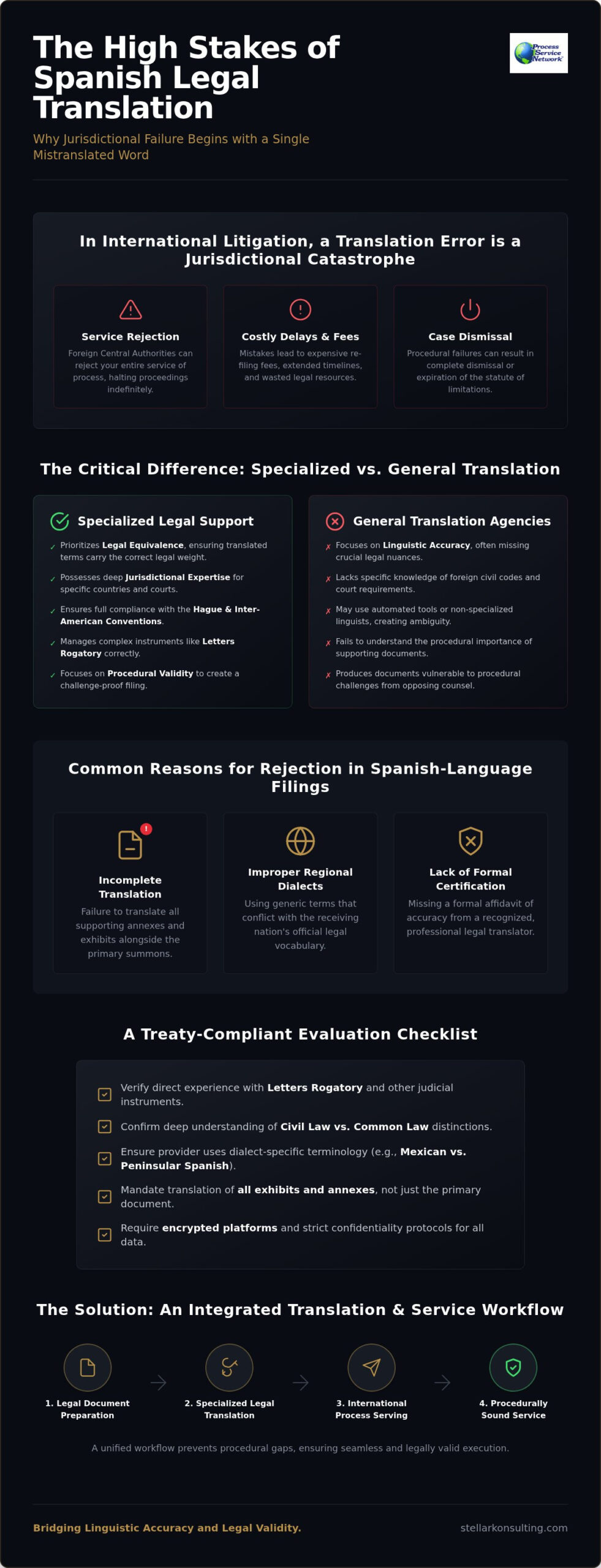
Translation is a mandatory requirement under Article 5 of the Hague Convention for many signatory nations. When executing Hague Convention service of process, the receiving Central Authority acts as a gatekeeper. They evaluate every page for completeness and accuracy. If a translation is deemed incomplete, meaning it lacks a translated version of a critical exhibit or annex, the entire request is typically returned to the sender without service being attempted. Common reasons for rejection in Spanish-language filings include:
- Failure to translate all supporting annexes and exhibits alongside the primary summons.
- Use of improper regional dialects that conflict with the receiving nation’s official legal terminology.
- Lack of a formal affidavit of accuracy from a recognized professional translator.
The primary goal of these translations is procedural validity. This ensures that the service is legally sound and immune to challenges regarding its form or content. By viewing translation as a component of the service of process chain rather than a standalone task, legal teams can avoid the procedural traps that often derail international cases.
Critical Criteria for Evaluating Spanish Translation Providers
Selecting a partner for spanish legal translation services requires a rigorous assessment of their technical and legal proficiency. A primary Critical Criteria for Evaluating a potential provider is their direct experience with specialized judicial instruments, such as letters rogatory legal services. These documents follow a rigid diplomatic format that a general translator cannot replicate. Furthermore, an authoritative provider must demonstrate a sophisticated understanding of the civil law vs. common law divide. A translator who doesn’t grasp how a “Power of Attorney” functions differently in a civil law jurisdiction may use terminology that invalidates the document’s intent. Security remains paramount; ensure your partner utilizes encrypted platforms and strict confidentiality protocols to protect sensitive litigation data during the discovery phase.
Dialect Matters: Mexican vs. Peninsular vs. Latin American Spanish
Spanish is not a universal legal language, and a generic translation often overlooks regionalisms that are vital for court acceptance. For instance, the terminology required when serving legal documents in Mexico differs sharply from the Peninsular Spanish used in Spain or the variations found in Argentina. Mexican legal codes use specific terms for “service” and “notification” that, if swapped for Peninsular equivalents, can cause immediate rejection by a local judge. Using a translator familiar with the target country’s specific legal code is a non-negotiable step for maintaining procedural integrity and avoiding the jurisdictional failures mentioned previously.
Certification and Notarization Requirements
Certification requirements vary by jurisdiction and the nature of the filing. In the United States, a certified translation typically requires an affidavit of accuracy signed by the translator. However, many Spanish-speaking nations require a “Traductor Jurado” or sworn translator, who is officially authorized by their government to sign and stamp legal documents. Depending on the treaty requirements, you might also need notarization or an Apostille to prove the translator’s credentials to a foreign Central Authority. Understanding these distinctions early prevents last-minute delays in international filings. Stellar Konsulting provides specialized spanish legal translation services that account for these regional certification standards, ensuring your documents are ready for professional legal document translation and immediate service.
Comparing Specialized Legal Support vs. General Translation Agencies
Law firms often face a choice between high-volume, general-purpose translation agencies and boutique legal support firms. While volume-based agencies prioritize speed and low entry costs, they frequently lack the procedural expertise necessary to navigate Hague Service Convention translation requirements. This gap in knowledge creates significant hidden costs for the client. A single rejected filing leads to re-filing fees, lost time, and the potential for a missed court deadline. Boutique firms like Stellar Konsulting mitigate these risks by treating spanish legal translation services as a specialized legal function rather than a commodity. This approach includes managing complex formatting requirements, such as dual-column layouts where the source and target text are presented side-by-side for the court’s convenience.
The Problem with Volume-Based Translation
Volume-based models typically rely on per-page pricing that incentivizes speed over precision. Many of these agencies utilize Machine Translation Post-Editing (MTPE), a process where AI generates the initial text and a linguist briefly reviews it. This method often misses critical legal nuances, especially under the transparency and oversight requirements of the EU AI Act that took effect on August 2, 2026. High-stakes litigation requires human-only translation workflows to ensure that every term of art is applied correctly within the specific legal context. Rushed, automated translations are prone to errors that can undermine the credibility of a filing and invite challenges from opposing counsel.
Consultative Support and Strategic Value
A strategic partner does more than translate text; they provide a comprehensive logistical framework for international litigation. This includes a deep understanding of the Inter-American Service Convention and the ability to coordinate with other essential services. For instance, if a defendant’s location is uncertain, a provider who understands international skip tracing costs and methods can streamline the entire process. A strategic partner prevents procedural bottlenecks by ensuring that the translation, skip tracing, and service of process are executed as part of a single, unified strategy. This level of integration is a hallmark of Stellar Konsulting’s authoritative approach to international legal support, providing a steady hand through the complexities of cross-border disputes.
Treaty-Compliant Translation Checklist for 2026
Achieving treaty compliance requires a methodical audit of every document destined for a foreign Central Authority. When utilizing spanish legal translation services, the primary objective is to ensure the filing is beyond reproach in the eyes of the receiving court. This starts with confirming the target jurisdiction’s specific language requirements. While some countries allow for English summaries, most Spanish-speaking signatories to the Hague Convention demand a full translation of all documents. This includes every exhibit, annex, and supporting affidavit. Omitting a single invoice or email attachment often results in the entire service package being returned months after the initial filing, creating a significant procedural setback.
Consistency across all translated pages is equally vital. Legal terms must remain uniform throughout the complaint, the summons, and any attached contracts. Central Authorities frequently audit documents for terminological stability; a discrepancy in how a party is identified or how a specific legal remedy is described can trigger a rejection. Verify that the translator’s certification meets the exact standards of the receiving nation. Some jurisdictions require a simple affidavit of accuracy, while others demand a sworn translation from a linguist registered with a specific national ministry.
Preparing Documents for the Hague Convention
Service under Article 5 of the Hague Convention follows a rigid structure. You must translate the “Summary of the Document to be Served” into Spanish, even if the primary summons is accompanied by a full translation. This summary is often the first page the Central Authority reviews. Formatting rules also differ between Article 5 and Article 10 service. For Article 5, the documents pass through official government channels, requiring a higher level of formal certification. Common pitfalls in Spanish translations include failing to use the specific legal register required by Latin American authorities, who may view Peninsular Spanish terms as imprecise or inapplicable to their civil codes.
Inter-American Service Convention Specifics
The Inter-American Service Convention is often more rigid than the Hague Convention for certain countries. This treaty requires the use of mandatory forms, specifically Forms A, B, and C. These forms must be translated with absolute precision to ensure they align with the required diplomatic channels. Form A acts as the letter rogatory, Form B provides the essential information for the person being served, and Form C is the certificate of execution. Each form has a specific layout that must be preserved. Any deviation from these templates can lead to a refusal by the receiving state’s judiciary. Ensure your translation partner understands how to navigate these diplomatic nuances to prevent a total service dismissal. For a filing that satisfies these rigorous requirements, trust Stellar Konsulting to deliver professional legal document translation that ensures jurisdictional acceptance.
Integrating Translation with International Process Serving
Efficiency in international litigation is often compromised when translation and process serving are treated as isolated tasks. Stellar Konsulting bridges this gap by providing a single point of accountability for both functions. By choosing professional spanish legal translation services that are integrated with the service of process, legal teams ensure that their documents move seamlessly from the linguist’s desk to the foreign court’s jurisdiction. With over 30 years of experience, the firm prepares every translated document with the final proof of service in mind. This foresight prevents the common issue of translations being rejected because they don’t align with the specific procedural requirements of the target jurisdiction.
Reducing Turnaround Times Through Unified Logistics
Unified logistics allow for the simultaneous execution of skip tracing and translation. If a defendant’s location is unconfirmed, skip tracing can proceed while the core legal documents are being translated into the required dialect. This parallel processing significantly reduces the overall timeline for international service. It also eliminates the risk of documents being lost or misinterpreted between separate vendors. Every draft is audited for compliance from the initial phase through to the final execution of service, ensuring a procedurally sound result. When a single firm manages the workflow, the transition from document preparation to physical service is instantaneous, removing the administrative bottlenecks that often plague cross-border disputes.
Global Reach and Professional Authority
Stellar Konsulting maintains a high degree of international competence, navigating both the Hague Convention and the Inter-American Service Convention with precision. This expertise is particularly valuable for complex filings in Mexico and across Latin America where diplomatic channels are rigid. The firm’s established network and deep understanding of regional legal codes provide clients with a sense of grounded reliability. To initiate a project, counsel typically provides the primary summons and complaint for an initial procedural review. Stellar Konsulting then assesses the target jurisdiction’s specific treaty declarations to determine the exact requirements for spanish legal translation services. This methodical approach ensures that once the translation is complete, it is immediately ready for dispatch to the foreign Central Authority or local agent.
The firm’s national reach and international standing make it a sophisticated guide for law firms handling high-stakes tasks across diverse jurisdictions. There is a quiet commitment to results that stems from decades of handling sensitive legal documents. By aligning translation with the logistical realities of international service, Stellar Konsulting ensures that jurisdictional challenges are addressed before they can impact the case timeline.
Securing Procedural Integrity for International Filings
Success in international litigation depends on the seamless alignment of linguistic precision and procedural compliance. By prioritizing specialized spanish legal translation services, you protect your litigation from the jurisdictional failures that often arise from improper terminology or incomplete filings. We’ve explored how a unified approach to translation and service of process eliminates the friction between vendors and ensures every document meets the rigorous standards of foreign Central Authorities. It isn’t just an efficiency; it’s a critical risk-mitigation strategy that ensures your case moves forward without unnecessary delays.
Stellar Konsulting brings over 30 years of specialized international legal support to every engagement. Our deep expertise in both the Hague and Inter-American Service Conventions allows us to navigate complex global requirements with authoritative confidence. By offering integrated skip tracing and translation services, we eliminate the logistical gaps that often derail cross-border disputes. You’ll gain a partner that understands the nuances of international law and handles high-stakes tasks with the reliability your firm requires.
Request a Consultation for Spanish Legal Translation and International Service to ensure your next international filing is executed with professional authority.
Frequently Asked Questions
Is a certified translation always required for international service of process?
Most international treaties and foreign Central Authorities require a certified translation to ensure legal documents are procedurally valid. Under Article 5 of the Hague Service Convention, the receiving state typically mandates that the summons and complaint be translated into its official language. Certification provides the necessary assurance of accuracy that foreign courts demand. Failing to provide a certified version often leads to the immediate rejection of your service request by the target jurisdiction.
What is the difference between Mexican Spanish and European Spanish in legal documents?
Mexican Spanish and European Spanish utilize distinct legal terminologies reflecting their specific civil codes and judicial traditions. In Mexico, terms related to service or notification follow precise definitions that differ from those used in Spain’s courts. Using the wrong dialect can create procedural ambiguity, potentially allowing a defendant to challenge the service. Expert spanish legal translation services account for these regional nuances to ensure the document aligns with the target country’s legal requirements.
Does the Hague Convention require the translation of all exhibits?
The Hague Service Convention generally requires the full translation of all documents intended for service, including all exhibits and annexes. While some jurisdictions might accept a summary, many Central Authorities will reject a filing if any part of the evidence or supporting documentation remains in English. Translating the entire package is a critical risk-mitigation strategy to prevent the request from being returned as incomplete after months of waiting for a response.
Can I use a local notary for an international legal translation?
A local notary can only notarize the translator’s signature on an affidavit of accuracy; they cannot verify the translation’s legal validity or linguistic precision. For many international jurisdictions, a simple notarization is insufficient. You may need an Apostille or a translation performed by a sworn translator recognized by the target country’s government. It’s essential to verify the specific requirements of the receiving Central Authority before proceeding with only a local notarization for your documents.
How long does a professional Spanish legal translation typically take?
The timeline for a professional translation depends on the volume of the documents and the complexity of the legal terminology. A standard summons and complaint may be completed within a few business days, but complex litigation involving extensive exhibits requires more time. Stellar Konsulting prioritizes a methodical approach to ensure accuracy, often coordinating translation alongside skip tracing to keep the overall service of process timeline as organized and efficient as possible.
What happens if a foreign court rejects my translation?
If a foreign court or Central Authority rejects a translation, the entire service of process request is usually returned to the sender. This results in significant delays, additional re-filing fees, and the potential for the statute of limitations to expire. You’ll likely need to commission a new, treaty-compliant translation and restart the formal service process from the beginning. This outcome highlights the importance of using a provider with deep expertise in international legal treaties.
Why is “sworn translation” different from “certified translation” in Spain?
In Spain, a sworn translation must be performed by a translator authorized by the Ministry of Foreign Affairs, European Union and Cooperation. These translators use an official stamp and signature recognized by Spanish courts. A certified translation in the United States typically refers to a professional translation accompanied by a signed affidavit of accuracy. Many Spanish authorities won’t accept a standard US certification without additional authentication or a sworn translator’s official credentials.
How much does Spanish legal translation cost for a standard summons and complaint?
The cost for spanish legal translation services varies based on the total word count, the complexity of the legal terminology, and the specific certification requirements of the target jurisdiction. Documents with extensive technical exhibits or those requiring sworn translation in a foreign country will involve different pricing structures. Rather than relying on flat per-page rates, professional firms provide project-specific quotes that reflect the precise logistical and legal needs of your international litigation.