

A court-ordered judgment is effectively worthless if the debtor has successfully vanished across international borders. You’ve likely invested significant time and resources into litigation, only to discover that the target has relocated to a jurisdiction where domestic databases offer no visibility. It’s a common frustration for legal professionals who find that bad data and strict privacy regulations, such as the GDPR, can stall even the most robust recovery efforts and lead to failed service attempts.
Mastering international skip tracing for judgment enforcement is the essential first step in transforming a foreign judgment into tangible asset recovery. This article provides a technical overview of how to locate elusive debtors while maintaining strict procedural compliance with global standards. We’ll explore the nuances of the 2019 Hague Judgments Convention, the limitations of informal searches, and the methodical approach needed to secure a verified physical address for successful service of process abroad. By understanding these cross-border complexities, you can ensure your judgments remain enforceable and your recovery efforts are legally sound.
Key Takeaways
- Recognize that standard domestic data aggregators are often insufficient for global searches and require specialized investigative intelligence.
- Understand how international privacy regulations, including the GDPR, dictate the specific methods used to locate debtors legally across borders.
- Learn why a verified physical address is the critical component of international skip tracing for judgment enforcement to ensure subsequent service is legally actionable.
- Identify the procedural requirements for transitioning from a successful skip trace to formal service via the Hague Convention or Letters Rogatory.
- Discover how to navigate the complexities of non-Hague jurisdictions by combining corporate registry data with localized field intelligence.
The Strategic Role of Skip Tracing in International Judgment Enforcement
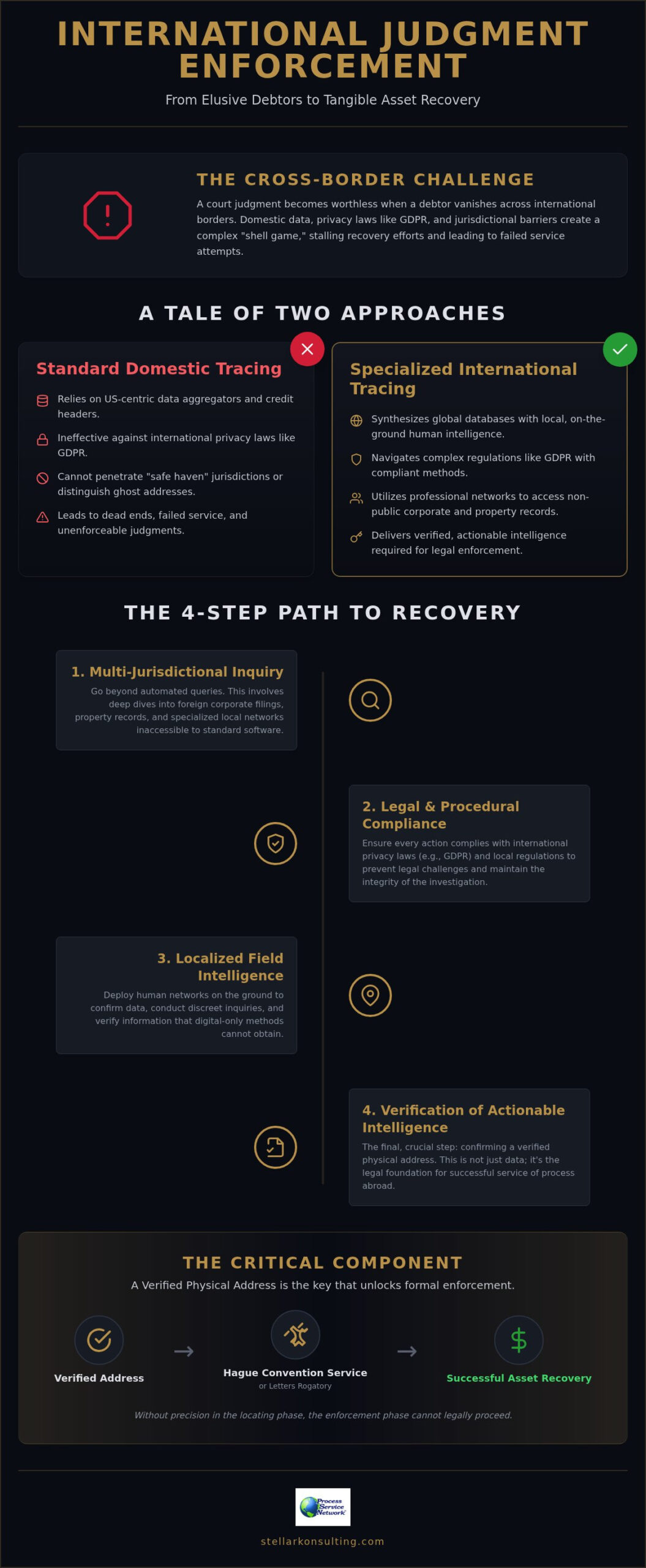
International skip tracing for judgment enforcement is the specialized methodology of locating individuals or corporate entities that have crossed national borders to evade financial liabilities. While domestic skip tracing relies heavily on credit headers and utility records within a single country, international efforts require a sophisticated synthesis of global databases and local human intelligence. Standard collection methods frequently fail when a debtor relocates abroad because domestic investigators often lack access to foreign registries or fail to account for differing privacy standards. Precision during this phase is mandatory; a judgment is only as strong as your ability to find the person responsible for satisfying it.
Satisfying “due diligence” requirements is a critical component of this process. Most courts require a documented, exhaustive search before they will authorize alternative methods of service or recognize a foreign judgment. Precise location data isn’t just a convenience; it’s the legal foundation that ensures a judgment remains enforceable and resistant to challenges based on improper notice. Without this verified data, the path to recovery is effectively blocked by procedural technicalities.
The “Shell Game” of International Asset Movement
High-stakes litigation often prompts debtors to move assets or themselves to jurisdictions they perceive as “safe havens.” These individuals rely on the fact that international borders create significant barriers for standard investigators. Traditional skip tracing techniques used in the United States, such as searching Social Security databases, are ineffective once a subject enters a different legal system. Effective investigation must shift from automated database queries to complex, multi-jurisdictional inquiries. This transition involves tracking movement through corporate filings, property records, and specialized local networks that aren’t accessible through standard domestic software.
Legal Necessity of Actionable Intelligence
In the context of international law, “good enough” data is a liability. Using an outdated or unverified address can lead to immediate case dismissals in foreign courts or the rejection of service requests by Hague Convention central authorities. These bodies require specific, verified physical locations to execute formal service. Standard collection methods frequently fail when a debtor relocates abroad for several reasons:
- Domestic credit headers don’t track international moves.
- Privacy laws like GDPR restrict access to traditional data sources.
- Language barriers hinder communication with local authorities.
Stellar Konsulting leverages over 30 years of experience to ensure that the intelligence gathered is actionable. Successful international skip tracing for judgment enforcement serves as the essential prerequisite for Formal Hague Service of Process or Letters Rogatory. Without a verified residential or business address, the subsequent legal steps cannot proceed. This leaves the creditor with a valid judgment but no means of recovery. Precision in the locating phase directly dictates the success of the enforcement phase.
Navigating Jurisdictional Hurdles: Beyond Basic US Data Aggregation
Many legal professionals rely on automated US data aggregators that update frequently but lack global reach. These tools are often ineffective for international skip tracing for judgment enforcement because they cannot access foreign credit headers or utility records. In jurisdictions like the European Union, the General Data Protection Regulation (GDPR) imposes strict limitations on how personal data is processed and shared. This regulatory environment makes automated data scraping not only difficult but potentially illegal. Relying on software that works in the United States often leads to dead ends when a debtor moves to a country with high data privacy standards.
Debtors frequently exploit “ghost” addresses or mail forwarding services in tax havens to obscure their true location. These services provide a veneer of residency while the individual remains physically elsewhere. Automated tools cannot distinguish between a legitimate physical residence and a commercial forwarding suite. Overcoming these barriers in international skip tracing for judgment enforcement requires accessing non-public records through professional human networks that understand local registration requirements and residency permits. These networks can verify if a location is a physical dwelling or merely a post office box disguised as a suite.
International Skip Tracing Techniques and Tools
International skip tracing techniques utilize specialized global networks to bypass the limitations of domestic search engines and public databases. Open Source Intelligence (OSINT) plays a vital role, but it must be supplemented by proprietary global intelligence networks. These networks provide insights into local language databases, regional property registries, and corporate filings that are not indexed by common search engines. Effective OSINT involves analyzing digital footprints and social patterns that reveal a debtor’s current lifestyle and location, even when they attempt to maintain a low profile.
Compliance and Ethics in Global Investigations
International asset recovery and the tracing that precedes it must be conducted with strict adherence to local laws. Using “black market” data or unauthorized leaks can jeopardize a case, rendering the evidence inadmissible in a court of law. It’s essential to maintain a clear chain of custody for all evidence gathered during the trace to ensure it survives legal scrutiny during enforcement. If the data is obtained unethically, it can lead to sanctions against the firm or the dismissal of the enforcement action entirely. For firms requiring a reliable partner in these complex matters, Stellar Konsulting provides the necessary oversight to ensure compliance and procedural integrity.
Case Analysis: Asset Recovery from a Defunct Cross-Border Entity
Consider a scenario where a corporate debtor dissolves its US operations and relocates its principal officers to a non-Hague jurisdiction. This maneuver is specifically designed to exploit the lack of treaty-based cooperation between nations, creating a jurisdictional vacuum that standard domestic tools cannot fill. In these instances, international skip tracing for judgment enforcement shifts from simple data retrieval to an investigative deep-dive into corporate succession and asset transfers. Success requires a methodology that combines rigorous corporate registry searches with on-the-ground field intelligence to successfully pierce the corporate veil.
The goal is to establish a direct link between the defunct entity and the debtor’s new international presence. This process involves more than just identifying a new office; it requires proving that the new foreign entity is merely an alter ego of the original debtor. By tracking the flow of capital and the relocation of key personnel, investigators can build a profile that supports the recognition of the judgment in the new jurisdiction, even when no formal treaty exists.
Step 1: Identifying the Corporate Veil
Tracing the movement of capital from a defunct US entity to a foreign subsidiary requires an analysis of both digital footprints and human narratives. Often, locating witnesses for international testimony provides the critical leads necessary to track debtor movement across borders. These individuals, including former business partners or high-level administrative staff, can offer insights into the beneficial owners of offshore accounts that automated systems frequently miss. Identifying these links is the essential first step in proving that the assets were moved with the intent to defraud creditors.
Step 2: Confirming Physical Presence for Service
Once the general location is established, investigators must confirm a specific physical presence to satisfy international legal requirements. Many debtors in non-Hague jurisdictions utilize false residency claims or specialized mail-drop services to evade process servers. Confirming a physical residence or business location is essential for satisfying the rigorous standards of Hague Service of Process or Letters Rogatory. Legal Document Translation also plays a vital role in this phase. Identifying local foreign records often depends on the ability to interpret regional filing systems, property titles, and utility registrations accurately in the local language.
In this analysis, the synthesis of registry data and field intelligence allows the creditor to link the principal to hidden assets in a jurisdiction previously thought unreachable. The result is a verified address that supports a valid service of process. High-stakes recovery efforts like these demonstrate why specialized legal support is mandatory. Navigating these complexities requires a partner with a global network and over 30 years of experience in international procedural law. Stellar Konsulting provides the specialized intelligence needed to ensure that international skip tracing for judgment enforcement leads to a successful recovery rather than a procedural dead end.
Verifying Actionable Intelligence for Valid Foreign Service
Actionable intelligence in international skip tracing for judgment enforcement is defined by data that meets the specific procedural requirements of a foreign court or a Central Authority. Unlike marketing leads, which prioritize “right-party contact” through phone numbers or email addresses, legal intelligence must provide a verified physical location. Without a confirmed residential or business address, the subsequent steps of service are impossible to execute. This verification process involves a methodical four-step approach to ensure resources are allocated effectively.
- Step 1: Physical Address Verification. We confirm the debtor’s actual residential location through local registries, utility records, or field visits to ensure they are physically present at the site.
- Step 2: Feasibility Assessment. We evaluate if the location allows for service via the Hague Convention or if alternative methods like Letters Rogatory are necessary.
- Step 3: Cost-Benefit Analysis. It is essential to calculate international skip tracing costs against the total value of the judgment to ensure the recovery effort remains economically viable.
- Step 4: Temporal Validation. Data must be current. We verify that the information is fresh enough to prevent “return of service” failures, which often occur when a debtor moves during the processing of legal documents.
Actionable Data vs. Raw Information
A phone number or an active social media profile might indicate a debtor’s general vicinity, but it is insufficient for initiating legal recovery. Actionable data requires confirming current employment or specific asset locations to facilitate garnishment or seizure. In countries with limited public infrastructure, where digital records are scarce, we rely on local networks to verify presence. This grounded approach ensures that the intelligence provided can withstand the scrutiny of a foreign judge or a process server on the ground.
Vetting Your International Skip Tracing Partner
Choosing a partner requires more than checking a list of services. You must ask about their international source network and their specific knowledge of Hague Convention service of process. A qualified partner provides transparency in reporting and a clear cost structure for global investigations. They should demonstrate an understanding of how location data integrates with the broader legal strategy of judgment enforcement. If you are ready to secure a verified location for your next case, consult with our international specialists to ensure your data is actionable.
Closing the Loop: Integrating Skip Tracing with Global Process Serving
Locating a debtor across international borders is a significant tactical victory, but it remains incomplete without the immediate execution of formal legal service. International skip tracing for judgment enforcement serves as the engine that drives the recovery process; however, its value is only fully realized when the location data is transitioned into actionable legal notice. Many legal teams struggle at this specific junction, losing precious time as the debtor potentially relocates while the paperwork is being prepared. Success requires a seamless handoff between the investigative phase and the service phase to prevent the trail from going cold.
Stellar Konsulting manages the complex logistics of cross-border document delivery, ensuring that once a target is verified, the legal paperwork is served according to both local regulations and international standards. In jurisdictions where treaties like the Hague Convention do not apply, we utilize Letters Rogatory legal services to facilitate judicial assistance through diplomatic channels. This methodical approach ensures that even in non-treaty countries, the judgment remains on a path toward recognition and enforcement. By closing the loop between data and service, we transform raw intelligence into a legally binding reality.
The Integrated Approach to International Litigation
Utilizing a single firm for both skip tracing and process serving provides significant procedural continuity that fragmented services cannot match. When the investigators who located the debtor coordinate directly with the process servers, the risk of case dismissal due to technical errors or delays is drastically minimized. This synergy allows for Legal Document Translation to be prepared in advance, ensuring that translated documents are ready for immediate personal service the moment a physical location is confirmed. This continuity is essential for maintaining the integrity of the evidence and the validity of the service under foreign law.
Next Steps for Legal Professionals
For legal professionals, the preparation phase is vital for a successful recovery. It’s recommended to ensure your case file includes all known aliases, previous corporate affiliations, and potential asset links before initiating a trace. Once the debtor is found, the strategy shifts to regional execution, such as serving legal documents in Mexico or other specific jurisdictions where local procedural nuances must be respected. Finalizing the recovery involves using skip trace data not just for service, but for identifying the specific accounts or property required for post-judgment asset seizure.
The transition from investigation to enforcement is the most critical stage of international litigation. If you are managing a complex cross-border case and require a partner with over 30 years of experience, contact Stellar Konsulting for a strategic evaluation of your international requirements.
Transitioning from Location to Legal Enforcement
Successful recovery begins with the realization that locating a debtor is only half the battle. Effective international skip tracing for judgment enforcement requires a sophisticated synthesis of global intelligence and strict procedural precision. By verifying physical addresses and ensuring compliance with regional privacy laws, you transform elusive data into actionable service. This integrated approach minimizes the risk of case dismissal and ensures that your litigation efforts lead to tangible results.
Navigating these cross-border complexities is often procedurally risky without seasoned guidance. Stellar Konsulting provides over 30 years of international legal support experience and specialized expertise in Hague and Inter-American conventions. Our global network of investigative professionals is equipped to handle the logistical challenges of diverse jurisdictions, ensuring your case remains on track. It’s time to leverage professional intelligence to finalize your recovery efforts.
Secure Your International Recovery with Stellar Konsulting and ensure your judgments are enforceable worldwide. Success in foreign jurisdictions is entirely achievable with the right strategic partner by your side.
Frequently Asked Questions
Is skip tracing for international debt recovery legal under GDPR?
Skip tracing remains legal in GDPR-regulated jurisdictions when it’s conducted for the purpose of establishing, exercising, or defending legal claims. This falls under the “legitimate interest” provision of the regulation. Stellar Konsulting utilizes methodical, compliant processes to ensure that all data gathered remains admissible in court. It’s essential to partner with a firm that understands these privacy hurdles to avoid compromising the integrity of your international judgment enforcement efforts.
How long does a typical international skip trace take?
The duration of an international search typically ranges from two to six weeks. This timeline depends on the target country’s public record infrastructure and the level of cooperation from local registries. In jurisdictions where digital records are scarce, our global network must perform manual verifications, which can extend the process. We prioritize accuracy over speed to ensure the resulting address is actionable for Formal Hague Service of Process or Letters Rogatory.
What information do I need to provide to start an international skip trace?
To initiate a trace, you should provide the debtor’s full legal name, date of birth, and last known residential or business address. Any additional identifiers, such as passport numbers, social media profiles, or known corporate affiliations, significantly improve the success rate. Comprehensive data allows our investigators to distinguish your target from others with similar names, which is a critical step in international skip tracing for judgment enforcement across diverse global databases.
Can you skip trace a debtor in a country with no public records?
We can successfully locate debtors even in jurisdictions with minimal public data. In these scenarios, we move beyond automated software and utilize localized human intelligence and proprietary investigative networks. This approach involves analyzing corporate filings, property transfers, and community-based leads to verify a physical presence. Our 30 years of experience allows us to navigate these “data-dark” regions while maintaining the procedural standards required by US and foreign courts.
What happens if the skip trace locates the debtor in a non-Hague Convention country?
If a debtor is located in a country that is not a party to the Hague Convention, we transition to the Letters Rogatory process. This involves a formal request from a US court to the foreign judiciary to facilitate service. Stellar Konsulting manages the complex logistics of these diplomatic channels, ensuring that the location data gathered during the skip trace is utilized correctly to meet the specific legal requirements of the non-treaty jurisdiction.
How much does professional skip tracing for international judgment enforcement cost?
Fees for international skip tracing for judgment enforcement vary based on the geographic region and the complexity of the debtor’s evasion tactics. Factors such as the need for local field visits, document translation, and the accessibility of regional databases influence the final cost. We offer transparent reporting and structured pricing to help legal professionals calculate the feasibility of the search against the potential recovery value of the specific judgment.
Can skip tracing find assets as well as people?
Professional skip tracing frequently identifies assets alongside the debtor’s physical location. During the investigation, we often uncover linked real estate, corporate holdings, or high-value personal property that can be targeted for seizure. This intelligence is vital for the recovery phase of litigation, as it allows creditors to move immediately from service of process to the actual collection of funds once the foreign court recognizes the judgment.
Is skip trace data admissible in a foreign court?
Skip trace data is primarily used to demonstrate the “due diligence” required by courts before authorizing alternative service methods. For this data to remain valid in a foreign court, it must be obtained through legal, ethical channels. Stellar Konsulting maintains a strict chain of custody and adheres to local investigative laws to ensure that all location evidence remains beyond reproach during the subsequent recognition and enforcement of your foreign judgment.