Relying on the Department of State for legal delivery isn’t a matter of choice; it’s a high-stakes necessity when every other international treaty has failed. When the Hague Convention doesn’t apply, you’re often left with a process that can take anywhere from six months to two years to complete. You probably already know that service of process via diplomatic channels is notoriously slow and fraught with bureaucratic risks. The constant fear of case dismissal due to improper service or a rejected diplomatic note can stall even the most robust litigation strategies.
This guide provides the clarity needed to master this complex “method of last resort” and secure a valid proof of service that stands up in U.S. courts. We’ll demystify the roles of the Department of State and local foreign courts while addressing the strict requirements of 22 C.F.R. § 92.85. You’ll gain a clear understanding of the necessary timelines, the importance of professional translation, and the logical progression required to navigate foreign bureaucracies successfully. By the end of this article, you’ll have a strategic roadmap for managing international legal delivery when standard channels are unavailable.
Key Takeaways
- Identify the specific legal scenarios where service of process via diplomatic channels is mandatory, particularly for foreign states under the FSIA or in non-treaty jurisdictions.
- Navigate the multi-step Department of State bureaucracy to secure a valid proof of service that maintains jurisdictional integrity in U.S. courts.
- Recognize the critical role of certified legal document translation in preventing the summary rejection of diplomatic notes by foreign ministries.
- Manage litigation expectations by understanding the extended timelines and complex variables inherent in international judicial assistance.
- Ensure strict compliance with federal statutory requirements and 22 C.F.R. § 92.85 to avoid procedural errors that could lead to case dismissal.
Understanding Service of Process via Diplomatic Channels
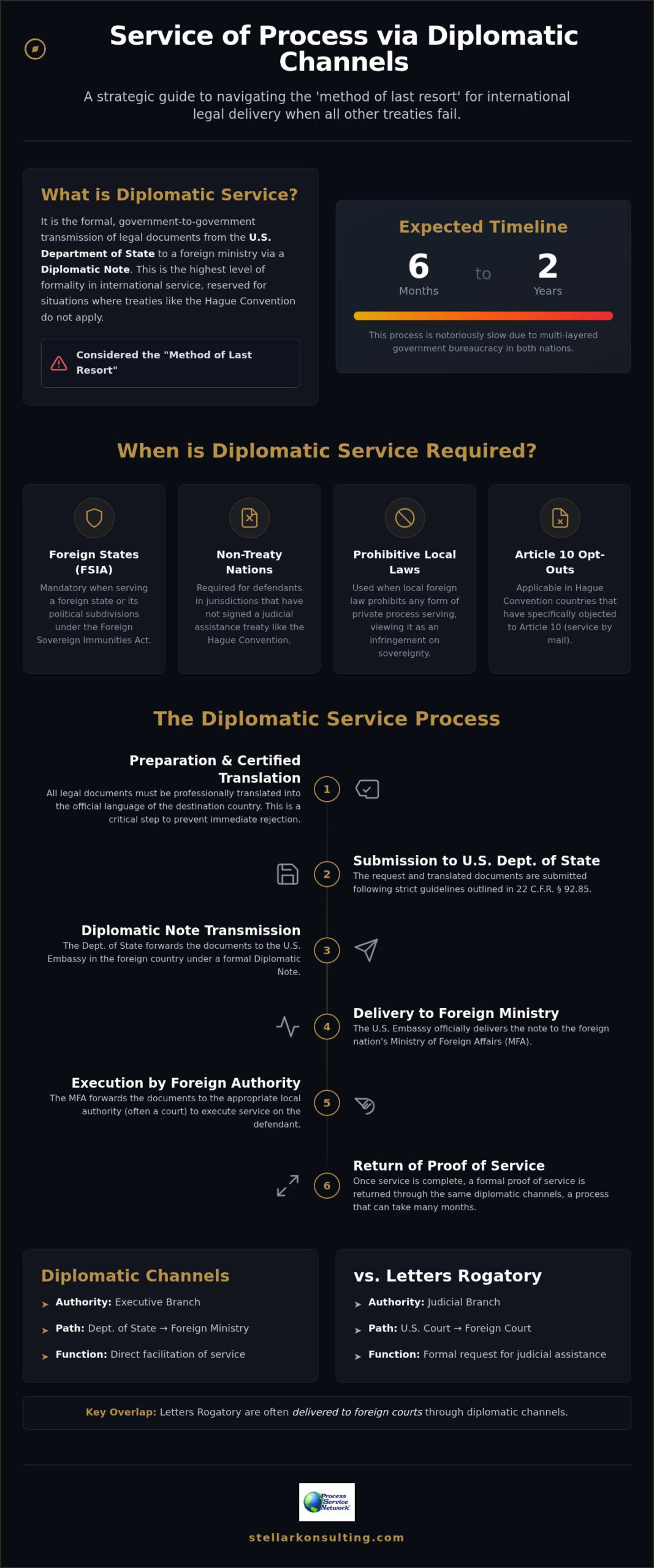
Service of process via diplomatic channels is the formal transmission of legal documents from the U.S. Department of State to a foreign ministry through a Diplomatic Note. It represents the highest level of formality in Service of Process, often utilized when traditional treaties like the Hague Convention are not applicable. Because it involves the executive branch of two sovereign governments, it’s considered the “method of last resort” in the hierarchy of international service. This procedure ensures that the legal documents reach the appropriate authorities in a foreign jurisdiction through official government-to-government communication.
This method is essential in two primary scenarios. First, it’s mandatory when serving a foreign state or its political subdivisions under the Foreign Sovereign Immunities Act (FSIA). Second, it’s used for private defendants residing in jurisdictions that haven’t signed a judicial assistance treaty and where local law prohibits informal service. While serving an individual via diplomatic channels is rare, it’s often the only path to ensure a U.S. court maintains jurisdiction over a defendant in a restrictive environment. Many legal professionals overlook this option for private parties, but it remains a critical tool for cases involving defendants in non-treaty countries.
The Legal Basis: 22 CFR Part 95 and FSIA
The Foreign Sovereign Immunities Act (FSIA) provides the statutory framework for litigation against foreign states in U.S. courts. Specifically, 28 U.S.C. § 1608(a)(4) mandates the use of diplomatic channels if service cannot be achieved through a special arrangement, an international convention, or by mail. This process is governed by 22 CFR Part 95, which outlines how the Department of State facilitates these requests. The Vienna Convention on Diplomatic Relations provides the underlying international law that protects the sanctity of diplomatic communications, ensuring that documents delivered through these channels are officially recognized by the receiving state’s Ministry of Foreign Affairs (MFA).
Diplomatic Channels vs. Letters Rogatory
There’s often procedural overlap between these two methods, leading to confusion among practitioners. A Letter Rogatory is a formal request from a U.S. court to a foreign court for judicial assistance. In many instances, the Department of State delivers these judicial requests through diplomatic channels. However, the authority differs. A Letter Rogatory is a judicial-to-judicial request, whereas service of process via diplomatic channels is an executive branch facilitation. Understanding when to use Letters Rogatory Legal Services: Navigating International Judicial Assistance is vital for counsel, as the choice depends on whether the destination country requires court intervention or accepts direct diplomatic filing.
When is Service via Diplomatic Channels Required?
Service of process via diplomatic channels isn’t just a fallback; it’s often the only legally defensible path in jurisdictions where judicial cooperation is strained or non-existent. While the Hague Convention covers over 75 nations, many significant global actors remain outside this framework. In these regions, local law may strictly prohibit any form of private process serving, categorizing it as an infringement on national sovereignty. Utilizing unauthorized methods in these areas can lead to the non-recognition of U.S. judgments, rendering months of litigation useless.
The requirement for this method also extends to countries that are party to international treaties but have specifically opted out of Article 10. These nations don’t permit service by mail or private process servers, leaving the formal diplomatic route as the primary alternative. Additionally, cases involving sensitive political or national security interests often necessitate this high-level involvement to ensure that the transmission of legal documents doesn’t trigger diplomatic friction.
Navigating Non-Treaty Jurisdictions
Identifying “unfriendly” jurisdictions is the first step in risk mitigation. Countries that haven’t signed the Hague Convention or the Inter-American Convention often require a formal Diplomatic Note to acknowledge U.S. judicial authority. This is particularly true in jurisdictions where the state views judicial assistance as a sovereign act rather than a clerical one. Before committing to a specific strategy, it’s beneficial to review our guide on Informal International Service of Process: A Strategic Comparison for Legal Professionals to understand where formal channels become unavoidable. Relying on informal methods in restrictive environments often results in a total inability to enforce a final judgment abroad.
The Sovereign Immunity Hurdle
When a lawsuit targets a foreign government, its agencies, or political subdivisions, compliance with the Foreign Sovereign Immunities Act (FSIA) is mandatory. Section 1608 of the FSIA outlines a strict hierarchy for delivery. Attempting direct service on a foreign embassy located within the United States is a common error that leads to immediate challenges; international law generally views embassy grounds as inviolable and not a valid location for service on the home state. Instead, litigants must often coordinate through the DOJ Office of International Judicial Assistance to ensure documents reach the foreign ministry through the proper executive channels.
The importance of this protocol was highlighted in the Yukos Capital Ltd. v. Russian Federation ruling, where the court scrutinized the delivery of diplomatic notes to ensure strict adherence to statutory requirements. Failure to follow these steps precisely can result in a lack of personal jurisdiction, even if the defendant has actual notice of the suit. If you’re managing a complex cross-border dispute involving a sovereign entity, utilizing expert translation services is essential to ensure your filings meet the rigorous standards of foreign ministries. This methodical approach ensures that the service of process via diplomatic channels withstands any subsequent motion to dismiss.
How to Execute Service via Diplomatic Channels: A Step-by-Step Guide
Executing service of process via diplomatic channels requires a disciplined adherence to a five-step procedural framework. Unlike standard domestic service, every document in the package must withstand the scrutiny of both U.S. and foreign executive officials. Mistakes in the initial filing often lead to rejections months later, making precision mandatory. The process begins with the preparation of the summons and complaint, accompanied by mandatory certified translations. Once these are ready, counsel must secure a court order or a formal request for international judicial assistance from the presiding judge. For a deeper understanding of how the initial delivery of these foundational documents must meet foreign procedural standards, our guide on international summons and complaint service provides a comprehensive procedural framework for both Hague and non-Hague jurisdictions.
- Step 1: Preparation. Assemble the legal package, ensuring all documents meet the specific formatting requirements of the destination country.
- Step 2: Judicial Authorization. Obtain the necessary court order or Letter Rogatory to authorize the Department of State’s involvement.
- Step 3: Submission. Send the completed package to the U.S. Department of State, Office of Overseas Citizens Services, for processing.
- Step 4: Diplomatic Transmission. The State Department issues a Diplomatic Note and transmits the documents to the foreign Ministry of Foreign Affairs (MFA).
- Step 5: Verification. Receive the formal return of service or certificate of delivery through official channels.
Document Preparation and Mandatory Translation
A primary cause for rejection at the foreign MFA level is the absence of high-quality, certified translations. Foreign ministries won’t accept documents that aren’t presented in their official language. It’s standard practice to provide the entire legal package in duplicate or even triplicate, depending on the jurisdiction’s specific requirements. These copies ensure that both the foreign ministry and the local court have original-quality sets for their records. Precision in formatting the Diplomatic Note is equally vital, as any deviation from international protocol can stall the request indefinitely.
Coordinating with the Department of State
The Department of State acts as the essential intermediary between the U.S. court and the foreign government. While there’s a $95 fee for incoming service requests handled by private contractors, outgoing requests for service of process via diplomatic channels are often evaluated on a case-by-case basis. Counsel must provide a detailed transmittal letter that includes the case caption, the nature of the suit, and the full address of the party to be served. Once accepted, the package travels through the “diplomatic pouch” system, a secure method of transport for official government communication. Tracking this package requires patience, as the movement through these government-to-government layers is intentionally methodical to ensure sovereign compliance.
Common Challenges: Timelines, Rejections, and Risks
Navigating service of process via diplomatic channels is an exercise in strategic patience. Unlike the relative efficiency of treaty-based methods, this path involves layers of sovereign bureaucracy that operate on their own internal schedules. Legal professionals often refer to this as the “black hole” of international litigation because of the limited visibility once a package enters the diplomatic pouch. The primary risk isn’t just the delay; it’s the potential for a foreign Ministry of Foreign Affairs (MFA) to refuse the request entirely without providing a detailed explanation. This lack of transparency can leave a U.S. case in procedural limbo, threatening court-imposed deadlines and increasing the risk of dismissal.
Managing the 6-12 Month Wait
Expect a timeline ranging from six to twelve months, though some jurisdictions can exceed two years. It’s vital to set realistic expectations with clients and the presiding judge from the outset. U.S. courts generally respect the principles of international judicial comity, but they require consistent proof of effort to maintain an active docket. Providing the court with a detailed timeline of your attempt at service of process via diplomatic channels helps justify extensions of time under Federal Rule of Civil Procedure 4(m). Regular status inquiries to the Department of State can help, though these updates are often limited to confirming the documents have reached the relevant embassy or foreign ministry.
Handling MFA Rejections and Non-Cooperation
Rejections often occur due to minor clerical errors, improper translations, or perceived infringements on national sovereignty. If an MFA refuses to accept a Diplomatic Note, the State Department may issue what’s known as a “Meeker Letter.” This formal statement confirms that the U.S. government attempted service but was rebuffed by the foreign state. In many U.S. jurisdictions, a Meeker Letter serves as essential evidence to move for alternative service, such as service by publication. This transition is much smoother when you’ve already exhausted the steps outlined in The Definitive Guide to Hague Convention Service of Process, as it proves to the judge that no less-intrusive path was available.
A secondary risk involves alerting the defendant prematurely. Because diplomatic service is highly formal and involves government-to-government communication, a well-connected defendant might learn of the lawsuit long before official delivery occurs. This can lead to the shielding of assets or other evasive maneuvers. Managing these variables requires a partner who understands the nuances of the Department of State bureaucracy. If you’re facing a potential rejection or an uncooperative foreign ministry, you should engage Stellar Konsulting for professional diplomatic coordination to ensure your jurisdictional safeguards remain intact.
Strategic Advantages of Professional Legal Support for Diplomatic Service
Navigating the Department of State’s bureaucracy requires more than just filling out forms; it demands a deep understanding of international law and executive protocol. Engaging professional support for service of process via diplomatic channels ensures that your case doesn’t fall victim to the procedural pitfalls that often stall unassisted attempts. Expertise in the Foreign Sovereign Immunities Act (FSIA) is particularly crucial. With over 30 years of experience in international legal support, Stellar Konsulting ensures every statutory requirement is met, preventing jurisdictional challenges that could dismantle your litigation strategy before it truly begins.
One of the most significant advantages is the integration of specialized legal document translation. A foreign Ministry of Foreign Affairs (MFA) will often reject a diplomatic note for the slightest linguistic ambiguity or formatting error. By providing comprehensive translation services tailored for diplomatic notes, we ensure your documents meet the rigorous standards of the receiving state. This proactive management extends beyond mere filing; it involves constant follow-up with the State Department and foreign authorities to keep the process moving through the secure diplomatic pouch system.
Beyond the State Department: Comprehensive Global Support
Stellar Konsulting bridges the gap between U.S. law firms and complex global bureaucracies. While some government contractors handle the clerical aspects of incoming requests, they often lack the bespoke consulting needed for high-stakes private litigation. Our global network allows us to provide local insights, helping you determine if diplomatic channels are truly the best path or if alternative methods like the Inter-American Service Convention are more appropriate. We also utilize professional skip tracing to confirm the correct party is being targeted before the diplomatic note is even drafted, saving months of potential misdirection.
Mitigating the Risk of Service Dismissal
In international litigation, the cost of a single procedural error is measured in years, not just days. A rejected diplomatic note can set a case back by twelve to twenty-four months, often leading to a dismissal for failure to serve. The value of doing it right the first time cannot be overstated. By maintaining a national and international focus, we provide the steady, matter-of-fact expertise required to navigate these sensitive tasks. This methodical approach ensures that your service of process via diplomatic channels stands up to the highest level of judicial scrutiny. If you’re ready to secure your jurisdictional standing, you should Consult with Stellar Konsulting on your international service strategy.
Securing Jurisdictional Integrity in Global Litigation
Mastering the complexities of international delivery ensures that your litigation remains viable even in the most restrictive jurisdictions. While service of process via diplomatic channels is a lengthy and methodical procedure, it provides a level of sovereign recognition that informal methods simply cannot match. Success in this arena depends on strict adherence to the Foreign Sovereign Immunities Act and the meticulous preparation of diplomatic notes. By prioritizing certified translations and proactive coordination with the Department of State, you can successfully navigate the bureaucratic layers of international law.
With over 30 years of specialized experience, our team offers deep expertise in FSIA and global treaty compliance. We maintain a national presence with a truly global reach, acting as a steady partner in high-stakes legal tasks. Don’t let a single procedural error derail your case. Partner with Stellar Konsulting for Reliable International Process Serving to ensure your documents are delivered with precision and authority. You’ve done the hard work of building your case; let us provide the expertise to secure its jurisdictional foundation.
Frequently Asked Questions
Is service via diplomatic channels the same as service by mail?
Service via diplomatic channels is fundamentally different from service by mail. While mail is a direct transmission to the defendant, the diplomatic route involves a formal government-to-government exchange. The U.S. Department of State transmits the legal package to the foreign Ministry of Foreign Affairs. This method is often the only option when a country has specifically objected to service by mail under international treaties or where no such treaty exists.
How much does the U.S. Department of State charge for diplomatic service?
For incoming requests from other countries to the United States, there’s a $95.00 USD fee payable to the private contractor for the U.S. Department of Justice. For outgoing requests from the U.S. to foreign jurisdictions, the Department of State doesn’t list a universally applicable fee. Costs are typically determined on a case-by-case basis and may include expenses passed on by the foreign government for their local administrative processing.
Can a private individual initiate service via diplomatic channels without an attorney?
Technically, a pro se litigant can request this service, but the procedural hurdles make it extremely difficult without professional guidance. The process requires a court order or a formal request for international judicial assistance that must meet strict federal and international standards. Most individuals find that navigating the State Department’s requirements and ensuring the necessary certified translations are accurate requires the expertise of a seasoned international process serving firm.
What happens if the foreign country refuses to accept the diplomatic note?
If a foreign state’s Ministry of Foreign Affairs refuses to accept the note, the U.S. Department of State may issue a formal statement known as a Meeker Letter. This document confirms that the attempt at service of process via diplomatic channels was made but rejected by the sovereign entity. You can then use this letter in a U.S. court to request alternative means of service, such as service by publication.
Does the Hague Convention allow for service via diplomatic channels?
Yes, the Hague Service Convention recognizes this method under Article 9. It allows member states to use diplomatic channels to forward legal documents to the designated authorities of another member state. However, because the Central Authority mechanism established by the Convention is much faster, the diplomatic route is usually reserved for situations where the Central Authority is unresponsive or for specific types of sovereign defendants.
How long does it typically take to receive a return of service through diplomatic channels?
You should expect a timeline of six months to one year to receive a return of service. In some complex jurisdictions, such as China, the process can take up to 24 months. This delay occurs because the documents must pass through the U.S. Department of State, the U.S. Embassy abroad, and finally the foreign Ministry of Foreign Affairs before being delivered to the local court.
Is service via diplomatic channels valid for divorce or family law matters?
Service of process via diplomatic channels is valid for family law matters, including divorce and child custody cases, when the defendant resides in a non-treaty country. If the jurisdiction prohibits private process servers or service by mail, this formal route is the only way to obtain a judgment that a U.S. court will recognize as valid. It ensures that the defendant’s due process rights are respected.
Can I serve a foreign government official through their embassy in the United States?
You generally cannot serve a foreign government official or a sovereign entity through their embassy in the United States. International law and the Foreign Sovereign Immunities Act require that service be made directly on the foreign ministry in the home country. Attempting to deliver documents to an embassy is a common procedural error that often leads to the immediate dismissal of a case for lack of personal jurisdiction over the defendant.